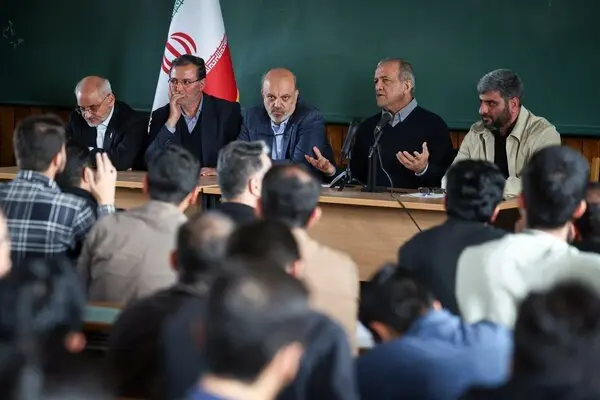
President Masoud Pezeshkian made the remarks on Thursday, November 19, at the Fourth National Congress of Pioneers of Liberation, attended by Basij Student Organization officials from universities across the country. Emphasizing the need to conserve energy, he said: “If we are to get through this situation, we must embody the spirit of the Basij, like the Basij members in the early years of the Revolution: people who closed their shops, left their classrooms, put their families aside and defended the Revolution with all their strength.”
The president continued: “Our circumstances today are far more complicated than they were then. This is not just a military war in which we go to the front lines and fight with weapons. Our enemies stand at a distance and carry out their actions from afar. In addition, they have imposed a cultural war on us and are pursuing economic warfare with great intensity in an effort to force us to surrender.”
Pezeshkian noted: “Given these circumstances, we must continue on our path and not retreat. To make progress, we need to look at things differently, think differently and act differently. Otherwise, if we expect to accomplish things under the same expectations and demands we had before the war, it simply will not be possible.”
The president said: “We cannot continue along our path with the same expectations we had in the past. When we were students, we also discussed these issues in the context of student affairs. There is a verse in the Holy Quran that says: ‘And [recall] when you said, “O Moses, we can never endure one kind of food, so pray to your Lord to bring forth for us some of what the earth grows: its herbs, cucumbers, garlic, lentils and onions...”’ Prophet Moses (peace be upon him) confronted Pharaoh, and then his people and relatives joined him. Yet those same people told him: ‘Ask God to provide us with a variety of food; we cannot make do with just one kind.’ If we have carried out a revolution, we must be prepared to endure hardships. If such measures are being taken against us, we must act in a way that enables us to achieve our goals. We cannot expect to have everything at our disposal while also being at war.”
Referring to the pressure caused by sanctions and the economic blockade, he said: “They want to use the blockade and sanctions to force us to surrender. It is up to you and us to act together. While continuing our lives, our activities and development, we must also be able to withstand these conditions. Management is extremely important in this regard, and you can provide us with considerable help.”
The president added: “There is much more to discuss on this subject, and you undoubtedly have your own views on it. In the energy sector, including electricity, gas, gasoline and diesel, we can reduce consumption to some extent. We consume three times the global average amount of electricity, and our gas consumption is also considerable.”
Pezeshkian stressed: “Although we have the world's second-largest gas reserves, we are now facing problems and constraints. There are shortcomings in how we manage energy, how much we consume, and our behavior and patterns of energy use. We need each other's help to get through this situation, and everyone must help one another, because these measures cannot be achieved through orders and coercion.”
He said that if the country wanted to increase its resilience and withstand pressure from its enemies, it had to prepare itself for this kind of war. “War today is no longer limited to being present on the front lines. It is also being waged in the economic arena, and we must carry out the necessary reforms in this area.”
Pezeshkian emphasized: “We, too, are now trying to reduce energy consumption and heating as much as possible. There is no need to leave a large number of lights on or heat every room in which we live. We do not necessarily need to set the indoor temperature at 25 or 23 degrees or higher. We can wear suitable clothing and live comfortably at lower temperatures. For example, the room where I am sitting here is colder than the outdoors, which is why I have taken off my jacket. We can adapt to these conditions, and nothing serious will happen.”
Stressing the need for everyone to contribute to overcoming the challenges ahead, he said: “If each of us takes one step forward, we can get through the winter with strength. We used to respond to energy shortages by shutting down industrial and production activities. But now we are determined to avoid cutting off energy supplies to the production sector. If production stops, there will not be enough products and goods in the market in the future, and shortages will lead to higher prices.”
Pezeshkian added: “Beyond rising prices, there is also the issue of unemployment. Unemployment means poverty, dissatisfaction and thousands of other problems. We must therefore help prevent this from happening. These are areas in which you, too, can help us. Many people drive to work.”
The president said: “At administrative meetings, I regularly advise our colleagues, brothers and sisters that, even in cities outside the capital, if the distance between home and work is a 10-minute walk, why use a car? What is wrong with walking that distance? If we can reduce gasoline, diesel and electricity consumption in this way, we will undoubtedly increase our resilience.”