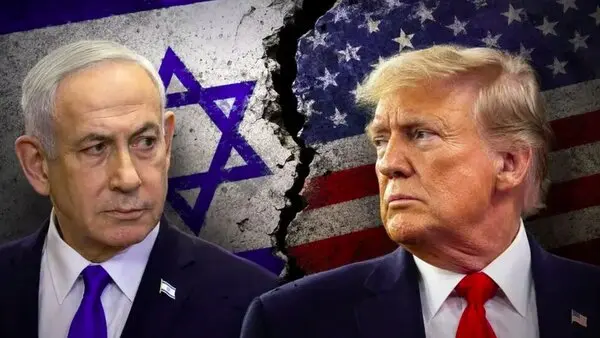
Developments in Tel Aviv and Washington at the same time show that the confrontation with Iran has become more than a military and security issue; it is also a point of convergence, and potentially conflict, between the political calculations of US and Zionist regime leaders. Benjamin Netanyahu is facing mounting pressure from rival parties and a weakening parliamentary position, while Donald Trump is grappling with the economic, security and political consequences of prolonging the war. The difference in their interests and priorities raises a fundamental question: Is Netanyahu trying to steer Trump back toward a course that could offer the Israeli prime minister a political opportunity while imposing strategic costs on the US president?
Tel Aviv Besieged by Political Crisis; War as a Means of Changing Political Landscape
The defeat of the Likud candidate in the Knesset speakership election and the election of Matan Kahana with the support of 66 lawmakers, including Arab representatives, signal a significant shift in the political balance within Israel’s parliament. The development comes as Netanyahu’s opponents seek to curb his political power and pave the way for a change of government. Although losing the speakership election does not, by itself, mean the government will fall, it undoubtedly points to Netanyahu’s reduced room for maneuver and the growing difficulty of managing his political coalition.
In this environment, an escalation of the external crisis and a return to wartime conditions could reshape Tel Aviv’s political agenda. By shifting public attention from domestic disputes to an external threat, war could give Netanyahu greater room to maneuver and overshadow the political pressure on his government. Therefore, while his personal motive for starting a war cannot be established with certainty, the potential for a military crisis to alter Israel’s domestic political calculations cannot be ignored.
Washington Under Shadow of Threats; Fine Line Between Security Warnings, Threat Narratives
Developments in US security are also significant. A CNN report citing claims that Iran might use a dirty bomb or chemical weapons on US soil heightened concerns about domestic security. Marco Rubio tempered the claim from a security assessment perspective, stressing that there was no imminent threat to Washington. At the same time, reports emerged of security threats against US officials, and Treasury Secretary Scott Bessent was transferred to a military base to receive enhanced protection.
These developments alone do not prove the existence of a coordinated operation against US security. However, when considered alongside the Mossad chief’s visit to Washington and his efforts to secure the Trump administration’s support for renewed strikes on Iran, they raise broader questions about the environment in which decisions are being made in the United States.
The issue is not simply the transfer of security information; how that information is reported, amplified and used for political purposes also matters. Claims of threats attributed to Iran, even if unverified, can heighten security concerns in the United States and influence decision-makers’ calculations. It is therefore essential to distinguish between credible warnings, unverified intelligence claims and possible efforts to steer political decisions.
Mossad Mission in Washington; Bringing the Military Option Back to Trump’s Table
A Reuters report on Roman Gofman’s visit and his request that Trump administration officials support joint strikes on Iran shows that Tel Aviv is still seeking to restore the military option to the center of Washington’s decision-making. These efforts come as Trump has, at least recently, relied primarily on economic pressure and a blockade as tools against Iran, while showing no clear willingness to accept the costs of a new war.
The difference between the two sides’ calculations becomes clear at this point. For Netanyahu, a return to war could provide an opportunity to change the domestic political climate and rebuild his security and political standing. For Trump, however, re-entering the war would mean accepting a range of unpredictable costs, from rising energy prices and disruption to global markets to an expanded conflict and mounting pressure from US public opinion.
An Alliance with Different Priorities; Who Wants the War and Who Pays the Price?
The alliance between Washington and Tel Aviv does not necessarily mean that their interests are aligned or that they share the same political priorities. Netanyahu may view an escalation of the confrontation as a way to manage his domestic and security crises, while Trump is seeking to preserve what he claims to have achieved without becoming embroiled in a costly, protracted war. From this perspective, efforts to amplify the Iranian threat and alter the perceptions shaping US decision-making should be assessed in the context of the two sides’ differing calculations.
The central question is not simply whether Netanyahu wants war or whether Trump has abandoned pressure on Iran. The decisive question is: Who will bear the cost of a decision to go to war, and who will benefit politically from its consequences? Iran, for its part, has repeatedly emphasized its defensive readiness and the high cost of any aggression against it. A return to military confrontation could therefore produce consequences far beyond the initial calculations of those who plan it.
For Netanyahu, war could offer an opportunity to change the domestic political landscape and escape his current predicament. For Trump, however, it could mean being drawn back into a crisis whose consequences would extend beyond Tel Aviv and directly affect the US economy, security and domestic politics. This is the divergence in their calculations that must be taken seriously in assessing recent developments.