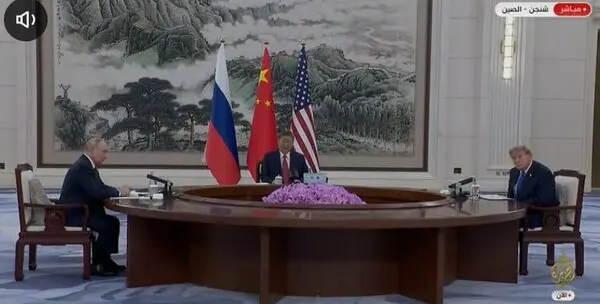
The trilateral meeting between US President Donald Trump, Chinese President Xi Jinping and Russian President Vladimir Putin ended in the Chinese city of Shenzhen after approximately 90 minutes. The meeting placed key issues, including Iran, the war in Ukraine, nuclear disarmament and the future of international security, at the center of discussions among the world's three major powers.
Chinese state media reported that the meeting lasted about an hour and a half, exceeding the original one-hour schedule. Despite the political significance of the gathering, none of the three leaders issued a joint statement after the talks, and no full official account of their outcome was released.
According to published reports, the discussions covered issues including nuclear arms control and the war in Ukraine. After the meeting, Putin left the summit venue, while Chinese President Xi Jinping accompanied him to his vehicle.
Trump: We Are Making History
At the start of the meeting, Donald Trump addressed Putin and Xi Jinping, describing the gathering as a significant event and saying, “We are really making history.”
The US president noted that previous leaders had generally avoided talking to countries with which they disagreed. He said that he and his counterparts had adopted a different approach, sitting down together to discuss their differences rather than distancing themselves from them.
Trump also stressed the three countries' responsibility for global developments, saying that the presidents of the United States, China and Russia, as leaders of three major powers, had a duty to hold open, respectful and constructive discussions on issues affecting not only their own populations but also the future of the entire world.
In another part of his remarks, Trump identified preventing the proliferation of nuclear weapons as an important area of cooperation among the three countries. Referring to Iran, he claimed, “We are doing the same thing in Iran.”
The US president also expressed hope that Putin and the other side wanted to end the war in Ukraine, adding that developments appeared to be taking place in that direction.
Xi Jinping's Message: Complete Elimination of Nuclear Weapons
One of the most important issues raised at the meeting was the Chinese president's position on the future of nuclear weapons.
Xi Jinping called for a comprehensive ban on nuclear weapons and their complete elimination, stressing that the world should move toward creating conditions free of these weapons.
Referring to the catastrophic consequences of nuclear war, the Chinese president said, “A nuclear war cannot be won and must never be fought.”
He also stressed the need to make every possible effort to prevent such a war. His position carries particular significance amid growing military and strategic competition among major powers.
Xi's remarks on nuclear disarmament came after Trump had also emphasized the need for countries to cooperate to prevent the proliferation of such weapons. However, the three countries' positions on how nuclear disarmament and restrictions on nuclear weapons should be achieved still require further clarification.
Putin: Shared Responsibility for Preserving Global Peace and Security
At the start of the meeting, Vladimir Putin referred to the historic standing of the United States, China and Russia, saying that the three countries were among the victors of World War II and shared responsibility for maintaining international peace and security.
The Russian president stressed the need for dialogue on global and regional developments and also identified energy security as an important issue for the three countries.
Putin further stated that constructive cooperation by the United States could help strengthen global stability. His remarks are notable amid geopolitical competition and strategic disagreements among Washington, Moscow and Beijing.
The meeting took place as the relations among the three major powers remain marked by a range of political, economic and security disputes. The war in Ukraine, trade and technology competition, the Taiwan issue and the future of the arms control system are among their main points of contention.
Taiwan, Ukraine and the International Criminal Court on the Sidelines of Talks
Alongside Iran and nuclear weapons, the war in Ukraine was also among the issues raised in Trump's remarks. Referring to his bilateral conversation with Putin, the US president spoke of the possibility of new developments toward ending the war, but provided no specific details of a possible agreement or the outcome of the discussions.
Trump also described the International Criminal Court as an institution that was out of control, claiming that it had exceeded the limits of its authority.
Meanwhile, China's Xinhua News Agency reported that Trump had told Xi Jinping during their bilateral talks that Washington did not support Taiwan's independence. Given the sensitivity of the Taiwan issue in US-China relations, the position carries considerable political significance.
Meeting Ends Without Joint Statement; Key Messages Await Further Clarification
The trilateral meeting's conclusion after 90 minutes, without a joint statement or the announcement of any specific agreement, indicates that, at least based on the information released so far, its practical outcome and the details of any possible agreement among the three sides remain unclear.
Nevertheless, the simultaneous discussion of issues such as Iran, the war in Ukraine, nuclear disarmament and Taiwan by the leaders of the world's three major powers gives the meeting significance beyond that of a merely ceremonial gathering.
At a time when Washington, Moscow and Beijing are each seeking to preserve and strengthen their strategic positions in the international order, the continuation of such dialogue could affect global political and security calculations. However, assessing the meeting's actual achievements will depend on the release of further details about the discussions and clarification of the three countries' practical positions on the issues raised.