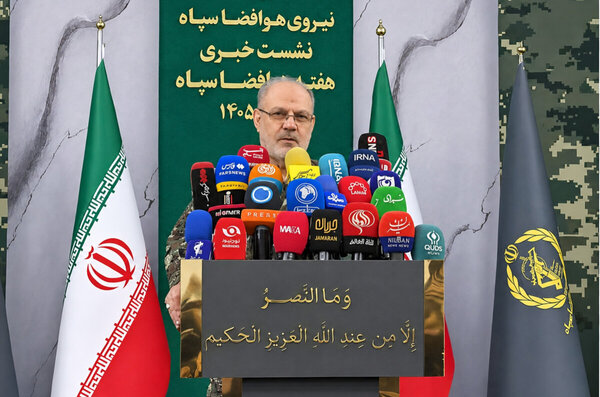
Brigadier General Hossein Mohebi, spokesman for the Islamic Revolutionary Guard Corps (IRGC), outlined the Aerospace Force's achievements, citing advances in the country's defense industries in missile, drone, and air defense system production. He said the force had transformed Iran from an importer of aerospace weapons into an exporter of military products.
Speaking at a press conference on Saturday, November 7, Mohebi pointed to the role of indigenous knowledge and the development of defense technologies in advancing the IRGC Aerospace Force. He said the force's achievements and performance were the result of the commands, orders, recommendations, and guidance of the martyred Imam of the Ummah.
Listing the force's achievements, Mohebi identified nine main areas, ranging from the indigenization of technology and arms exports to the development of air defense capabilities, the continuation of production under wartime conditions, and the establishment of deterrence.
First achievement: Developing indigenous expertise and adapting global aerospace knowledge
Mohebi said the first achievement of the IRGC Aerospace Force was the development of indigenous knowledge and the indigenization of global expertise in the aerospace industry.
“This was a very major achievement that played a key role in bringing about numerous transformations in our country's defense and offensive industries. It enabled us to move from importing aerospace military equipment to exporting it. It also allowed our aviation technology to surpass that of the enemy in terms of the values embedded in the components of this technology,” he said.
“For example, today our Shahed-136 drone has been copied in many countries around the world, even in the US, and is being produced and used under different names. This is a major transformation that we are witnessing today,” he added.
Second achievement: Turning knowledge into industry and producing a range of military equipment the country needs
The IRGC spokesman said the second achievement of the Aerospace Force was turning knowledge into industry and manufacturing a wide range of military products required by the country. Today, he said, Iran's aerospace industry exports its products to numerous countries around the world.
Mohebi added that the Arman missile, the 358 drone, and the Khordad-3 air defense system were among the weapons Iran exported to other countries.
“This is another major achievement, something our country had never experienced throughout its history. We had always been an importer of military equipment. Now, in addition to meeting our domestic needs, we are also an exporter. This major achievement belongs to the IRGC Aerospace Force,” he said.
Third achievement: Focusing on production and independence rather than purchases and dependence
Mohebi said the third achievement of the IRGC Aerospace Force was its focus on production and independence rather than purchases and dependence.
“Today, all our weapons in the Aerospace Force are produced using indigenous knowledge and expertise. It is not the case that we have imported weapons from other countries. Nor is this even a matter of reverse-engineering the spoils of war we captured from the enemy. It is a major accomplishment that, over time, we have reached a point where we are independent in the military industries, particularly the aerospace industry. We do not need to import weapons from other countries, bring in foreign military advisers to train us in their use, or depend on others for spare parts for our military equipment. This is a very major achievement that deserves attention,” he said.
Fourth achievement: Developing the ability to manage operations in the field during crises and under enemy bombardment
Mohebi said the fourth achievement of the Aerospace Force was developing the ability to manage operations in the field and deploy light and heavy weapons, as well as short- and long-range weapons, in the midst of war, during crises, and under enemy bombardment.
“You witnessed how, even under the enemy's extensive bombardment, we continued to launch strikes, according to the schedule we had set, against the enemy's assets, resources, forces, and equipment. The enemy was never able, even for a moment, to prevent us from carrying out our response or disrupt our launches. This was an enormous capability,” he said.
Fifth achievement: Establishing a balance of power through a focus on missiles, drones, and electronic warfare
The IRGC spokesman said the fifth achievement of the Aerospace Force was establishing a balance of power by focusing on missiles, drones, and the electronic warfare industry.
“By giving priority to missiles, we were able to stand up to the enemy's equipment and establish deterrence. By focusing on drone production, we were able to exert tremendous pressure on the enemy, and through electronic warfare, we were able to overcome the enemy's technology,” he said.
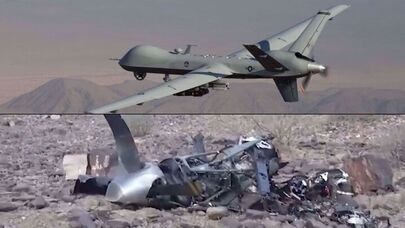
He added: “You have witnessed that, in just the past week or two, we took control of seven MQ-170 drones, which are enemy reconnaissance drones, and brought them safely down to the ground. This is nothing but the superiority of our technology over that of the enemy. The weapons the enemy has deployed are its latest weapons. Being able to overcome the enemy and bring down its drones intact is a very major achievement.”
Sixth achievement: Rapid, technology-driven entry into the production of air defense systems
Mohebi said the sixth achievement of the IRGC Aerospace Force was its rapid, technology-driven move into air defense system production.
“You are aware that this rapid development began after the Second Sacred Defense, that is, after the 12-day war. In this short period, our Aerospace Force reached a level of development that enabled us, during the Third Sacred Defense, or the Ramadan War, to overcome more than 260 enemy aircraft and other aerial platforms. These ranged from F-35 fighter jets to 18 F-16s and F-15s, as well as various MQ-1 and RQ-4 drones, Forpost and Lucas drones, and different types of micro-drones, aircraft, and other aerial vehicles deployed by the enemy,” he said.
Mohebi emphasized that the figures he had provided referred exclusively to the capabilities of the IRGC Aerospace Force. Other achievements, he added, had been presented by their colleagues in the Islamic Republic of Iran Army, which had also made progress in this field and announced its own figures.
Seventh achievement: Flexible capabilities to sustain missile and drone production during wartime
The IRGC spokesman said the seventh achievement of the Aerospace Force was developing the flexibility needed to continue producing missiles and drones during wartime and under enemy bombardment.
“This flexibility enabled us to rapidly move missile production from above ground to underground. As you know, we had previously established missile complexes for storing missiles and keeping them ready for use,” he said.
He added: “Now, drawing on indigenous knowledge, Iran's vast and diverse geography, and this capability, we have managed to establish an 'underground missile production city.' With this capability, we will never allow the enemy to stop us, even for a moment, from producing weapons or maintaining the links between our weapons systems. The enemy, out of ignorance, assumed that by counting our limited number of missiles, it could conclude that our production would soon run out. But it did not know that, by designing this flexible capability, we had moved production from above ground to underground and could continue the process without disruption.”
Eighth achievement: Reducing the radar visibility of missiles and drones and penetrating layers of air defenses
Mohebi said the eighth achievement of the IRGC Aerospace Force was reducing the radar visibility of its missiles and drones.
“You witnessed how, during this war, our missiles penetrated multiple layers of the enemy's air defenses and successfully struck their targets, leaving the leaders of the forces of disbelief astonished and bewildered. The technology used in these weapons rendered the enemy's modern air defense systems, including Patriot systems, ineffective. In fact, the speed and penetrating power of our missiles as they passed through the layers of air defenses made these systems ineffective against us,” he said.
Ninth achievement: Establishing effective deterrence against the enemy
The IRGC spokesman said the ninth achievement of the Aerospace Force was establishing effective deterrence against the enemy.
“When the enemy viciously attacked our infrastructure in an attempt to deprive the people of their daily necessities, the IRGC Aerospace Force carried out retaliatory operations targeting the enemy's artificial intelligence systems, processors, and infrastructure in the region, thereby containing the threat. These operations showed the enemy that if it targets our infrastructure, we will strike its infrastructure several times over. This is a very major achievement in the path toward establishing deterrence,” he said.