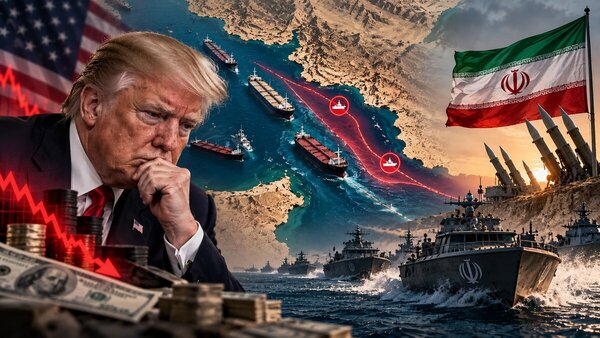
After failing to impose its objectives through military means and facing mounting political and economic costs from the war, Washington now appears to be changing its approach towards Iran, particularly following the Republicans’ defeat in the US midterm congressional elections. Its emphasis on the effectiveness of an economic and naval blockade, its stated reluctance to launch large-scale military operations, and its decision to keep the path to negotiations open are all components of an approach aimed at maintaining pressure on Iran without bearing the costs of an all-out war. Recent remarks by Marco Rubio about the sufficiency of economic pressure, along with Trump’s statements on maintaining the blockade while stressing the possibility of an agreement, can be viewed within this framework.
Under this strategy, the US is seeking to shift the costs of the war away from itself and its allies while keeping the resulting pressure on Iran’s economy. In other words, Washington is trying, as far as possible, to avoid repeating large-scale attacks and instead place Iran in a position of attrition through restrictions on oil exports, pressure on financial and trade transactions, and threats to resume military operations. It aims to use this situation to impose demands that it failed to achieve on the battlefield.
But this strategy has another dimension, one no less important than economic pressure: managing perceptions and political calculations inside Iran by bringing the war-versus-negotiations dichotomy to the fore.
War or Negotiations: Targeting Domestic Calculations
The US emphasis on maintaining the blockade while calling for negotiations can be assessed as something that goes beyond diplomacy. This combination could create an environment in which the central issue shifts away from the nature of Washington’s demands and the objectives of the blockade towards a domestic question: Should Iran negotiate to prevent war, or continue resisting and accept the risk of a return to military confrontation?
Such an environment could gradually create a divide between sections of society and political currents. One side presents negotiations as the only way to prevent war, while the other regards any negotiations conducted under pressure and threats as a prelude to retreat. As a result, instead of focusing primarily on US objectives, the nature of the blockade and the conditions for a balanced agreement, a significant part of the country’s political and media capacity is spent debating the choice between war and negotiations.
This is where the cognitive dimension of the new strategy becomes important. If the US succeeds in reinforcing this framing within Iran, it may be able to pursue some of its intended objectives by changing calculations and creating divisions over the country’s political priorities, without needing to intensify military pressure. In such circumstances, negotiations could cease to be a tool for securing national interests and become an independent demand that must be pursued even if the other side makes no change in its conduct. Meanwhile, resistance to unilateral demands could be portrayed as opposition to peace or a willingness to embrace war.
Of course, not every domestic disagreement over negotiations can be attributed to foreign cognitive operations. Differences of opinion over how to deal with a crisis are natural and even necessary. The problem arises when these differences move beyond expert debate and turn into identity-based and political confrontation, which could ultimately weaken the country’s ability to make decisions in the face of external pressure.
Negotiations: A Means of Resolving Disputes or Completing the Blockade?
To better understand this equation, it is also necessary to consider the history of US demands. Even before the 12-day war, Trump had presented Iran’s relinquishment of its nuclear rights as the alternative to military attack, rather than the lifting of sanctions and the fulfilment of Iran’s economic rights. This approach suggests that, if the same logic persists, Washington may view negotiations less as a mechanism for resolving disputes on balanced terms than as a means of securing unilateral concessions that it failed to obtain through military action.
The same question arises now. If the US maintains the blockade on the one hand and, on the other, calls for negotiations over Iran’s nuclear program without changing its previous demands, the central issue is not whether to support or oppose dialogue in principle, but the conditions and agenda under which it takes place.
Iran, for its part, has set out seven conditions for the start of negotiations, stressing the need to return to the conditions that existed before the war and prevent the consequences of pressure and aggression from becoming entrenched. On the nuclear issue, any negotiations over Iran’s commitments and restrictions must also address the lifting of sanctions and the country's ability to exercise its economic rights. The US cannot maintain the blockade while expecting Iran to begin negotiations on the basis of accepting a situation created by that very pressure.
National Cohesion: A Critical Point in the Blockade Strategy
The decisive point is that the blockade strategy can move closer to achieving its political objectives only if economic pressure leads to social exhaustion and political division. Under such circumstances, if the war-versus-negotiations dichotomy turns into a domestic rift, external pressure will be transformed from an economic instrument into a factor that weakens national decision-making capacity and the will to resist.
From this perspective, preserving national cohesion is not merely a propaganda imperative or a political recommendation; it is part of what is required to confront a war of attrition. This does not mean suspending criticism, overlooking economic problems or imposing uniformity of opinion on negotiations. On the contrary, there must be room for open, expert discussion of the available options. However, differences of opinion should not become tools for undermining shared interests and weakening the country’s negotiating position.
More importantly, the US must not be allowed to change the criteria by which its policy is assessed simply by changing the label attached to its confrontation with Iran. If military warfare has been replaced by an economic blockade, that change does not in itself mean the war has ended. Likewise, if negotiations are pursued alongside the blockade while maximalist demands remain in place, the mere proposal of talks cannot be taken as evidence that the nature of Washington’s policy has changed.
Issue Is Not a Choice Between War and Negotiations
The reality is that the war-versus-negotiations dichotomy is not Iran’s main issue. The real question is how to secure national interests in the face of a strategy that seeks to turn military pressure into economic, diplomatic and cognitive pressure. Iran can use diplomacy to reduce tensions and resolve disputes, but negotiations will have genuine meaning and purpose only if they are accompanied by the lifting of the blockade, the abandonment of military threats and recognition of reciprocal rights.
Under these circumstances, Iran’s response to the new US strategy should focus on clearly explaining the nature of the blockade, maintaining defensive readiness, reducing economic vulnerabilities and preventing political disagreements from turning into divisions that undermine national cohesion.
If the US has failed to impose its will on Iran through war, it should not be allowed to achieve the same result through a blockade and the creation of domestic divisions. The main danger is that hostilities may cease on the battlefield while their underlying logic continues in the country’s economy and political sphere, leaving society preoccupied with disputes over the choice between war and negotiations instead of confronting the source of external pressure.
The most serious strategic mistake, therefore, would be to confuse a change in the US tools of confrontation with a change in its objectives. Negotiations do not necessarily mean the end of war, just as resisting excessive demands does not mean opposing diplomacy. The key criterion should be whether the chosen course leads to the removal of pressure, the fulfilment of Iran’s rights and a balanced agreement, or merely turns the blockade into another instrument for imposing the same outcomes that the war failed to achieve.