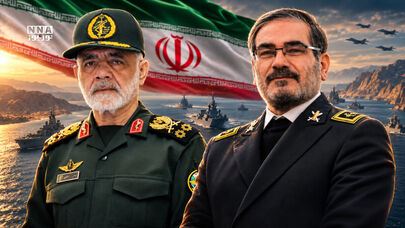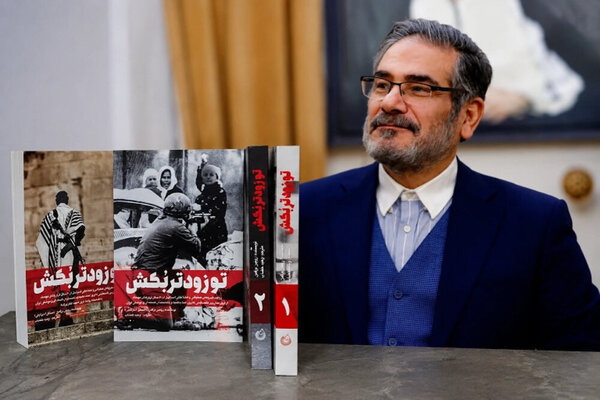
Among all the accounts of the life of the martyred Rear Admiral Ali Shamkhani, perhaps no characteristic reveals the true dimensions of his personality more clearly than his deep attachment to books, reading and research. Many knew him as a strategic commander, an experienced politician and a security official. But those who knew him personally spoke of a man for whom books were an inseparable part of everyday life. Many knew Shamkhani through his security, military and political responsibilities, but those close to him repeatedly said that behind the serious, strategic demeanor of this senior commander was a curious mind, a reflective spirit and a passion for reading.
From his youth until the final moments of his life, he regarded reading not as a pastime but as a necessity for personal growth, decision-making and a precise understanding of global developments. For him, books were an instrument of soft power, a means of gaining a deeper understanding of people, society, politics and security.
As the virtual book fair opens, remembering figures such as Shamkhani takes on added significance. They demonstrated that a close relationship with books is not confined to universities and libraries: even while carrying the most demanding and complex security and military responsibilities, one can remain committed to reading, research and intellectual inquiry.
Shamkhani was among those managers who did not simply read books; he engaged deeply with their contents. It has been reported that while reading, he carefully marked important passages, wrote notes in the margins and recorded key points so that he could return to them later. This approach shows that he did not read merely to pass the time, but regarded reading as an investment in his intellectual development.
One of the last books that martyred Ali Shamkhani mentioned during his well-known interview with Javad Mogouei was Rise and Kill First, by Ronen Bergman, a book about the hidden history of Israel’s systematic assassinations and the Mossad’s covert operations.
During one part of the interview, Javad Mogouei asked why Shamkhani believed Israel had attempted to assassinate him at the beginning of the 12-day war. In his response, referring to the contents of the same book, Shamkhani stressed that he had spent years serving as a soldier and working to build Iran’s strength. Israel, he explained, viewed Iran’s power as a threat and therefore targeted individuals who had played an effective role in strengthening the Islamic Republic.
This response was more than a political analysis. It showed that, through continuous and careful reading, martyred Shamkhani sought to understand the enemy’s behavior and security logic through credible documents and accounts. He believed that understanding the enemy was part of national strength, and that success in the complex arena of intelligence and strategic warfare was impossible without deep study and analysis. Political, security, historical and intelligence-related books were always part of his reading list. He also made a habit of marking important passages with colored highlighters and taking notes on key points.
Today, our society needs the promotion of a culture of books and reading more than ever. A generation that reads is better equipped to analyze events, less likely to be deceived and capable of thinking more deeply. Books keep the historical memory of nations alive and strengthen their ability to distinguish truth from falsehood.
The virtual book fair is also a valuable opportunity for society to return to a culture of reading, allowing families, young people and university students to bring books back into their everyday lives. If figures such as martyred Ali Shamkhani are being honored today, one of the most important reasons is this very deep connection with knowledge, reading and thought.
A culture of reading is not merely an individual habit; it is a matter of civilization. A society that reads is more resilient in the face of competing narratives, psychological operations and the distortion of truth. Perhaps this is why the enemies of a nation first seek to reduce public awareness and distance people from reading.
This was no ordinary choice of reading material. A man who had spent years at the heart of the region’s security developments was, in the final days of his life, reading a book that recounted the hidden layers of Israel’s assassination apparatus. It was as though he sought to understand the enemy not through speeches and public statements, but through documents, accounts and the admissions of Israelis themselves.
For Shamkhani, Rise and Kill First was not simply a political or security-related work; it was a document for understanding the logic governing Israel’s security establishment. He knew well that in today’s complex conflicts, understanding the enemy’s mindset is more important than knowing its equipment.
This profound approach to reading is what sets commanders such as Shamkhani apart from many figures whose experience is limited to politics. He was a man of analysis, reading and understanding. That is why books remained part of his life even during the busiest days of his service.
In contemporary history, few books have shed as much light on Israel’s security and intelligence apparatus as Rise and Kill First. The account is told not by one of Israel’s opponents, but by an Israeli journalist who spent years at the heart of the Zionist regime’s mainstream media. Drawing on thousands of documents and hundreds of interviews, he has revisited the secret history of Israel’s systematic assassinations.
Ronen Bergman, the book’s author, delves into the hidden layers of the Mossad, Shin Bet and Israel’s security establishment, presenting a picture fundamentally at odds with the regime’s official propaganda. He shows how assassination, the physical elimination of opponents and covert operations have not been exceptional measures, but rather a central pillar of Israel’s security policy.
In the closing sections of Rise and Kill First, the narrative moves closer to the present day, tracing targeted assassinations from the streets of Beirut and Damascus to the heart of Tehran. In these sections, Bergman discusses the assassinations of Resistance commanders, Iranian nuclear scientists, and complex intelligence and cyber operations.
He describes methods that resemble scenarios from spy films: explosions involving mobile phones, car bombings, armed drones, multilayered intelligence operations and the use of sophisticated security technologies to physically eliminate targets.
Perhaps this was why the book attracted the attention of martyred Ali Shamkhani, a figure who had spent years at the heart of the region’s most important security and strategic developments and had consistently sought to develop an accurate, deep and well-documented understanding of the enemy.
He did not put books aside until the final days of his life. He regarded reading as part of his intellectual and national responsibility and regularly asked the staff of his office, as well as close colleagues and friends, to purchase the latest books for him. It was this scholarly spirit and commitment to reading that made him a distinctive figure: a manager who believed that decision-making was impossible without study, research and a deep understanding of the issues at hand.
Ultimately, this highly ranked and cultured commander was martyred on February 28, 2026, in an attack planned by the terrorist governments of the United States and Israel. Yet his name will remain not only in the political and security spheres, but also in society’s cultural and intellectual memory, as that of a leader devoted to reading, reflection and books.