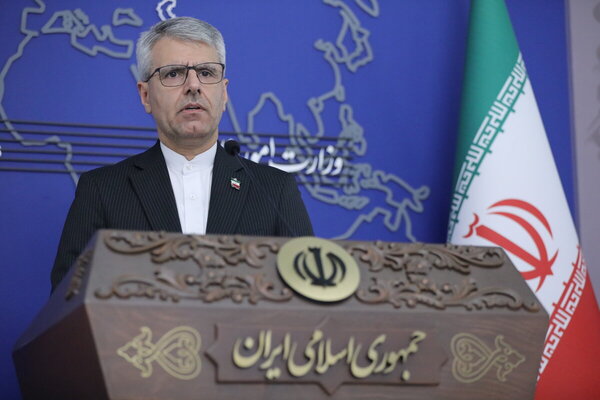
At a press conference with domestic and foreign media outlets, Baqaei was asked by Nournews about criticism directed at the government and the Foreign Ministry over diplomats’ use of military rhetoric and military and security officials’ responses to threats. He said some people seemed to have forgotten that Iran was engaged in an all-out war with extremely malicious actors who had mobilized all their capabilities to undermine the very existence of Iran.
He added that, under such circumstances, any division of responsibilities or domestic debate could in no way serve as an excuse for any component of the state to falter or fall short in defending Iran.
Referring to the other side’s approach, Baqaei asked whether Iran’s adversaries observed any rules or limits in their aggression against the country. “Their diplomats carry daggers at their backs, while their military personnel put on a diplomatic act whenever necessary. Just look at their language, from insults and abuse to the use of words intended to harm Iran.”
The Foreign Ministry spokesperson stressed that, when the country is in a state of war and defending its very existence, all officials and components of the state are obliged to monitor their own conduct and use language appropriate to responding to the enemy.
As Long as te IAEA Maintains Its Biased Approach, We Do Not Expect Any Change in Cooperation
At the press conference, Baqaei criticized the performance of the International Atomic Energy Agency (IAEA) in response to a question about a new report by its Director General, Rafael Grossi, and the possibility of referring Iran’s nuclear file to the UN Security Council once again.
Referring to the publication of IAEA reports by some Western media outlets before their official release, Baqaei said this was not the first time such reports had appeared in certain Western media outlets ahead of their formal publication. He described this as a structural flaw that the agency must address.
He added that, regardless of how the reports were released, the IAEA continued to insist on one-sided reporting about Iran’s nuclear program under the influence of the biased approaches of some of its officials and pressure from the US and European countries. This approach, he said, had damaged the credibility of the agency as a competent international authority and made it accountable for the consequences.
Referring to the US and the Zionist regime’s attacks on Iran’s nuclear facilities, the Foreign Ministry spokesperson said the IAEA had been expected to state the facts as soon as possible and acknowledge that the root cause of the current situation and the disruption to its activities was the US and Israel’s military aggression against Iran.
Baqaei stressed that Iran had been attacked twice during negotiations and that nuclear facilities under the country’s safeguards had been targeted, yet the IAEA, its Board of Governors and its Director General had ignored this reality.
On the possibility of Iran withdrawing from the Treaty on the Non-Proliferation of Nuclear Weapons (NPT), he said the matter must be decided by the relevant institutions in accordance with legal procedures. Iran is a member of the treaty and remains committed to its obligations under it.
Regional Countries Should Account for Their Participation in the Aggression Against Iran Instead of Demanding Compensation
Responding to a question about demands for compensation from Iran at a UN Security Council meeting, Baqaei said the claims made by the secretary-general of the Gulf Cooperation Council were baseless. Regional countries, he added, should be careful not to reopen old wounds by raising such issues.
Recalling the extensive support provided by some regional countries to Saddam Hussein’s regime during the Imposed War, he stressed that the matter remained unresolved and that their arms, political and military assistance had been documented.
Baqaei added that countries that had made their territory, airspace and facilities available to the US and the Zionist regime for military aggression against Iran could not demand compensation from Tehran. Under paragraph (f) of UN General Assembly Resolution 14, he said, countries that have participated directly or indirectly in an act of aggression are considered accomplices of the aggressors. Iran, he stressed, is the party entitled to seek compensation.
The Foreign Ministry spokesperson stated that all instances of regional countries’ participation had been documented and communicated through diplomatic channels, and that the Islamic Republic of Iran was pursuing the matter seriously. He also emphasized that Iran’s defensive measures, taken under Article 51 of the UN Charter, had targeted the sources of the attacks, as well as US military bases and assets, and had not been directed against the national sovereignty of neighboring countries.
Direction of US Foreign Policy in West Asia Is Being Set Elsewhere
Reacting to JD Vance’s removal and developments inside the United States, the Foreign Ministry spokesperson said domestic and electoral disputes in the US were of little importance to Iran, although such divisions had repeatedly affected US diplomacy.
He added that there was no meaningful difference between individuals in the United States when it came to the country’s military aggression against Iran. This was because, it appeared, even in Washington, decisions on the issue were not being made there; the direction of US foreign policy in West Asia was being determined elsewhere.
Baqaei stressed that what mattered to the Islamic Republic of Iran was the conduct and behavior of the United States as a state, not the coming and going of individuals or changes in political parties.
Iran’s Consultations with Russia and China on Regional Developments Continue Uninterrupted
Responding to the possibility that Iran would be discussed at the trilateral meeting between Russia, China and the United States in Shenzhen, Baqaei said it was not unusual for global powers to discuss another global power. However, Iran remained in close contact with Russia and China, and both countries were fully aware of Tehran’s positions.
Referring to Iran’s strategic relations with Moscow and Beijing, he added that Russia and China opposed the United States’ unilateral approach and understood well that regional developments were the result of illegal and adventurist US actions. In any engagement with Washington, he said, the issue of US accountability must be taken into consideration.
On Tehran’s consultations with the two countries, Baqaei stressed that discussions with Russia and China were continuing on an ongoing basis. These consultations took place through telephone calls, Iran’s embassies in Moscow and Beijing, and the ambassadors of those countries in Tehran. Various issues, including regional matters, were on the agenda.
France Should Address Its Technical Vulnerabilities Instead of Accusing Iran
The Foreign Ministry spokesperson described cyber-related allegations made against Iran by some Western officials as unsupported by credible evidence and documents. Tehran, he said, viewed these claims as part of a recurring pattern of political narrative-building and blame-shifting.
Referring to the accusations made by France, he added that around five to six months earlier, a company based in the Zionist regime had reported a vulnerability in the systems in question. Paris, therefore, should address and repair its technical vulnerabilities instead of making baseless accusations.
Baqaei also referred to the Zionist regime’s history of so-called “false flag” operations, saying that, from Tehran’s perspective, these allegations could be an attempt to help European governments escape public pressure and align Europe with Tel Aviv’s regional objectives.
US Has Used Diplomacy Twice to Set Up Surprise Attacks
Reacting to recent statements and threats by US officials, as well as speculation about the end of negotiations, the Foreign Ministry spokesperson said Iran was not concerned with domestic disputes in the United States. However, the reality was that Washington had distorted the meaning of diplomacy and negotiations.
Emphasizing that diplomatic negotiations are intended to prevent tensions and establish peace, he added that the United States had used diplomacy twice in less than nine months to lie in wait and launch surprise attacks. For this reason, he said, global public opinion viewed US diplomatic claims with suspicion.
Baqaei stressed that a country such as Iran, which had bitter experience dealing with the United States, was obliged to take those experiences carefully into account in every diplomatic process and, when necessary, draw on them.
No Military Aggression Against Iran by the US or Anyone Else Will Go Unanswered
Baqaei stressed that Iran relied on its domestic capabilities to safeguard its national security and interests. “We are focused on our own work and are not waiting for anyone.”
He added that Iran’s use of diplomacy and its declared readiness to engage in diplomatic processes did not mean placing its hopes in the other side or other parties. Rather, Iran acted on the basis of its own assessment and with the aim of safeguarding its national interests and security.
Regarding Iran’s response to US aggression, Baqaei said Tehran’s position had been clear for a long time. “We have declared that we will leave no blow unanswered, and no military aggression against Iran will go without a response.”
US Has No Belief in Human Rights or International Rules
Reacting to the US approach toward international human rights mechanisms, the Foreign Ministry spokesperson said this conduct showed that Washington did not believe in its own human rights rhetoric and attached no value to international law or international rules.
Referring to recent statements by US officials, he added that these positions demonstrated the height of irresponsibility among the US ruling establishment, which regarded itself as the world’s preeminent power and believed that power had replaced the law.
Baqaei noted that over the past two years, the United States had withdrawn from numerous international documents and organizations, distancing itself from established international norms. Its approach toward the International Criminal Court and its efforts to shield the Zionist regime from accountability for committing war crimes and genocide were also part of the same policy, he stressed.
The Foreign Ministry spokesperson concluded that these developments should compel countries around the world, particularly European countries that claim to uphold the rule of law, to adopt more realistic positions toward US policies.
Iran Will Not Relinquish Its Right to Nuclear Enrichment Under the NPT
Asked about the possibility of the United States proposing a plan to halt Iran’s enrichment activities, Baqaei said Washington’s declared policy from the outset had been to demand that Iran give up its right to the peaceful use of nuclear energy. The Islamic Republic of Iran, however, would not relinquish its fundamental rights and sovereign rights enshrined in the Treaty on the Non-Proliferation of Nuclear Weapons.
Iran Declared Its Readiness to Facilitate the Transfer of Humanitarian Supplies from the Beginning of the War
Reacting to a UN request to facilitate the passage of shipments of chemical fertilizers through the Strait of Hormuz, the Foreign Ministry spokesperson said Iran had been in contact with relevant UN departments since the beginning of the US and the Zionist regime’s military aggression, even at the height of the fighting, and had declared its readiness to cooperate in the transfer of humanitarian supplies.
He added that the United Nations had been obliged from the outset to respond to this military aggression and the violation of Article 2, Paragraph 4 of the UN Charter. It could not consider the matter settled by issuing a statement and calling on the parties to exercise restraint.
Baqaei stressed that, rather than addressing Iran, UN officials should question the party responsible for creating the situation. The United States, through sanctions and an economic blockade, had disrupted the movement of ships and the transfer of goods to Iran.
Humanitarian Conditions in Gaza Are Catastrophic; Israel Is Using the Cold as a Weapon of Genocide
At a press conference with domestic and foreign media outlets, Foreign Ministry spokesperson Esmaeil Baqaei described the humanitarian situation in Gaza as catastrophic, referring to the worsening humanitarian crisis and the continuation of the Zionist regime’s crimes against Palestinians.
Referring to recent funeral and memorial ceremonies for unidentified martyrs, he said that for Iranians, the funerals of unidentified martyrs of the Sacred Defense were not merely a reminder of the Imposed War. They also brought to life a profound truth about the identity, history and culture of the Iranian people.
Paying tribute to Iran’s martyrs, particularly the unidentified martyrs of the Sacred Defense, Baqaei emphasized the magnitude of their sacrifice.
Gaza’s Humanitarian Crisis Worsens as the Cold Season Begins
The Foreign Ministry spokesperson continued by referring to developments in the occupied Palestinian territories, saying that one issue that could not be overlooked was the situation there, particularly in Gaza.
He added that the Zionist regime was also using winter to advance its campaign of genocide against the Palestinians, and that the humanitarian situation in Gaza had reached catastrophic proportions.
Referring to the consequences of rainfall, flooding and cold weather in Gaza, Baqaei said that over the past two to three weeks, large numbers of Palestinians, particularly women and children, had lost their lives because of flooding, rain and the cold.
Addressing conditions in the West Bank, the Foreign Ministry spokesperson said the situation there was no better than in Gaza. Attacks on Palestinians, the demolition and bombing of homes, mass arrests and torture in prisons were continuing.
He also criticized the continued attacks by settlers against Palestinians in the West Bank.
Emphasizing the need to support the Palestinian people, Baqaei said: “Raising our voices in support of Palestine is, in fact, raising our voices for humanity.”
Referring to the responsibility of Muslim countries regarding developments in Palestine, he called on these countries, as well as the international community as a whole, to take practical action to address the situation.
The Foreign Ministry spokesperson stressed that the Palestinian issue was not merely an Arab, regional or Islamic issue, but an issue concerning humanity in the contemporary world.