What initially appeared to be a communications failure at US air traffic control towers and centers turned into a national crisis within hours. Aircraft were grounded, airports descended into chaos, and a network of domestic and international travel was thrown into disarray. The disruption continued into the following day, exposing not only the deteriorating state of critical US infrastructure but also raising serious questions about the security of communications networks and the government’s spending priorities.
From a Communications Failure to a Nationwide Flight Suspension
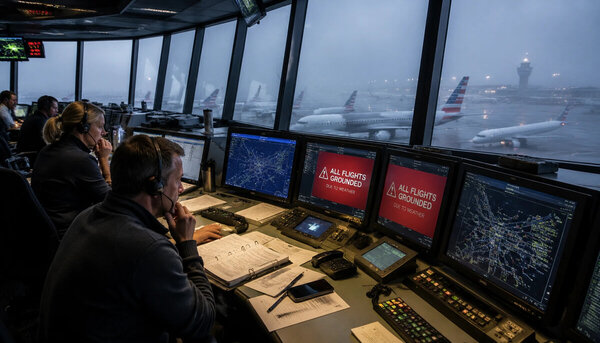
Following widespread disruptions to radio frequencies and communications systems at air traffic control centers, the US Federal Aviation Administration (FAA) ordered a nationwide suspension of passenger flights. The unprecedented move effectively plunged the US aviation network into a far-reaching crisis, once again exposing the vulnerability of the country’s critical infrastructure.
The disruption affected communications between air traffic controllers and pilots across different parts of the flight network. Reports pointed to simultaneous problems involving radio communications, radar systems, and equipment at control centers — a situation that posed operational risks to the safe continuation of normal flight operations.
According to the US transportation secretary, communications problems had spread to air traffic control centers across the country, prompting officials to launch an investigation into the technical aspects of the disruption.
More Than 30,000 Flights Caught Up in the Crisis
The scale of the disruption became clear when The New York Times reported that more than 30,000 flights had been scheduled for the remainder of the day. The sudden suspension of air operations disrupted travel plans for millions of passengers.
According to published figures, thousands of flights were delayed at various stages of the crisis, while cancellations also reached several thousand. Flightradar24 reported that at least 7,000 flights had been canceled, while other reports indicated that more than 15,000 flights had been affected.
The crisis was not confined to major airports. It disrupted domestic flights, inbound and outbound international services, and the schedules of airlines across the network.
Acknowledging Outdated Technology: A Retreat from Claims of Superiority
Remarks by US Transportation Secretary Sean Duffy shed further light on the crisis. He said that the navigation and communications systems used in parts of the country's aviation network were outdated and that existing infrastructure faced serious challenges in handling current demands.
Pointing to aging equipment, Duffy said US air traffic control towers needed to be modernized and that substantial investment was required at airports across the country. He warned that continuing to operate with the existing infrastructure could pave the way for similar problems to recur.
He also criticized the lack of funding for modernizing these systems, raising the question of how many times the US aviation system would have to fail before the necessary budget was allocated to fix it.
The remarks came as US officials were discussing the need for approximately $50 billion in investment to rebuild and modernize aviation infrastructure — systems whose proper functioning is directly linked to the safety and lives of millions of Americans.
$50 Billion to Save Passengers’ Lives; Many Times That Amount Spent on a Fruitless War
Perhaps the most important question raised by the crisis for the American public is not simply what caused the disruption to the aviation systems, but how the US government prioritizes its financial resources.
While US officials say $50 billion is needed to modernize a network responsible for safely guiding millions of passengers, the same administration has spent vast financial resources in recent months on a war in West Asia that has brought Washington no clear strategic gains, while imposing heavy human and economic costs.
The direct and indirect costs of the war, taking into account military operations, troop deployments, equipment, ammunition, and damage resulting from the conflict, are estimated to be many times higher than the amount required to modernize aviation infrastructure. Meanwhile, dozens of US service members have lost their lives, and military attacks have killed large numbers of innocent people, including children and school students.
This contradiction raises a serious question about the US government's priorities: How can a government that faces financial constraints in funding critical infrastructure and protecting its own citizens allocate resources many times greater to a costly war with no clear strategic gains?
In other words, does the safety of American citizens and the maintenance of infrastructure on which the lives of millions depend every day take priority, or does the government prioritize spending on military adventurism beyond its borders?
Claims That There Was No Cyberattack; Cause of Disruption Remains Unclear
As the widespread suspension of flights raised concerns about a possible cyberattack, Markwayne Mullin, the US secretary of homeland security, said no evidence had so far emerged that the disruption was deliberate or that a cyberattack had taken place.
Donald Trump also ruled out the possibility of artificial intelligence involvement or a cyberattack in an interview with Fox News. The FBI likewise said it had found no indication of a cyberattack behind the outage affecting the Federal Aviation Administration's services.
However, the absence of initial evidence of a cyberattack does not mean the cause of the incident has been established. US officials have said they are continuing to investigate the technical source of the disruption. Until a detailed, independent, and transparent technical report explains how the incident occurred and identifies the chain of contributing factors, no definitive conclusion can be drawn about the underlying cause of the crisis.
This is particularly important because aging communications and navigation networks, combined with the growing reliance of critical infrastructure on digital systems, can increase vulnerability to cyber threats. Therefore, even if no cyberattack occurred in this incident, cybersecurity and the resilience of the aviation network remain serious concerns.
22 Air Traffic Control Centers Affected; Aging Network Under Pressure from New Equipment
Further reports indicate that the communications disruption affected 22 regional air traffic control centers across the United States.
In explaining the technical causes of the incident, Duffy pointed to problems involving routers and outdated communications network equipment. He said incoming data had overloaded some equipment, causing instability in communications and radar systems.
According to Duffy, some parts of the infrastructure still rely on copper telephone lines and outdated technology, while newer equipment did not experience the same disruption during the incident.
These explanations suggest that the problem was not merely an isolated technical failure. Rather, the gap between outdated technology and the demands of the modern US aviation network has become one of the country's major challenges.
The US transportation secretary also stressed the need for substantial investment to modernize the network. Reports on the administration's press briefing put the funding required to upgrade aviation infrastructure at $50 billion.
Crisis Spills Over into International Flights and Rail Services
The disruption was not limited to domestic flights within the United States. In response to a request from the US side and the technical problems that had emerged, the European Organisation for the Safety of Air Navigation (Eurocontrol) announced the suspension of flights from Europe to the United States.
Air Canada also canceled all of its remaining flights operating between Canada and the United States in both directions. Alongside restrictions on international flights, the decision extended the crisis to cross-border air transport networks.
At the same time, reports emerged of disruptions to the website and mobile application of passenger rail operator Amtrak. In Argentina, aviation authorities announced precautionary measures and said flights in the country had been suspended.
As a result, a crisis that began with the communications network of US aviation had consequences extending beyond the country's borders.
Flight Suspension Order Lifted, but Questions Remain Unanswered
After more than four hours, the Federal Aviation Administration lifted its nationwide grounding order and authorized the gradual resumption of flight operations.
However, lifting the order did not mean an immediate return to normal. The US transportation secretary warned that restoring order to flight schedules would take time, and airlines would continue to face the consequences of cancellations, aircraft repositioning, and restrictions on crew working hours.
According to published reports, at least 600 flights were also diverted to alternative routes. Airlines warned that the effects of the disruption could continue through Saturday and even into the remainder of the weekend.
It is important to note that during the nationwide suspension, aircraft that were already in the air were allowed to continue their journeys and land under established flight safety procedures. The grounding order therefore primarily affected departing flights and the network's normal operations.
Ultimately, what remained of the incident was not merely thousands of canceled flights and stranded passengers, but the exposure of vulnerabilities in the infrastructure responsible for operating one of the world's largest air transportation networks.
Despite US officials' remarks about aging equipment and their initial rejection of the possibility of a cyberattack, the precise source of the disruption still requires investigation and the publication of a transparent technical report. Until then, attributing the incident definitively to a specific technical failure or entirely ruling out other possibilities would be premature.
The crisis has also once again highlighted a contradiction in the US government's policymaking: an administration facing challenges in securing $50 billion to make its own critical infrastructure safer has spent resources many times that amount on a costly war in West Asia — a war whose toll has been borne not only by the US public budget, but also by American service members and thousands of innocent people, including schoolchildren.