At a time when the international community has condemned the US-Israeli military aggression against Iran and called for an end to the war, the restoration of Iran’s rights, and compensation for the damage caused by the aggression, including its environmental consequences, the International Atomic Energy Agency (IAEA) has once again taken a confrontational approach toward Tehran by issuing a questionable report. The agency claims that, due to restrictions on inspectors’ access to Iranian nuclear facilities targeted in military attacks, it lacks reliable information about the current status, quantity, and location of Iran’s enriched uranium stockpiles, and has called for the immediate resumption of inspections.
This claim comes even as the agency has refrained from condemning US and Israeli attacks on Iran’s nuclear facilities. Such an approach once again demonstrates that political considerations have taken precedence over professional and technical responsibilities, and that the IAEA’s reports could pave the way for another act of aggression. Moreover, with the expiration of UN Security Council Resolution 2231, Iran’s nuclear file has been closed. Continuing to issue reports under the previous framework is not only legally unjustifiable but will also deepen Tehran’s distrust of the agency and further complicate efforts to resolve outstanding issues, including the reopening of the Strait of Hormuz.
A Closed File Cannot Be Reopened Through Manufactured Reports
The IAEA continues to issue periodic reports on Iran even though the expiration of the JCPOA in 2025 and the termination of UN Security Council Resolution 2231 have brought the previous basis for such reporting to an end. Under these circumstances, Iran’s nuclear status should return to normal, and related sanctions should be lifted.
The activation of the snapback mechanism by Western countries and the IAEA’s continued reporting are at odds with international law and internationally accepted commitments. Such conduct not only undermines the agency’s credibility but also establishes a dangerous precedent in the international monitoring system, one that could erode the confidence of member states and even prompt some countries to reconsider the scope of their cooperation or withdraw from the Treaty on the Non-Proliferation of Nuclear Weapons (NPT).
A file whose legal basis has expired cannot be kept open indefinitely through repetitive reports and new allegations.
Grossi: From Monitoring Responsibilities to Alignment with Aggressors
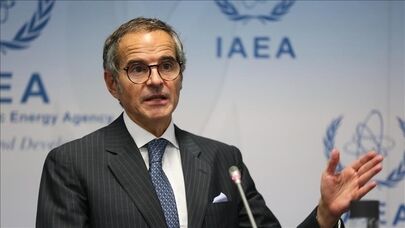
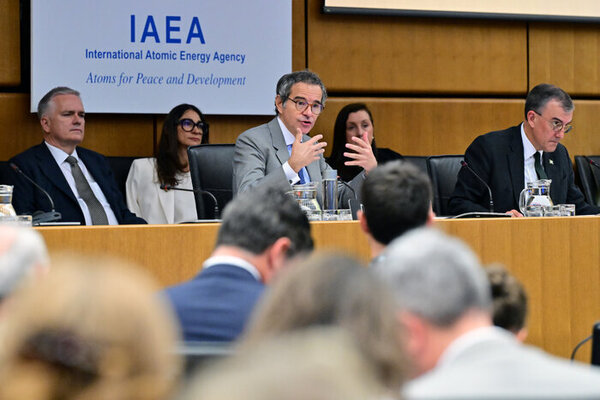
The contents of the IAEA’s latest report bear a striking resemblance to Trump’s claims about the need to prevent Iran from acquiring nuclear weapons—the very allegations used as a pretext for waging war against Iran. It appears that Grossi, the agency’s director general, who is also reportedly aspiring to become UN secretary-general, continues to play into Washington’s hands rather than safeguard the agency’s independence.
The attacks during the 12-day war took place after IAEA reports and a resolution adopted by European countries at the agency’s Board of Governors had helped lay the political groundwork for aggression. During the Ramadan War, facilities whose confidential information was in the agency’s possession were also targeted. This raises serious questions about the protection of sensitive information and the agency’s responsibility in this regard.
Grossi had previously added to the atmosphere of uncertainty surrounding Iran by making claims about its enriched uranium stockpiles and certain potential locations. Now, too, the IAEA’s biased report could become a tool for Trump to ease some of the domestic pressure resulting from his warmongering against Iran.
Inspections of Bombed Facilities: A Demand Without a Safeguards Basis
Iran has maintained extensive cooperation with the IAEA over the years. However, suspending access following the bombing of its nuclear facilities was a decision shaped by wartime conditions and the country’s security requirements.
On the one hand, the attacks were carried out using information whose origins and methods of transfer raise serious questions. On the other, the agency has not even been willing to condemn these acts of aggression.
Importantly, the safeguards framework contains no specific protocol for inspecting facilities that have been bombed. Therefore, Iran cannot be expected to grant immediate access without the establishment of a clear mechanism and guarantees for the security of the facilities and the protection of sensitive information.
Tehran’s demand is precisely the development of such a mechanism, with recognition of Iran’s right to self-defense and full compliance with its security requirements. A country whose nuclear facilities and scientists have been targeted in acts of aggression cannot disregard its national security or continue cooperating with an institution whose conduct has become the subject of serious distrust.
The IAEA’s Double Standards and the Need to Reconsider the Nuclear Doctrine
The IAEA’s double standards in dealing with nuclear activities around the world are another issue that cannot be overlooked. The agency has failed to respond effectively to the hundreds of billions of dollars in increased spending by nuclear-armed powers to modernize their arsenals. French President Emmanuel Macron’s recent remarks on the role of nuclear weapons in his country’s deterrence policy provide another example of this approach.
The IAEA’s responsibilities are not limited to monitoring the nuclear activities of non-nuclear-weapon states. Disarmament and the elimination of nuclear weapons are also part of its international responsibilities—obligations on which no meaningful progress has yet been made.
At the same time, the agency has remained silent in the face of explicit threats by Trump and Netanyahu to bomb Iran’s nuclear facilities, including the threat involving Kharg Island, as well as Trump’s offer of a $20 million reward for information about Iran’s nuclear facilities.
Taken together, these actions, alongside US-Israeli military aggression against Iran’s nuclear facilities and scientists and the failure to secure the rights Iran is entitled to as an NPT member, have turned a change in the country’s nuclear doctrine into a serious demand in public opinion.
The fundamental question is: What has Iran gained from its membership in the IAEA and its refusal to develop nuclear weapons in the face of such threats and aggression? Furthermore, in a world where international law is effectively subject to double standards, what guarantees of national security can unilateral adherence to commitments provide?
Discussions about changing Iran’s nuclear doctrine during Friday prayers, along with a statement issued by the Assembly of Experts, indicate that this issue is becoming a public demand for a reassessment of the existing situation.
Ultimately, the West must have realized that sanctions, threats, and pressure will not change Iran’s strategy. As military and political officials have emphasized, the Strait of Hormuz will not be reopened without the fulfillment of Iran’s seven conditions, and any threat will be met with a firm response proportionate to the country’s current capabilities. The targeting of a US radar system in Bahrain is one example of this reality.
The illusion of using the IAEA as an instrument of pressure must also be abandoned. Iran will bring an end to the state of neither war nor peace not through surrender, but through a firm response to military threats, breaking the economic blockade by relying on domestic capabilities and cooperation with neighboring countries, linking diplomacy with military action, and drawing on the strength of its people.
The Strait of Hormuz cannot be reopened through pressure, just as the trust lost in the IAEA cannot be restored through political reports.