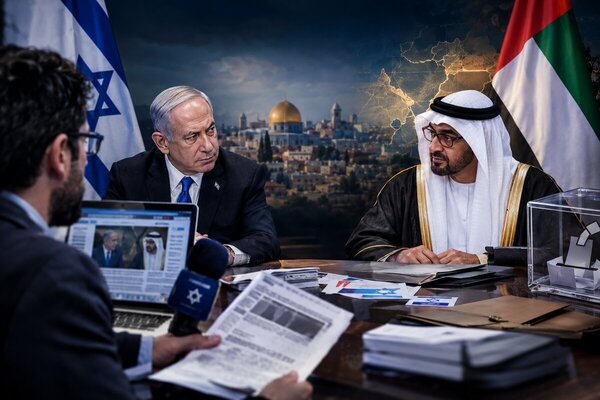
Nournews: With less than a month to go before Israel’s October 27 election, a series of security, media and diplomatic developments has created a picture centered on Benjamin Netanyahu, the Iranian threat and the role of Abu Dhabi. According to an account published by a senior Haaretz journalist, these developments form part of a highly complex electoral plan allegedly designed and coordinated between Netanyahu’s team and bin Zayed.
According to the account, which the journalist presented in a conversation with a Wall Street Journal reporter, unfavorable polling for Netanyahu’s coalition prompted the Israeli prime minister’s campaign team to develop a scenario aimed at highlighting an imminent security threat and portraying Netanyahu as Israel’s only strong and capable protector.
According to information disclosed by the Haaretz journalist, the plan was discussed at two meetings in Tel Aviv and Dubai on September 2 and 11, and was ultimately approved by Netanyahu and Mohamed bin Zayed, the president of the UAE.
The timing of subsequent developments, including Netanyahu’s trip to Abu Dhabi and the content of the Israeli prime minister’s recent security messages, suggests that the journalist’s account is based on information about the strategy underlying Netanyahu’s campaign.
An Election in Which Netanyahu Is Facing Difficulties
Recent polls show that Israel’s election remains deadlocked, with neither camp reaching the 61-seat threshold needed for a parliamentary majority in many surveys.
In the latest Kan poll, published on September 28, the Yashar party led by Gadi Eisenkot was projected to win 23 seats, while Netanyahu’s Likud was projected to take 21. The two main blocs were each projected to hold 52 seats. In the same poll, 39% of respondents said they preferred Netanyahu as prime minister, compared with 38% for Eisenkot.
A few days earlier, a Maariv poll put Likud at 18 seats and Yashar at 22, while estimating that Netanyahu’s coalition parties would win a combined 49 seats.
Reuters also wrote in its September 29 election analysis that polls generally pointed to a significant decline in Likud’s projected number of seats, while Netanyahu had once again focused his campaign on presenting himself as Israel’s “protector” against regional threats.
Under such circumstances, highlighting an external threat could take on particular importance for the Israeli prime minister’s campaign — especially as the October 27 election is Israel’s first nationwide election since the October 7, 2023 attack.
Netanyahu’s responsibility for that attack and the security failures that left Israel vulnerable to Hamas’s assault remain among the central issues in the political contest.
Abu Dhabi: The Regional Link in the Scenario
Against this backdrop, Netanyahu’s surprise trip to Abu Dhabi takes on greater significance.
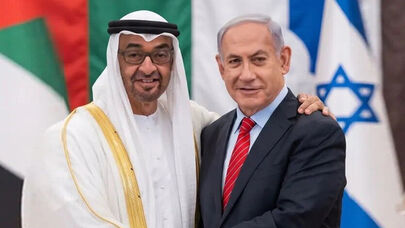
According to the UAE’s official announcement, the visit was made at the invitation of Mohamed bin Zayed, with the talks focusing on bilateral relations and regional developments, particularly Iran.
Reuters reported that the meeting between Netanyahu and bin Zayed lasted around six hours.
The significance of the visit for Netanyahu’s alleged electoral strategy lies precisely here: while Netanyahu is speaking inside Israel about the possibility of an attack by Israel’s enemies before the election, outside Israel he is discussing Iran, Yemen’s Ansarullah and regional security issues in the capital of one of Israel’s closest regional partners.
In this way, a threat that might otherwise be perceived inside Israel as merely an electoral message is presented in Abu Dhabi as a prominent regional security concern.
From this perspective, the UAE’s role in advancing the scenario is not merely that of a host for a diplomatic meeting. Abu Dhabi, in this carefully orchestrated yet complex display, provides what could be described as regional validation for Netanyahu’s security narrative — the same narrative that the Israeli prime minister needs to make an impact in the October 27 election.
Media Reports About Arab Officials: A Bigger Picture
The visit was accompanied by a wave of reports about representatives from Arab countries attending meetings with Netanyahu.
Israeli media initially reported that representatives from Saudi Arabia, Jordan, Morocco and other countries in the region were present, with some reports suggesting that the meetings involved an even broader group of participants.
Sources also said the discussions focused on Iran, the threat posed by Yemen’s Ansarullah and security coordination.
But the reports were quickly met with denials.
A senior Saudi official said that no Saudi official had met with Netanyahu during his visit to the UAE. The Israeli newspaper Yedioth also amended its initial report, saying it was unable to confirm such a meeting. Jordan likewise denied that its representative had attended.
These denials, however, do not change one important point: in the initial hours after the reports emerged, an image of broad Arab-Israeli coordination in Abu Dhabi entered the media space — an image that retained the potential to have an impact even after parts of the reports were denied.
It is therefore important to distinguish between whether a meeting actually took place and the media impact of reports that such a meeting had taken place.
From Abu Dhabi to Election Warnings
Netanyahu’s repeated electoral displays — including the release of a video of him at an Israeli airbase in which he said there were signs that Israel’s enemies could launch an attack before the election and warned that Israel’s “long arm” would reach its enemies anytime and anywhere — appear to form further pieces of his campaign’s effort to portray an external threat as imminent.
Reuters described the position as part of Netanyahu’s electoral effort to rebuild his security credentials.
Netanyahu’s repeated statements and actions in this context prompted his electoral rival, Yair Lapid, to call for a security briefing on the issue.
Netanyahu’s office said last night that he had briefed Lapid on assessments concerning the possibility of attacks before the election.
Against this backdrop, the sequence of events is notable: the alleged joint electoral plan developed by Netanyahu and bin Zayed in September; Netanyahu’s trip to Abu Dhabi at bin Zayed’s invitation; the focus on Iran; reports of representatives from Arab countries attending meetings, followed by denials of some of those reports; Netanyahu’s warning of a possible attack before the election; and, finally, the delivery of a security briefing to the opposition leader.
By bringing a foreign actor into Israel’s domestic electoral equation, Netanyahu has effectively narrowed the line between regional diplomacy and electoral competition. Abu Dhabi, by assuming such a role, has likewise exposed itself to the potential security and political consequences.
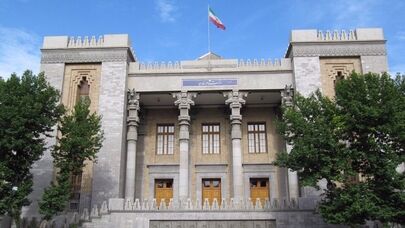
Tehran’s official reaction indicates that such costs are not merely hypothetical. Following Netanyahu’s visit to the UAE, Iran’s Foreign Ministry condemned the trip and warned of the “very dangerous consequences” of Israel’s presence in the region. It also called on regional countries to remain alert to the consequences of such a presence and not allow their territory to be used for destabilizing actions.
From this perspective, Netanyahu has not merely brought a regional partner into his electoral calculations; he has also tied part of his campaign’s security narrative to a foreign actor — a move that could expose both sides to costs extending beyond electoral calculations if regional tensions escalate.
Taken together, these developments suggest that, ahead of the October 27 election, Netanyahu is placing significant emphasis on rebuilding his security image, with Abu Dhabi emerging as one of the key stages for that effort.
The Israeli prime minister has not relied solely on his campaign’s domestic capabilities to bolster his political position; he has also brought a foreign actor into the electoral equation — a high-risk move that could expose both Netanyahu’s electoral standing and the UAE’s regional position to unpredictable costs.