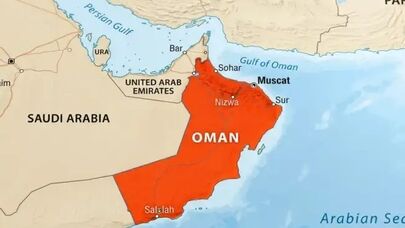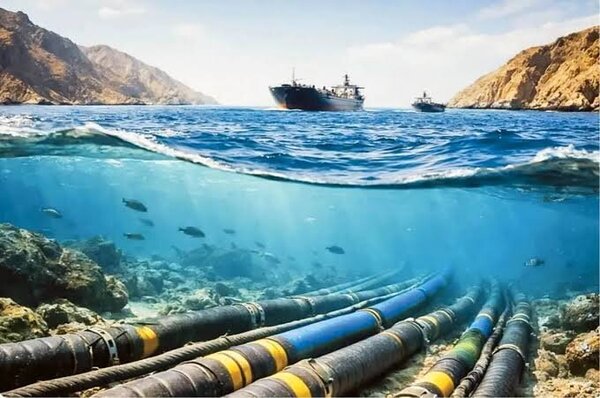
In recent days, senior Iranian security and military officials have explicitly warned that internet cables on the seabed of the Persian Gulf could be targeted if the United States and Israel launch another attack on Iran. Citing serious concerns among Arab countries in the region about the potential consequences, Al Jazeera has warned that damage to communications cables in the Strait of Hormuz could disrupt digital connectivity across the region.
The significance of this warning lies in the fact that a substantial part of modern economic and social life depends on infrastructure that is largely invisible to the public. An extensive network of fiber-optic cables laid across the seabed connects banks, data centers, technology companies, cloud services, and millions of users. This is why regional officials have also expressed concern about the potential consequences of damage to these cables. Disruptions would not simply be a communications problem; they could spill over into trade, financial services, transportation, the digital economy, and even data center operations.
Al Jazeera’s report presents a broad picture of the potential impact, citing a figure of 80 percent for the share of global internet traffic dependent on these cables. Some experts, however, argue that this claim should be treated with technical caution. The International Cable Protection Committee has described the share of international bandwidth passing through the Strait of Hormuz itself as negligible in comparison with global international bandwidth. According to these experts, damage to cables in the Strait of Hormuz would not necessarily mean a global internet blackout, as the worldwide network has numerous alternative routes.
However, this technical distinction, even if accepted, does not diminish the significance of the issue. Rather, it points to a more realistic—and perhaps more consequential—understanding of the threat. Iran does not need to shut down the global internet to affect internet connectivity worldwide. It would be enough to damage part of the region’s sensitive communications infrastructure during a war to impose substantial economic and communications costs on neighboring countries. The significance of cables in the Strait of Hormuz should therefore be assessed not in terms of their share of the global internet, but in terms of their role in the Persian Gulf’s communications architecture.
Several major submarine cable systems pass through the region, and the Arab countries of the Persian Gulf depend on this network to varying degrees. Some countries have alternative land-based or maritime routes, preventing the disruption of one or several cables from bringing their communications systems to a complete collapse. However, the capacity of these alternative routes is not unlimited. A sudden transfer of large volumes of traffic to other routes could reduce available capacity, increase latency, and disrupt certain services.
Developments in the Red Sea in recent years have also shown that disrupting global communications networks does not necessarily require cutting every cable. Damage to several major routes in the area forced operators to reroute some traffic through alternative pathways, while increased latency and degraded connection quality were observed in certain locations. This experience highlights an important reality: in infrastructure warfare, disruption can sometimes matter more than complete destruction.
It is from this perspective that Iran’s warning should be understood. If Iran’s critical infrastructure comes under attack during a military confrontation, Tehran will also have a range of retaliatory options at its disposal. These options would not necessarily be limited to conventional military targets. Energy infrastructure, shipping, ports, trade routes, communications networks, data centers, and other economic and technological chokepoints could all factor into the calculations of modern warfare.
In this context, Iran’s message is less about claiming that “we can shut down the global internet” and more about signaling that if war is imposed on Iran, Tehran will not necessarily respond only on the ground or in the theaters chosen by the aggressor. This is particularly significant for the deterrence equation. As national economies become increasingly dependent on interconnected infrastructure, their areas of vulnerability also expand. Countries with advanced technology, massive data centers, and sophisticated digital economies are simultaneously dependent on networks of physical infrastructure that, in many cases, pass through a limited number of geographic chokepoints. Submarine cables are precisely one such vulnerability.
There is, of course, an important distinction between threatening critical infrastructure and deciding to target it. Deliberate attacks on civilian communications infrastructure could have significant legal and political consequences and affect even countries that are not directly involved in a war. For this reason, a threat should not automatically be interpreted as a definitive decision to carry it out. From a deterrence perspective, however, the very fact that such an option has been raised sends a clear message: a potential future war will not necessarily remain confined to the rules or battlefields selected by the aggressor.
If a country threatens to attack Iran’s critical infrastructure or proceeds with such an attack, Tehran will naturally assess the range of tools at its disposal to defend itself and impose costs on its adversary. Undersea cables are just one of these potential instruments, alongside energy infrastructure, shipping, ports, and other critical chokepoints that could feature in such calculations.
Perhaps the most important aspect of Al Jazeera’s report, then, is not the sweeping claim about “80 percent of the global internet,” but the exposure of a less visible reality: modern warfare no longer takes place solely on battlefields that can be seen. Part of a country’s power and vulnerability lies beneath the water, inside data centers, and along routes carrying millions of financial transactions and communications every day.
Undersea cables may appear to be little more than strands of fiber optics, but in today’s economy, they form part of the vital arteries of nations. And when a war reaches the point where a country’s critical infrastructure is targeted, it is unrealistic to expect the other side to set aside all its available tools and respond only within the confines of conventional warfare.
Undersea cables may not be able to shut down the global internet, but they can become part of the cost of war—and that is precisely what makes them a potential element in deterrence calculations.