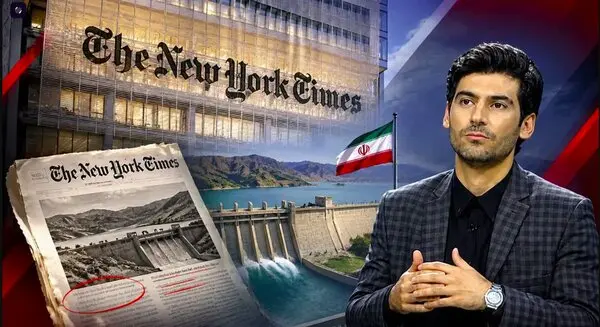
Published on November 16, 2026, the report claims that some water projects may serve not only civilian purposes but also supply water and electricity to military facilities. The publication of such reports, whether intentionally or unintentionally, helps create a narrative that could justify future US attacks on Iran. In an interview with Nournews, international affairs analyst Shoaib Bahman examined the context and objectives behind the publication of such reports.
The publication of an unusual report in The New York Times suggesting a possible connection between some of Iran's dam and water-transfer projects and underground missile facilities goes beyond a technical or environmental discussion. This seemingly media-driven initiative is, in fact, part of a broader psychological warfare campaign aimed at laying the groundwork for a war against infrastructure. Making such claims could pave the way for justifying attacks on Iran's vital civilian infrastructure in a future round of hostilities.
The report, published on November 16, 2026, draws on geographical assessments and the views of several experts to claim that some water projects may have served military facilities in addition to their civilian purposes, including supplying water and electricity. Notably, Kaveh Madani, director of the United Nations University Institute for Water, Environment and Health, warned in response to the report that geographical proximity between two infrastructure facilities, even if established, does not demonstrate a causal relationship between them. In his view, turning speculation into a security narrative could have dangerous consequences for civilian water infrastructure. The significance of this warning lies in the concept of “dual-use infrastructure.” If the mere proximity of a dam, power plant or water-supply facility to a military site becomes grounds for designating it as a military target, the distinction between military objectives and essential services for the public will become extremely vulnerable.
Under these circumstances, the publication of such reports, whether intentionally or unintentionally, helps create a narrative that could justify future attacks. In an interview with Nournews, international affairs analyst Shoaib Bahman examined the context and objectives behind the publication of such reports.
Many experts believe that US media outlets engage in a form of narrative-building before Washington undertakes military action or aggression. How do you analyze this pattern, and what examples of it have occurred in the past?
Using the media to advance US foreign policy objectives is nothing new. The US has a long history of using media, cinema and, particularly, Hollywood to shape public opinion and create the psychological and political groundwork for military action. In many cases, a particular narrative is established in the media before military action takes place. This narrative seeks to portray the other side as a threat and ultimately make subsequent actions acceptable, or at least tolerable, to public opinion.
Therefore, when media outlets such as The New York Times or CNN publish reports about potential threats from Iran, these reports should be examined within the broader framework of the war of narratives and psychological operations. The publication of such reports alone does not prove that they were commissioned by the government. However, their timing and content can raise serious questions about the political and security objectives behind these efforts to shape public opinion.
The recent New York Times report raises the issue of links between Iran's dam construction and military infrastructure and missile cities. Why do you consider this kind of narrative-building concerning?
The key point in this report is the question raised at the outset: Why has Iran pursued dam construction despite facing various crises? The answer is not particularly complicated. Iran is a country facing water shortages, drought and serious challenges in managing its water resources. Dam construction is one of the tools used to manage water resources and meet agricultural, industrial and urban needs.
However, when a development project serving the fundamental needs of society is linked to military infrastructure and missile cities, it effectively creates the conditions for changing how the public perceives its nature. This is where the main concern arises, as such narratives could be used in the future to justify targeting facilities that are fundamentally civilian and essential in nature.
Could the publication of such reports be viewed as part of an effort to legitimize a potential US attack on Iran's vital infrastructure?
This possibility cannot be ruled out. When an internationally reputable media outlet analyzes a country's vital and civilian infrastructure within the framework of military threats, there is a risk that the distinction between military and civilian targets will gradually become blurred in public opinion.
Of course, independent evidence would be required to establish that such a report was directly commissioned by the Trump administration. However, from a media-analysis perspective, the content of such reports could help create an environment in which attacks on vital infrastructure are presented as justified on security and military grounds.
It should be borne in mind that dams, water-supply facilities and energy infrastructure are directly connected to the lives of millions of people. Attacking such facilities, if the relevant legal conditions are met, could constitute a war crime. Therefore, attempts to normalize attacks on these facilities cannot be allowed to go unchallenged, and changing their designation or offering security-related justifications cannot absolve those responsible of their legal obligations.
Alongside this issue, CNN has published reports suggesting that Iran might use dirty bombs or chemical weapons inside the US. Can these two efforts to shape public opinion be analyzed within a common framework?
Yes. At least from the perspective of the war of narratives, there are significant similarities between the two. In one case, efforts are being made to frame Iran's vital infrastructure as part of military threats; in the other, a portrayal of Iran as a threat to US domestic security is being presented.
What is noteworthy is that some of these media outlets have, at various times, been critical of Donald Trump's policies and the war against Iran. For this reason, any change in tone or emphasis on threats of this nature warrants closer scrutiny. Of course, a media outlet's opposition to Trump does not mean that all its reports about Iran or in line with US government policy are orchestrated. Nevertheless, the possibility of political exploitation of such reports cannot be ignored. The main question is whether these narratives are helping create a media consensus in favor of future military action.
From the perspective of international law, what would be the consequences of targeting dams and water infrastructure?
Water infrastructure is among the most important vital facilities in any country, and its protection holds a special place under international humanitarian law. This is particularly true of dams, hydroelectric power plants and facilities whose destruction could cause extensive harm to civilian populations.
Under the rules of international humanitarian law, dams and similar facilities containing dangerous forces enjoy special protection. Even when such facilities are considered military objectives, strict restrictions apply to attacks against them. Therefore, any attempt to normalize attacks on this infrastructure must be treated with serious concern. Water, electricity and other vital facilities are not instruments of military pressure that can simply be placed on a list of wartime targets.
Iran has spoken of the possibility of reciprocal action in response to threats against its vital infrastructure. What impact could this approach have on the calculations of the US and its regional allies?
One of the important components of deterrence is the credibility of a reciprocal threat. This means that the other side must understand that any action against a country's vital interests will not come without consequences.
Iran has demonstrated in previous military engagements that it does not leave attacks on its infrastructure unanswered. During the 12-day war and subsequent military developments, responding to attacks against facilities and strategic interests has been particularly important.
The central message of this approach is that if Iran's vital infrastructure is targeted, the other side and its regional allies cannot assume they will remain immune to the consequences of an escalation. This could serve as a deterrent in the calculations of US decision-makers and their regional partners.
The geographical distance between the US and West Asia has always been one of Washington's strategic advantages. To what extent could this distance embolden the US to engage in an infrastructure war against Iran?
US geography has always been an important advantage for the country. During the world wars and many regional conflicts, geographical distance meant that the US mainland was less exposed to direct threats. This enabled Washington to participate in conflicts beyond its borders at a lower direct cost.
However, this advantage is no longer absolute in today's world. Technological advances, growing economic and communications interdependence, and the presence of US investments and infrastructure in different parts of the world have significantly reduced the strategic value of geographical distance.
The US must take into account in its calculations that the costs of a regional war would not necessarily remain confined to the battlefield. US investments, commercial interests and infrastructure in the region could be affected by the consequences of instability and conflict. Even if US territory is not directly involved in the war, its economic, political and security consequences could spill over into the country, affecting public opinion and Washington's political calculations.
If the US decides to enter a new phase of an infrastructure war against Iran, would such a decision be strategically advantageous for Washington?
If the decision is made based on rational calculations and a careful assessment of costs and consequences, entering such a war cannot be considered a low-cost option for the US. Destroying Iran's vital infrastructure would not simply be a limited military action. It could expand the scope of the conflict and have far-reaching consequences for regional security and the economy.
The important point is that the US should not assume that its considerable geographical distance from Iran would shield it from the consequences of such a war. US economic interests and investments in the region, potential repercussions for energy markets and the domestic political impact of the war are all factors that Washington must take into account.
Deterrence is effective when the other side is convinced that the cost of aggression will far outweigh its potential gains. Therefore, preventing an infrastructure war would not only serve Iran's interests, but also regional stability and the long-term interests of the US.