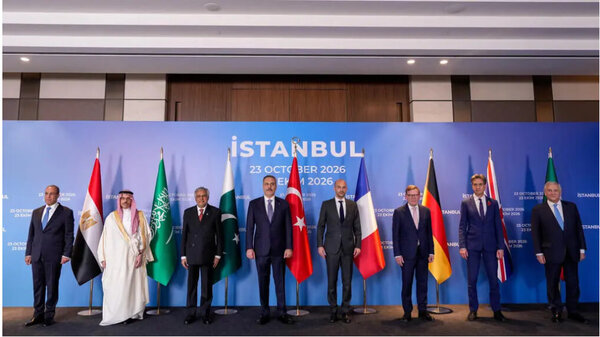
Nournews: Amid rapidly evolving international developments, particularly in West Asia, Türkiye hosted a meeting attended by the foreign ministers of Türkiye, Saudi Arabia, Pakistan, and Egypt, alongside their counterparts from the European troika of France, Germany, and the United Kingdom. Discussions covered developments in Palestine, the US-Israeli war against Iran, and the need to ensure freedom of navigation through the Strait of Hormuz and the Bab el-Mandeb Strait. Yet the gap between diplomatic rhetoric and realities on the ground remains. The continued pursuit of unrealistic demands by some countries will not resolve these crises; instead, it will make them more complicated. This is particularly true given that one side of the equation is a Europe that has lost much of its former standing in global affairs.
Palestine and Yemen: A Lack of Political Will to Curb Aggression
Although Türkiye, Saudi Arabia, Pakistan, and Egypt identified the Israeli regime's occupation as a key source of regional instability, their emphasis on a two-state solution, negotiations, and humanitarian aid to Gaza—without taking practical action against the regime or demanding an end to US and European support for it—reflects a lack of the political will needed to confront the occupation. European countries, for their part, have merely stressed that settlement construction in the West Bank is unlawful, while overlooking other dimensions of the Israeli regime's crimes and occupation.
The Istanbul meeting's insistence on dialogue comes as the United States and the Israeli regime have effectively demonstrated that they are unwilling to pursue a diplomatic settlement and instead rely on coercion. Under these circumstances, invoking diplomacy without confronting those responsible for aggression offers no viable path toward ending the crisis.
In Yemen, Saudi aggression and the support provided by its Western allies have also contributed to the continuation of the conflict. France and the United Kingdom have announced the deployment of forces and weapons to Saudi Arabia, while the European Parliament has adopted a resolution calling for the leadership and branches of Yemen's Ansarullah movement to be designated as terrorist entities and for targeted sanctions against the movement's missile and drone supply chains to be tightened.
The Istanbul meeting, meanwhile, emphasized keeping the Bab el-Mandeb Strait open and halting Ansarullah's attacks without addressing the root of the crisis: the Yemenis' right to legitimate self-defense against occupation and Saudi aggression. Yemen is not fighting for territorial expansion; it is seeking to preserve what it already has. Demanding that Yemen unilaterally abandon its resistance is inconsistent with the principles of international law. Ending the war requires Saudi Arabia and its allies to commit to ending their interference in Yemen's internal affairs and lifting the blockade imposed on the country.
Europe: A Marginalized Player With Fading Ambitions
The Istanbul meeting cannot restore Europe's lost standing. From Ukraine to West Asia, the continent has been pushed to the margins of global affairs and has increasingly become a vehicle for issuing statements rather than an effective geopolitical actor. Relying on such limited capacity to resolve regional crises, including the war in Yemen, is unlikely to yield meaningful results.
The leaders of the European troika appear, in this article's assessment, to be seeking their political survival through the continuation of war and the creation of crises. Their insistence on prolonging the war in Ukraine, alignment with the United States against Iran, and disregard for the Israeli regime's occupation are presented as manifestations of this approach. Severe domestic crises have also weakened Europe's ability to play an effective role in foreign policy.
Europe today resembles a dirty cloth expected to clean a window—a metaphor for the limits of its credibility and effectiveness. Its diplomatic posturing should therefore not be mistaken for genuine power to resolve international crises.
The Strait of Hormuz: Diplomacy Cannot Work Without Accountability
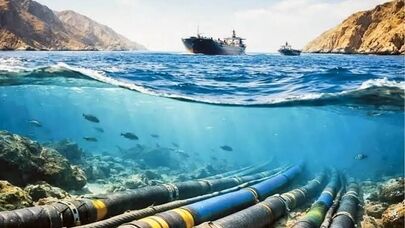
The foreign ministers attending the Istanbul meeting stressed the importance of maritime security and freedom of navigation, calling for the swift and full resumption of safe, unimpeded passage through the Strait of Hormuz. They also warned of disruptions to global supply chains and the flow of energy, food, and fertilizers.
These demands come as the European troika speaks of its readiness to negotiate with Iran on nuclear issues while simultaneously calling for an avoidance of further escalation. French Foreign Minister Jean-Noël Barrot said that escalating tensions between Iran and the United States would produce no winners, while Turkish Foreign Minister Hakan Fidan described diplomacy and dialogue as the only way forward.
However, failing to condemn US-Israeli aggression and alleged crimes, while disregarding Iran's right to legitimate self-defense and unilaterally urging Tehran to refrain from escalation, constitutes an obvious contradiction. The European troika has played a role in the US aggression against Iran, either directly or through NATO, and must be held accountable. Political meetings cannot whitewash Europe's involvement in crimes against Iran.
There is also a clear path to reopening the Strait of Hormuz: Iran has announced that it is prepared to reopen the waterway within one week, subject to seven conditions. Practical support for those conditions could help resolve the issue.
Europe cannot have it both ways—acting as Washington's accomplice while expecting to remain on friendly terms with Tehran. A country that participates in sanctions and threats against Iran cannot demand the reopening of the strait without accepting responsibility for its own actions.
Iran has consistently welcomed diplomacy, but circumstances have changed. Nuclear negotiations no longer occupy the same position they once did, and Europe must recognize the realities on the ground and Iran's role in global affairs. It must abandon its increasingly outdated demands and engage with the situation as it actually stands.