Pezeshkian said Iran considers itself a natural part of the region’s interconnected geography, rooted in shared history, culture, civilization and people-to-people ties.
Addressing the CIS summit, the Iranian president stressed that the region needs greater resilience than ever in the face of war, crises, external pressure and disruptions to economic and communication routes. Success, he said, depends above all on connecting the region’s capacities. “Our shared interests lie not in competition between routes, but in connecting them,” he said.
For Central Asia, Pezeshkian said, Iran is more than just a partner; it is a natural route linking Central Asia and Eurasia to open waters. Iran’s southern ports on the Persian Gulf and the Gulf of Oman, particularly Chabahar, can connect the region to South Asia, Africa and, ultimately, Europe.
He proposed establishing a flexible and effective “CIS+1” framework to promote dialogue and cooperation between Iran and CIS member states. The framework, he said, could expand joint cooperation in transit, energy, trade, mining, investment, technology, water, the environment, tourism, and scientific and cultural exchanges.
Pezeshkian also stressed that countries are not simply faced with a choice between isolation and dependence. Instead, they must connect their capacities so that each country can benefit from the advantages of their shared geography while preserving its independence and national choices.
“We want connectivity instead of fragmentation, cooperation instead of exhausting competition, interdependence instead of one-sided dependence, and security based on trust and shared interests instead of security based on threats,” he said.
Full Text of President Pezeshkian’s Speech at the CIS Summit
In the name of God, the Most Compassionate, the Most Merciful.
His Excellency Serdar Berdimuhamedov, President of Turkmenistan and Chair of the Summit;
Distinguished Presidents;
The esteemed Secretary-General of the Commonwealth of Independent States;
Ladies and gentlemen,
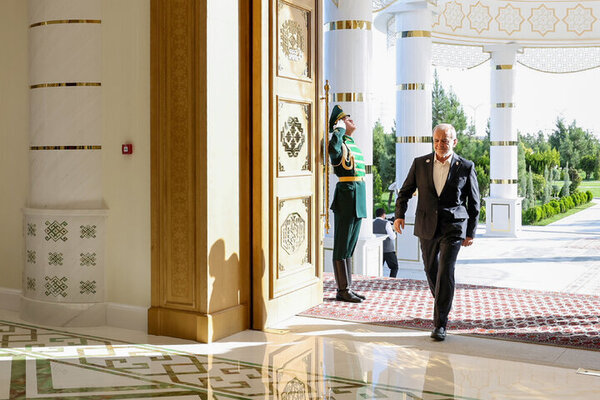
First, I would like to express my sincere gratitude to the friendly and brotherly government and people of Turkmenistan for inviting the Islamic Republic of Iran and hosting this important summit.
The Islamic Republic of Iran’s participation for the first time, as the first country invited as a special guest to the summit of the Commonwealth of Independent States, presents a valuable opportunity to strengthen existing ties and open a new chapter of cooperation with the countries of this group.
The fact that this summit coincides with the summit of Caspian littoral states on environmental issues also provides an appropriate opportunity to jointly consider geographical connections, shared interests, common concerns and the potential for cooperation between Iran and the Caspian littoral states and Central Asian countries.
Ladies and gentlemen,
Allow me to begin my remarks with a reality that cannot be overlooked in any discussion of the region’s future.
In recent years, the world and our region have faced interconnected crises whose consequences are no longer confined within the borders of a single country. Developments surrounding the Russia-Ukraine war, given their broader regional and international implications, have affected security, trade, transportation and, in particular, energy supplies and markets. These events and similar crises have shown that disruption in one part of the region can quickly lead to economic, social and even political pressures elsewhere.
Over the past year, Iran has also been targeted twice by military attacks by the United States and Israel. These blatant and illegal acts of aggression have not only harmed the people of my country and its civilian infrastructure, but have also affected many people across the region and the world.
These developments have made one reality clearer than ever: regional security and stability are indivisible. It is impossible to seek security and development for one part of the region while allowing insecurity, economic pressure and instability to take hold in another.
The Islamic Republic of Iran has consistently emphasized dialogue and diplomatic solutions as the means of achieving lasting peace and stability. However, dialogue is meaningful and has a chance of succeeding only when it is based on mutual respect, reciprocal commitments, and the abandonment of pressure and threats. Negotiation under the shadow of force is not negotiation; it is imposition and coercion.
At the same time, the experience of recent years has shown that the instrumental use of trade, banking, technology, energy and the international financial system against countries is not merely a bilateral issue. It also affects the economic security and development of the entire region and the world. Pressure and sanctions against Iran do not merely restrict Iran’s economic capacities; they also undermine trade, connectivity, energy cooperation and the regional order.
Distinguished heads of state,
Our region needs greater resilience than ever in the face of war, crises, external pressure and disruptions to economic and communication routes. Success in this regard depends above all on connecting the region’s capacities. Our shared interests lie not in competition between routes, but in connecting them.
For Central Asia, the Islamic Republic of Iran is more than just a partner; it is a natural route linking Central Asia and Eurasia to open waters. Iran’s southern ports on the Persian Gulf and the Gulf of Oman, particularly Chabahar, can connect the region to South Asia, Africa and, ultimately, Europe.
In this context, Turkmenistan’s proposal at the United Nations General Assembly to establish a transport corridor linking Central Asia, South Asia and Europe via the Caspian Sea could be put into practice by drawing on Iran’s capacities.
The North-South and East-West corridors are components of a single regional network, not competitors. Every new route therefore adds to the capacity of other routes and contributes to greater regional integration.
The same approach should be pursued in the energy sector. Instead of competing to exclude one another from energy markets, our region can become a network for energy production, transmission and exchange. Such a network would link oil, gas, electricity and renewable energy to shared economic interests and regional stability.
Strengthening trade also requires attention to practical regional mechanisms, including financial and barter arrangements, to facilitate exchanges among countries in the region. Such mechanisms can help sustain economic cooperation in the face of external disruptions and restrictions.
Ladies and gentlemen,
The Islamic Republic of Iran considers itself a natural part of the region’s interconnected geography. This connection is not merely geographical; it is rooted in shared history, culture, civilization and people-to-people ties.
On this basis, the Islamic Republic of Iran proposes establishing a “Commonwealth of Independent States plus Iran,” or “CIS+1,” framework as a flexible and effective mechanism for dialogue and cooperation.
This framework would enable us to expand joint cooperation in transit, energy, trade, mining, investment, technology, water, the environment, tourism, and scientific and cultural exchanges. It would also allow us to develop joint regional solutions to shared challenges, including climate change, declining water resources, environmental issues affecting the Caspian Sea and the Aral Sea region, organized crime, drug trafficking and other common concerns.
Today, more than ever, we need genuine multilateralism in our region. The countries of this important and strategic region must be among the principal actors shaping a multipolar world.
From this perspective, regional diplomacy is not simply about holding meetings. It must become a tool for managing crises, maintaining communication, preventing the spread of conflict and activating practical cooperation. This is the approach we pursue within the framework of the Islamic Republic of Iran’s neighborhood policy.
Ladies and gentlemen,
Today, we are not simply faced with a choice between isolation and dependence. Rather, we must connect our capacities so that each country can benefit from the advantages of our shared geography while preserving its independence and national choices.
We want connectivity instead of fragmentation, cooperation instead of exhausting competition, interdependence instead of one-sided dependence, and security based on trust and shared interests instead of security based on threats.
In conclusion, I would once again like to thank the government and people of Turkmenistan for inviting the Islamic Republic of Iran, hosting this summit and taking the valuable initiative to create opportunities for expanding cooperation between Iran and the member states of the Commonwealth of Independent States.
I hope this summit will mark a practical step toward building a region in which Central Asia, the South Caucasus and Iran are not separate spaces, but parts of a unified network of cooperation, security and development.
Our geographical circumstances have linked us together, but it is our political will that can turn this connection into a shared asset for peace, security and development.
Thank you for your attention.
Peace be upon you, and the mercy and blessings of God.