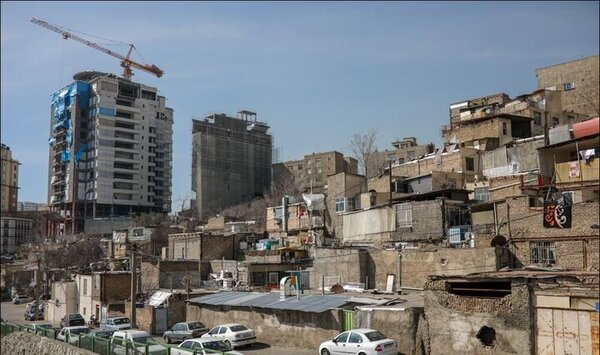
These figures, alongside estimates that more than six million people across the country live in such areas, show that the issue is no longer simply a matter of providing housing. It is linked to deeper challenges involving the economy, social justice, the distribution of public services and urban management.
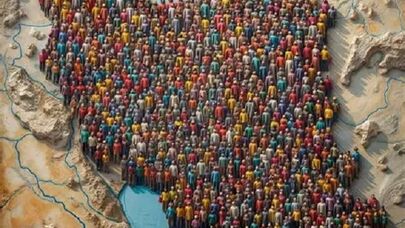
Thirty-six percent of Tehran province’s population lives in peripheral areas and informal settlements, while the figure in Alborz province is around one-third. These figures, announced in June by the head of the Tehran Province Management and Planning Organization, offer a troubling picture of living conditions in one of the country’s most densely populated areas.
The significance of these figures becomes clearer when we consider that the Tehran-Karaj metropolitan area, with a population of approximately 17mn to 18mn, faces several interconnected problems, including high housing costs, rising rents, traffic congestion, air pollution, water shortages and mounting pressure on urban infrastructure. In other words, population growth in this area has not only increased demand for housing but has also placed public services and natural resources under greater strain.
Tehran’s water resources were originally planned in 1970 to serve a population of around 5.5mn. In the following decades, however, the projected population of Tehran and Alborz provinces reached approximately 21mn. The population of the area has now approached that nominal capacity, while the provision of water, transport and other essential infrastructure remains constrained.
From Tehran to Other Cities: Informal Settlements Are No Longer a Local Issue
The scale of the problem is also significant at the national level. According to a report by the secretariat of the National Urban Regeneration Headquarters, cited in a report by the Iranian Parliament’s Research Center, approximately 6,226,000 people were living in informal settlements across the country in 2022, covering an area of 59,381 hectares.
More recent figures from the Ministry of Roads and Urban Development, however, point to an increase in this population. In September 2026, Abdolreza Golpayegani, deputy minister of roads and urban development and managing director of the Iran Urban Regeneration Corporation, put the population living in informal settlements at around 6.7mn. He also reported that approximately 20mn people lived across all categories of dysfunctional urban fabric, including deteriorated and historic neighbourhoods as well as informal settlements. It is therefore important to note that the figure of 20mn does not represent the country’s informal-settlement population; the two figures refer to groups defined differently for statistical purposes.
Meanwhile, 2024 data from the United Nations Human Settlements Programme (UN-Habitat) place approximately 29.8mn people, equivalent to 42.3% of Iran’s urban population, within the broader indicator of housing deprivation and slum conditions. This figure should not be directly compared with domestic statistics on informal settlements, as the international indicator assesses not only the geographical location of housing but also its quality and access to basic services.
The expansion of this phenomenon cannot be attributed solely to migration. Migration from less-developed areas to major cities leads to informal settlement when it coincides with a shortage of affordable housing, unequal employment opportunities and weak urban planning. Families unable to afford rents in formal urban neighbourhoods turn to areas where land and housing are cheaper, even if this means having more limited access to public services and essential infrastructure.
Addressing informal settlements is not only a social, economic and cultural necessity but also a security imperative. Such areas are sometimes described as "workshops for the production and distribution of social ills". The more these areas expand and the longer their rehabilitation is delayed, the greater the risk of undermining social security and, ultimately, public and national security.
In this regard, the cities surrounding Tehran and Karaj offer a clear example of the link between economic concentration and the expansion of informal settlements. The concentration of employment opportunities, healthcare and educational services, and administrative activities in the capital continues to make migration to the area attractive, while many smaller cities and areas of origin lack economic opportunities commensurate with their population capacity.
Addressing Informal Settlements: From Physical Enforcement to Economic Policy Reform
One of the most significant mistakes in dealing with informal settlements is to limit solutions to demolishing unauthorized structures or preventing further population inflows. The expansion of informal settlements shows that, unless the economic and social factors behind their emergence are addressed, physical restrictions alone cannot prevent the phenomenon from recurring.
In this context, the Ministry of Roads and Urban Development has placed on its agenda the preparation of a plan to reorganize and decentralize Tehran and Alborz provinces. The programme includes 24 measures covering the management of population concentration, the redistribution of economic activities, the protection of natural resources, and the management of water and energy consumption. Responsibilities for implementing these measures, timelines and monitoring mechanisms have also been defined, with a three-year evaluation period envisaged.
At the national level, formally recognizing residents' occupancy and clarifying property ownership are also important. A bill to formalize property documentation in informal settlements has been approved by the government and must now be submitted to parliament to become law. Proper implementation of this policy could give residents access to property rights and facilitate investment in upgrading their homes. However, issuing property deeds alone cannot replace the provision of water, sewage systems, schools, clinics and public transport.
The issue of informal settlements must be examined beyond the scope of a housing crisis, within the broader framework of spatial justice and balanced national development. Unless employment, housing, transport and the distribution of public services are reformed in a coordinated manner, population pressure on Tehran and Alborz will continue, while informal settlements will expand in other cities as well.
The reality is that residents of these areas are not simply people living outside the boundaries of urban planning. They are citizens who, because of economic and structural constraints, have had less access to public facilities and development opportunities. The success of urban regeneration policies, therefore, can only be measured by whether they improve the quality of life of these residents and ensure that they have equal access to urban services, rather than simply attempting to eliminate the visible signs of the problem.