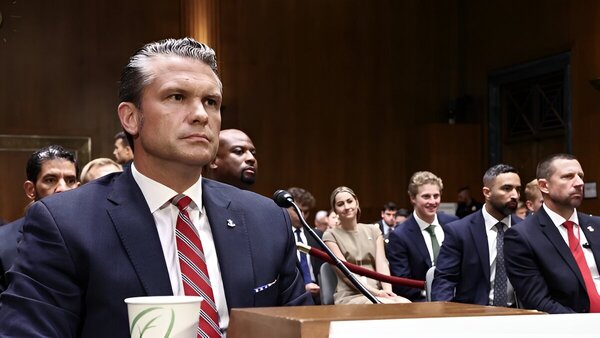
Pete Hegseth, President Donald Trump's Secretary of War, is facing one of the most serious crises of his tenure as the war against Iran, criticism of the Pentagon's military conduct, and growing political divisions in Washington have placed his position under considerable pressure. Although Republicans have so far blocked efforts to advance his impeachment in the House of Representatives, the scope of the allegations, divisions within the Republican Party, and the possibility that the case could return to Congress's agenda have cast uncertainty over the future of the US defense chief.
Eight Articles of Impeachment: The Iran War at the Center of Hegseth's Case
Republican Representative Thomas Massie of Kentucky has introduced an eight-article impeachment resolution against Pete Hegseth. The move is significant not merely because of political differences between Democrats and the Trump administration, but also because it reflects growing criticism of the US government's military conduct from within the Republican Party itself.
The resolution accuses Hegseth of conducting illegal wars or military operations against Iran, Yemen, and Venezuela; disregarding laws protecting civilians; participating in extrajudicial killings; and suppressing freedom of speech.
One of the central issues in the case is the US secretary's role in directing military operations against Iran and his responsibility for the humanitarian consequences of the war. The issue has become a major focus of criticism against the Pentagon, particularly following the attack on the school in Minab, which killed a large number of students.
In defending the need for impeachment, Massie used a pointed tone to challenge Hegseth's record, saying the secretary had been effective in killing 200 Iranian schoolchildren, bombing fishing boats, and carrying out an illegal abduction in Venezuela. However, Massie argued, these actions constitute violations of the law and the US Constitution.
Minab: The Attack That Challenged Military Justifications
One of the most significant aspects of Hegseth's case is the attack on the elementary school in Minab, an incident that carries particular weight in terms of international humanitarian law and command responsibility.
Trita Parsi, referring to Massie's argument, has emphasized the distinction between the complexities of an active battlefield and an attack that was planned in advance. In his view, the concept of the "fog of war," which is used to describe uncertainty and confusion during military operations, cannot easily be invoked to explain events on the first day of a pre-planned attack.
Parsi has pointed out that on the very first day of the war against Iran, the US military, under Hegseth's command, struck an elementary school three times, killing more than 150 children.
The incident has taken the case against the secretary beyond disagreements over military decisions, turning it into a question of accountability for civilian lives. Consequently, criticism is directed not only at the outcome of the war but also at how operational decisions were made and whether the rules governing civilian protection were observed.
Republicans Have Shielded Hegseth—for Now
Despite the introduction of the impeachment resolution, the US House of Representatives voted early Wednesday, with 211 votes in favor and 204 against, to refer the resolution to the relevant committee, preventing it from advancing to consideration on the House floor.
The vote does not mean the impeachment case has been closed. Rather, it has merely blocked its progress at the current stage. The support Hegseth received from most Republicans also demonstrated that Trump can still rely on his party's political strength to protect members of his administration.
Following the decision, Donald Trump described the Democrats' failed effort to impeach Hegseth as "disgraceful" and attacked Thomas Massie, calling him a defeated and disgruntled lawmaker.
The US president also portrayed Hegseth as one of the country's most popular and successful military officials, citing increased military recruitment as evidence of his performance and arguing that he deserved recognition rather than impeachment.
Trump even urged Congress to support the secretary, pointing to what he described as two US victories in Venezuela and Iran. His position suggests that the White House is seeking to tie Hegseth's political fate to the administration's broader defense of its military record.
Vance's Support: Diverging Narratives Over Electoral Defeat
US Vice President JD Vance's position is another noteworthy dimension of the case. In defending Hegseth, Vance dismissed the allegations against him as insufficient grounds for impeachment and insisted that the case had nothing to do with the war against Iran.
He identified Hegseth's efforts to confront the Pentagon's bureaucratic establishment as the central issue and described questions about whether the secretary had committed impeachable offenses as absurd.
However, Vance's defense comes against the backdrop of his earlier remarks identifying the war against Iran as one of the main factors behind the Republicans' defeat in the midterm elections.
This difference in positions highlights the political sensitivity of the Iran war within the US power structure, where even senior administration officials must balance defending Trump's military decisions against acknowledging their political costs.
Asked about Vance's assessment of the war's role in the Republicans' electoral defeat, Hegseth also declined to engage in the blame game, saying that politics was not his area of expertise.
Temporary Reprieve: A New Congress Could Change the Equation
An Axios report suggests that Hegseth's current political protection may not last. When the new Congress convenes in January, Democrats could revive the impeachment effort with greater momentum. A shift in the balance of power could also undermine the Republican support that has so far protected him.
Foreign Policy has likewise identified Hegseth's role in directing the war against Iran, growing divisions in Congress, and the Republicans' midterm election defeat as factors increasing the possibility of his impeachment and removal from office.
Meanwhile, Thomas Massie has predicted that Hegseth is unlikely to remain in his position through the end of this calendar year, although he has not called for the secretary to be imprisoned or prosecuted.
Hegseth, for his part, has described US military operations as legal and successful in response to the criticism, claiming that no secretary has ever been impeached for conducting lawful and successful military operations. He has also reiterated the claim that the United States prevented Iran from acquiring nuclear weapons, seeking to justify the war within the framework of the Trump administration's security priorities.
Journalists Threatened: Hegseth's Crisis Extends to Press Freedom
As political pressure on Hegseth mounts, the US Department of War's treatment of journalists has also become a source of controversy.
According to a Washington Post reporter covering the military, a security official working for Pete Hegseth warned journalists before a press briefing that they would be removed from the room if they failed to maintain civility and professionalism.
Journalists interpreted the warning as an attempt to prevent challenging questions about the secretary's performance. Another reporter also stressed that the White House had never treated journalists in this manner before.
The incident, viewed alongside the allegations of suppressing freedom of speech included in the impeachment resolution, has added a new dimension to Hegseth's crisis. A secretary who is expected to answer to the public and Congress for military decisions is now facing criticism over attempts to restrict the very mechanisms of public scrutiny and accountability.
Hegseth's Case Extends Beyond the Secretary of War's Office
Reza Nasri, an international law expert, has raised the issue of universal jurisdiction, warning that blocking Hegseth's impeachment or shielding him from prosecution within the United States would not necessarily close off legal avenues in other countries.
According to Nasri, if the US judicial system refuses or is unable to conduct a genuine investigation into allegations of war crimes, legal proceedings could potentially be pursued in countries that exercise universal jurisdiction.
Nasri has also placed Marco Rubio's campaign against the International Criminal Court within this broader context, pointing to the sanctions imposed on the court's president and, subsequently, on the institution itself in October. He argues that Washington's concerns over the possibility of US officials facing prosecution are important to understanding this approach.
Accordingly, even if Hegseth manages to weather the impeachment effort for now with the backing of Trump and congressional Republicans, questions surrounding the legal responsibility for military operations and their consequences will not necessarily disappear when his political tenure comes to an end.
Taken together, these developments show that Hegseth's case has become a focal point where the Trump administration's military, political, electoral, and legal crises converge. Support from the president and vice president has so far prevented the impeachment effort from advancing. However, intraparty divisions, the consequences of the war against Iran, the Minab school attack, and the possibility of legal proceedings continue to place the secretary's position under pressure.