It is common practice to measure wars primarily by the balance of military power: the number of fighter jets, the volume of firepower, missile capabilities, and the scale of destruction. But the experience of the two recent wars waged by the US and the Zionist regime against Iran has shown that, in today's world, the outcome of wars is not determined solely on the battlefield. In some cases, the fate of a conflict depends, even before it is decided in the command room, on the capacity of the society that must live under the pressure of war, make decisions, and safeguard its future.
What has unfolded in Iran from the 12-day war to the present is worth examining from this perspective. During this period, Iranian society has repeatedly surprised many analysts and observers, not just once. A country that has faced years of sanctions, alongside economic difficulties, social divisions, and extensive media and cognitive operations, did not reach the point its adversaries had expected when the external military attack reached its peak. This may have been the opposing side's most significant miscalculation: it viewed Iranian society solely through the lens of its problems and failed to see its latent capacities.
When th War Moved to Another Battlefield
The aim of modern warfare is not merely to destroy military equipment. Military power translates into political results only when it can also influence the will of the targeted society. If fighter jets and missiles cannot bring a society's life to a standstill, wear down its hope, and break its collective will, they do not necessarily lead to political victory.
This is where Iran's experience becomes significant. Despite all the difficulties it faced, Iranian society managed to prevent the war from unfolding solely on the battlefield designed by the enemy. Military pressure, economic sanctions, psychological threats, and cognitive operations were supposed to form parts of a single equation, one whose end point was the transfer of external pressure into an internal crisis.
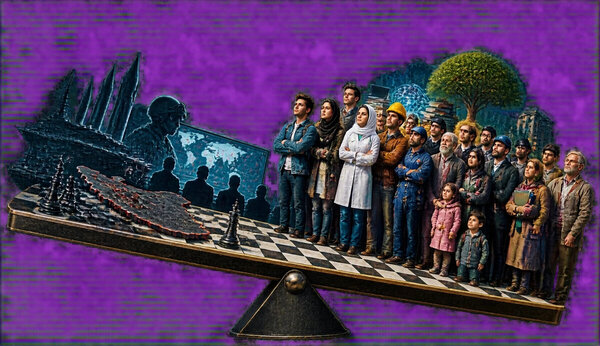
But what happened, at least so far, was different. Iran managed to shift the war from a contest focused solely on military power to a test of resilience, a battlefield where weapons are not limited to missiles and aircraft, and power is not measured solely by the scale of destruction. On this battlefield, a society's ability to maintain cohesion, keep daily life functioning, manage anxiety, rebuild hope, and prevent an external threat from turning into internal collapse becomes a strategic asset in its own right. This shift may be the most important surprise of this period.
It is important not to confuse social resilience with silence or the absence of problems within society. A resilient society is not necessarily one without protests or demands. Indeed, one of the defining characteristics of Iranian society is that, despite political and social differences, serious criticism of performance, and tangible problems in everyday life, it distinguishes between domestic issues and threats to the country's very existence.
This is the very asset that comes to the fore in moments of danger: the national interest. At such moments, Iran is not merely the name of a political structure; it becomes a common point of reference in which a large part of society, despite all its differences, sees itself. This capacity does not belong to any single political current or institution. It belongs to all the people, each of whom may have a different account of Iran's present and future, but who see the fate of Iran as a shared concern when the country itself is threatened.
Perhaps this is why so many calculations about the consequences of the war failed to match the reality of Iranian society. The expectation was that external pressure would become the central issue in Iran's domestic politics. Instead, the costs of the war gradually returned to the societies and domestic political arenas of the very parties that had instigated it. Questions about the human and economic costs, the reasons for continuing the conflict, and the responsibility of politicians became matters of public debate and political competition on the other side of the battlefield. This is the tangible meaning of a strategic reality: when the society targeted by a war denies the aggressor the ability to turn pressure into collapse, part of the cost of the war falls back on the party that started it.
Resilience: An Asset for Peace
Yet perhaps the most important question is only now beginning to emerge: what should be done with this national asset?
The greatest mistake would be to regard the people's resilience as an inexhaustible resource, as though society were obliged to bear the costs of crises time and again, only to be pushed back to the margins once the danger has passed. Resilience is the product of trust, hope, and a sense of belonging. If these foundations are weakened, no society can build its future indefinitely on the memory of past resistance alone.
Recognizing this capacity cannot be achieved merely by praising the people during wartime. Genuine appreciation means recognizing them in times of peace: listening to their demands, easing the pressures on their lives, fighting injustice, rebuilding trust, and providing opportunities for meaningful participation in determining the country's future. This is where resilience becomes not just a concept of defense, but one of development.
A society that has managed to sustain its life under the most difficult conditions and overturn the calculations of a complex war can turn that same capacity into a force for progress if it is given sufficient trust and opportunities for participation. The very society that demonstrated its ability to safeguard the country in times of danger can also become a driving force for science, the economy, technology, and development in times of peace.
The issue is not simply that the Iranian people managed to withstand pressure. More importantly, they demonstrated that Iran possesses a reservoir of social strength that has yet to be fully understood.
Perhaps this is the greatest lesson of this period: national power is not limited to what is stored in arsenals. Part of a country's strength lies in the historical memory of its people, their social bonds, their sense of belonging to their homeland, and their ability to preserve hope under difficult circumstances.
This asset served as a shield for the country during the war. In times of peace, it must also become an engine of progress.
During this period, Iran once again demonstrated that its people may disagree on many issues, but when the country's existence and future are at stake, they have a considerable capacity to turn their differences into common ground. Recognizing, protecting, and strengthening this capacity may be more important than any other lesson to be learned from these wars.
National resilience is not merely the ability to survive difficult times; it is the ability to build a better tomorrow out of those very difficult times.