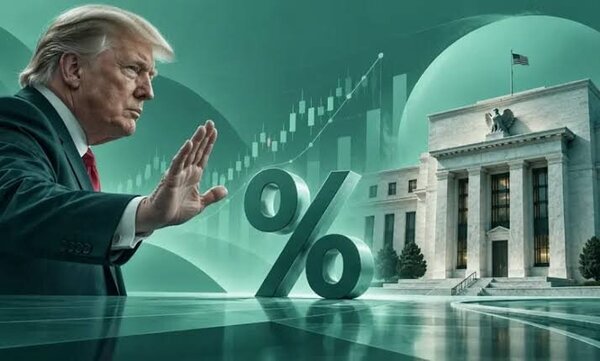
Nournews: On Wednesday, October 28, the Federal Reserve will announce its interest rate decision as the U.S. economy faces mounting pressure from energy markets, stock market volatility, high borrowing costs, and the fallout from the war with Iran. Beyond its economic significance, the decision carries political implications ahead of the November 3 U.S. midterm elections, whose outcome could affect the Republican Party’s position and Donald Trump’s ability to advance his agenda.
The central question is whether the Fed can make its decision based on its mandate to curb inflation and support employment, without yielding to pressure from the White House. Or will the conditions created by the war and the rising cost of living turn U.S. monetary policy into another factor in the electoral equation?
Trump Wants Lower Rates. What Does the Economy Say?
Donald Trump has repeatedly called for interest rate cuts and, in sharp remarks, accused Fed policymakers of ignoring the state of the U.S. economy. From the administration’s perspective, lower interest rates could reduce borrowing costs for households and businesses, stimulate demand and investment, and ease pressure on the housing market—all issues with added political significance ahead of the elections.
But lower interest rates do not automatically curb inflation. If energy prices and production costs continue to rise, monetary easing could stimulate demand at a time when supply is constrained. The likely result would be persistent price pressures and a more difficult path back to the Fed’s 2% inflation target.
Kevin Warsh, the Fed chair, has also previously stressed that interest rate decisions are not predetermined. Following the rate hike at the September meeting, markets are now waiting to see whether the central bank will pause at its October 27–28 meeting or continue tightening policy because of persistent inflation.
Oil: The Variable Complicating the Equation
The energy market is the most important external factor in this equation. At the close of trading on Friday, October 23, Brent crude rose to around $117 a barrel, its highest level since late April. Concerns about supply disruptions in the Middle East and the possibility of an escalation in hostilities were among the main drivers of the increase.
Higher oil prices affect the U.S. economy through several channels: they push up gasoline and diesel prices, raise transportation and production costs, and can ultimately feed through into the prices of goods and services. The impact is particularly tangible for households that spend a larger share of their income on essentials.
As a result, even if energy-driven inflation coincides with weakening demand in some parts of the economy, the Fed faces a difficult dilemma. Raising interest rates could ease inflationary pressure over the medium term, but it would also increase borrowing costs and the risk of slower economic growth. Cutting rates could support demand, but if the energy shock persists, it could increase the risk of inflation becoming entrenched at elevated levels.
Treasuries and Stocks: A Warning From the Heart of Financial Markets
The Treasury market is also reflecting investor concerns. On October 23, the yield on the 10-year U.S. Treasury note reached around 4.99%. At the same time, the Dow Jones Industrial Average fell 1.23%, while the S&P 500 dropped about 0.52%.
Rising long-term Treasury yields can increase borrowing costs for the government and businesses and put pressure on stocks. However, Treasury yields are not determined solely by Fed decisions. Inflation expectations, the supply of government debt, the budget deficit, and demand for safe-haven assets also play a role.
This matters all the more for Trump. Even if the Fed holds short-term rates steady, rising long-term yields could prevent mortgage rates and other financing costs from falling. The administration could therefore find itself in a situation where it wants cheaper money, while markets demand higher returns to compensate for concerns about inflation and war.
The Shadow of War Over the Elections
The more sensitive dimension of the issue is the possibility that the United States and Israel could resume attacks against Iran. Reports have emerged that military options are being considered and preparations are being made for potential strikes, but these reports do not mean a final decision has been made to launch an operation. Trump also said on October 8 that the United States would not attack Iran before the November 3 midterm elections. Nevertheless, speculation continues over the possibility of an escalation after the elections.
For markets, the issue is not simply when an attack might occur; the possibility itself matters. The greater the risk of conflict and disruptions to energy transit routes, the greater the likelihood of higher oil prices and rising insurance and transportation costs. This could intensify inflation expectations and further constrain the Fed’s room for maneuver.
Politically, the war has also become a potentially costly issue for the administration. Higher fuel prices and mounting pressure on household finances could deepen voter dissatisfaction, particularly if the administration’s promises to lower the cost of living diverge from Americans’ everyday experiences. In this context, Trump’s push for lower interest rates can be viewed as part of an effort to improve economic conditions before the elections, although interest rates alone cannot offset the effects of a major energy shock.
Wednesday’s Decision: More Than Just a Number
The upcoming meeting should not be judged solely by whether interest rates are raised or left unchanged. The wording of the Fed’s statement, along with Warsh’s remarks on inflation, energy, and the future direction of monetary policy, will also be critical.
If the central bank emphasizes the risk of persistent inflation, markets may take the prospect of tighter policy in the coming months seriously even if rates are not raised in October. By contrast, an emphasis on weak growth and easing price pressures could generate different expectations, although developments in the conflict could quickly change the outlook.
That is ultimately the dilemma facing the Fed on Wednesday: it must strike a balance between the risk of persistent inflation and the economic costs of restrictive monetary policy, while the White House grapples with electoral pressure and the consequences of war. The central bank’s independence becomes truly significant when its economic decisions do not align with the government’s political preferences.
If the war keeps energy prices elevated, even lower interest rates will not guarantee a rescue for Trump’s economy. And if the Fed continues with tighter policy to bring inflation under control, the cost of that choice could become visible before the elections—in the stock market, the housing market, and the everyday lives of Americans—making Trump’s task more difficult than ever.