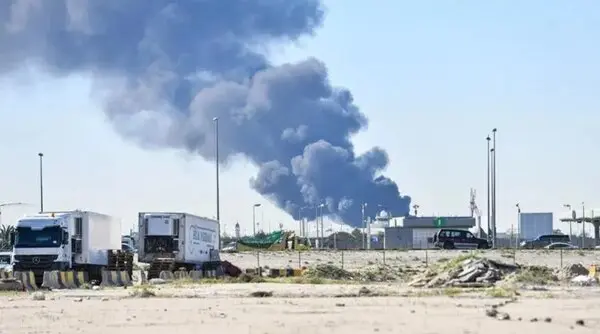
Following a deadly drone attack on one of Kuwait’s vital facilities, which claimed the lives of several Italian and Kuwaiti nationals, a media campaign emerged seeking to implicate Iran. The campaign unfolded despite unequivocal denials by Iran’s senior political and military officials of any involvement in the attack.
Available evidence and indications, coupled with the track record of the Israeli regime and Ukraine in fueling conflicts, highlight the need to investigate the possibility of a false-flag operation aimed at widening the scope of the war. These developments appear to have once again exposed the urgent need for a fundamental shift in the region’s security approach, away from foreign intervention and toward an indigenous security framework — an approach that Iran has been among the main proponents of.
Iran’s Responsible Conduct: Rejecting False-Flag Scenarios
Amid the media campaign seeking to blame Iran for the attack, senior Iranian officials adopted a clear and unequivocal position. Foreign Minister Abbas Araghchi described the incident in Kuwait, which claimed the lives of Italian nationals, as suspicious, suggesting that it could be part of a scenario designed to expand the war. He also announced Tehran’s readiness to cooperate with the two countries to establish the facts surrounding the incident.
Brigadier General Abolfazl Shekarchi, senior spokesperson for Iran’s Armed Forces, categorically rejected the accusations, stressing that Iran had conducted no military or offensive operations in the region.
The fact is that even at the height of the Ramadan War, Iran upheld the principles of good neighborliness and prioritizing relations with neighboring countries. Although regional Arab states allowed the United States and the Israeli regime to use their territory and airspace for military aggression against Iran, the Iranian Armed Forces confined their attacks to U.S. and Israeli bases, targets and interests, refraining from targeting civilians and civilian facilities in neighboring countries.
Moreover, some claims that Iranian missiles and drones had struck targets in regional countries were subsequently rejected by officials in those very countries, who attributed the incidents to malfunctions in U.S.-made Patriot air defense systems.
Against this backdrop, attributing the attack on the Kuwaiti facility to Iran is inconsistent with the country's established conduct and, above all, lends greater weight to the possibility of a false-flag operation.
Ukraine and the Israeli Regime: The Forces Behind the Drive for War
The capabilities and growing confidence of the Resistance Front are also significant in this context. From Iran and the Iraqi resistance to Hezbollah in Lebanon and the resistance movements in Yemen and Palestine, taking responsibility for operations and officially acknowledging the resulting damage have become established features of their conduct. This stands in contrast to the United States and the Israeli regime, which seek to conceal their losses and crimes through media censorship.
Kuwaiti and Italian leaders should therefore focus on establishing the facts and identifying those responsible for the incident rather than leveling accusations against Iran. A miscalculation in the face of a false-flag operation could exact a heavy toll on the region and the wider world.
More broadly, politically embattled leaders continue to see the escalation of conflict as a means of securing their political survival. Benjamin Netanyahu is lobbying and advancing baseless allegations about Iran’s chemical and nuclear programs in an effort to push U.S. President Donald Trump toward expanding the war.
On the other side, Ukrainian President Volodymyr Zelensky is concerned about growing Western support for compromise and negotiations with Russia, as any potential agreement could undermine his political standing. Ukraine’s attack on an Iranian vessel in the Caspian Sea, its strike against a Russian ship off the coast of Libya, and its attacks on Russian oil facilities — despite Washington’s official opposition — offer a telling record of Kyiv’s conflict-fueling conduct.
Against this backdrop, Ukraine’s military and diplomatic activities across the region have intensified. Reports of Saudi Arabia’s alleged efforts to purchase Ukrainian missile and interception systems, the reported presence of Ukrainian drone units in Libya, and accounts of the deployment of Ukrainian drone and loitering-munition operational networks in several regional countries — including Iraq’s Kurdistan Region, where thousands of such systems have reportedly been stockpiled — raise serious questions.
International affairs expert Marandi has also pointed to the presence of Ukrainian operational forces in northern Iraq and Syria, raising the possibility of Ukraine’s involvement in the alleged false-flag operation in Kuwait. Countries hosting such units cannot evade responsibility for the consequences of their presence on their territory.
Indigenous Security: The Only Way to Curb Foreign Intervention and Warmongering
Putting an end to this situation requires a fundamental overhaul of the region’s security strategy: moving away from imported security arrangements and foreign military umbrellas toward regional convergence and indigenous security mechanisms.
The Tehran quadrilateral meeting could serve as an effective step in this direction. The failure of the U.S. security umbrella to deliver on its promises, along with the dangerous consequences of relying on actors that fuel conflict, has become more evident than ever. Regional countries must assume their shared responsibility and lay the groundwork for lasting security — an approach Iran has consistently advocated and within which it also pursues the exercise of sovereignty over the Strait of Hormuz.
Building regional unity under the banner of Palestine in opposition to the Israeli regime, alongside developing mechanisms to end the U.S. military presence in the region, are essential components of this transformation.
At the same time, no false-flag operation can alter Iran’s strategic course. Any threat to Iran’s territorial integrity or national interests will be met with a forceful response, without geographical limitations.
Ukrainian leaders, too, must recognize this reality and refrain from testing Iran’s strategic patience — a policy that is now closely tied to deterring aggression and ensuring that aggressors and warmongers regret their actions.