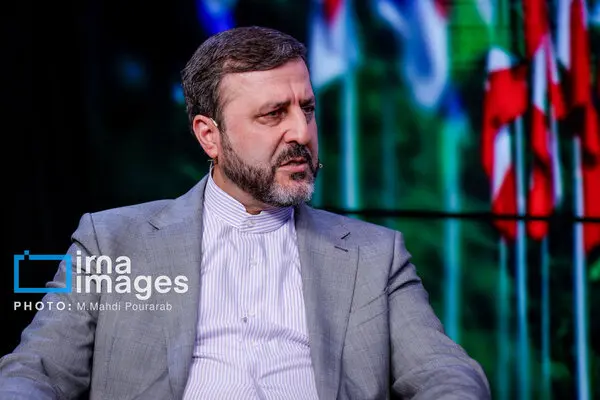
“The US has shown its bad faith at least three times over the past year and a half. This shows that the US cannot be trusted at the diplomacy table,” Gharibabadi said in a televised interview on Sunday evening.
He cited three instances: the 12-day war, which happened while negotiations were underway; the 40-day war, which also took place while talks were underway; and the Islamabad negotiations and the Memorandum of Understanding, which he said lasted at most two weeks.
No Iranian requirement removable from any deal
Gharibabadi said Iran’s key demands for a deal with the United States include a permanent end to the war on all fronts, an end to the US-imposed economic blockade, the issue of Iran’s blocked assets, and the lifting of certain sanctions, including in the oil sector.
He added that the US, after abandoning its commitments and fully annulling the Islamabad understanding, imposed new sanctions whose status must also be resolved, saying these cannot remain a new tool in Washington’s hands requiring Iran to negotiate their removal again.
Military presence, implementation timeline
Referring to the recent US military presence in the region and the timeline for implementing commitments, Gharibabadi said new military equipment and forces the US added to the region after the previous understanding are among the issues whose status must be clarified, and Washington must take practical steps on them.
He said these steps are not time-consuming: Iran’s initial plan to end the war and reopen the Strait of Hormuz was seven days, which over roughly the past two months of consultations with mediators, particularly Qatar and Pakistan, was reduced to two days.
This means the measures could be carried out within two days and ultimately lead to the reopening of the Strait of Hormuz, and the plan is now on the table, he added.
Gaps remain before talks
Gharibabadi said that given the Americans’ positions on these issues, there is still a gap before Iran can sit at the negotiating table and finalize the text of an agreement, because the US has views on implementing some of these measures within the two-day window or under the seven-day plan, and ultimately wants to postpone implementation of some of them to other times.
“These proposals are not operational from our perspective, because if even one of those issues I mentioned is not implemented at the current stage, fundamentally no understanding can be reached. Even if an understanding is formed, it would be unstable,” he said.
“We did not start the war. The Islamic Republic of Iran has fundamentally not been warmongering, and it was not us who started a war with the US or targeted US interests and bases. The war happened and we defended ourselves. We have always been in a position of self-defense.”
Iran still in a state of war
Gharibabadi said Iran faces two situations: the diplomatic path and the continuation of military threats and war conditions. Some refer to this as “neither war nor peace,” but “my personal belief is that from a legal perspective, we are still in a state of war and not in a neither-war-nor-peace situation.”
He said that if the US believes it can achieve results through military aggression, it has tested that path before, but did not achieve the result it expected and suffered heavy strategic defeats.
“The second path is diplomacy. So if the US is to move toward diplomacy, it is the US that must win the trust of the Islamic Republic of Iran.”
Sanctions ‘failed policy’
Gharibabadi said the Americans and President Donald Trump have recently announced they are no longer seeking a deal with Iran and consider economic sanctions an effective tool against Iran.
“This is nothing new, only the names change, but in reality they are the same failed policies,” he added.
The deputy foreign minister noted that Trump applied a “maximum pressure” policy against Iran in his first term but achieved nothing.
“It is true that sanctions have effects on people’s lives, but the damage imposed on the global economy, global energy markets, financial markets and the US itself is far heavier than the pressure brought to bear on Iran,” he said.