At a time when the country faces a range of security threats, economic pressures and complex external challenges, one of Iran’s most important strategic assets is cohesion at the decision-making level and public confidence in the institutions responsible for making those decisions. Under such circumstances, any statement or action that creates an image of deep and irreconcilable divisions at the top of the country’s decision-making structure carries significance beyond an ordinary political position or personal disagreement.
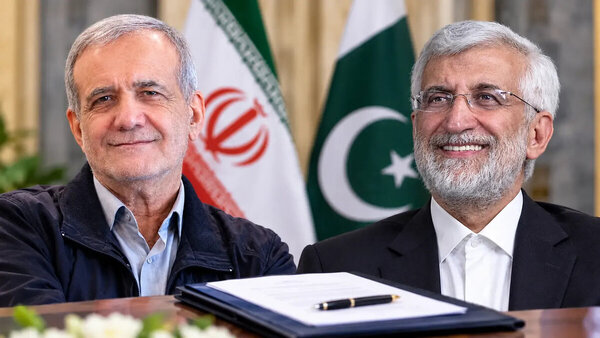
Saeed Jalili’s recent appearance on the Special News Talk program on the Khabar Network, during which he described the Islamabad understanding as a “misunderstanding”, once again brought this issue to the center of political and media debate. Referring to Trump’s dismissal of the understanding as worthless, Jalili said: “An understanding that the other side says is not even worth the paper it is written on is not an understanding; it is a misunderstanding.” He also described the logic of making reciprocal concessions to the United States as misguided.
Regardless of how defensible Jalili’s criticisms of the understanding’s contents may be, the more important issue is how these criticisms are presented and the political message they convey. The Islamabad understanding was neither a personal decision nor an initiative by a particular political faction. It was examined and decided upon within the framework of the country’s highest national security mechanisms. For this reason, particularly under the current sensitive circumstances, a distinction must be made between an expert critique of the provisions of a decision and calling into question its overall credibility and rationale.
An Understanding That Transcends Political Differences
The Islamabad understanding, regardless of its eventual implementation or subsequent US conduct, took shape at a difficult moment for the country, with the aim of halting the war, easing pressure and creating an opportunity to pursue national interests through diplomacy. Differences of opinion over the terms of such an understanding are only natural. Some provisions may be open to criticism from experts, its implementation guarantees may have been insufficient, or serious questions may be raised about the extent to which the US could be expected to honor its commitments. None of these considerations should prevent a critical examination of an important decision.
But there is a fundamental question: when an issue has been examined and decided at the highest level of national security decision-making, is it appropriate to call the decision itself into question with a term such as “misunderstanding” after the US side has breached its commitments? The US breach of its commitments first and foremost places responsibility on Washington. The fact that the other side failed to honour its obligations cannot, by itself, justify portraying Iran’s decision to pursue a diplomatic path as a miscalculation or as a failure to understand the nature of the United States.
Political and diplomatic agreements always involve risks. The art of decision-making lies in choosing among available options under complex circumstances and securing the country's interests at the lowest possible cost. A decision must also be assessed in light of the circumstances in which it was made and the alternatives available at the time, rather than solely on the basis of the outcome that emerged later. Saeed Jalili has every right to oppose any expert or political decision and express his views. Indeed, his position on the Supreme National Security Council may place an even greater responsibility on him to raise substantive criticisms. But that same position also increases his responsibility towards collective decisions and the wider consequences of his public statements.
The issue is not why Jalili opposes the Islamabad understanding. It is why criticism of a collective decision is being presented not through a focus on specific shortcomings and the proposal of an alternative solution, but through a broad, media-friendly label that could call the entire national decision-making process into question. If the Islamabad understanding was a mistake, it should be made clear which provision, calculation or implementation mechanism was flawed. If the US guarantees were inadequate, it should be explained what guarantees could have addressed those shortcomings. If pursuing diplomacy was wrong from the outset, it should be made clear what alternative path was available to halt the war, lift the blockade and secure the country's interests.
A decision taken within the country's official institutional framework cannot simply be stripped of its credibility through a brief label, while responsibility for presenting an alternative is left to others. This is particularly important because, in today's political climate, such statements quickly move beyond the realm of expert criticism and become a means of portraying divisions within the power structure. The reactions of some officials and members of parliament have also shown that the issue has moved beyond a simple difference of opinion.
Another important aspect of the matter concerns the performance of the national broadcaster. As the country's public broadcaster, the Islamic Republic of Iran Broadcasting (IRIB) naturally has a duty to provide space for different viewpoints. No national decision should be immune from expert scrutiny, and monopolizing public platforms for a single narrative does not serve society's interests. However, there is a difference between providing an opportunity for criticism and turning the national broadcaster into a platform for intensifying divisions within the country's decision-making structure.
When a member of the Supreme National Security Council appears on a widely watched program and describes as a “misunderstanding” a decision taken within the framework of the country's highest institutions, IRIB should also provide an opportunity for a thorough and comprehensive examination of the issue. The national broadcaster cannot remain indifferent to the political and social consequences of its choice of guests, program formats and the way disagreements are presented. This is especially important at a time when Iran's adversaries seize on every sign of domestic division to portray the country's decision-making structure as unstable and divided. Every expert and official has the right to criticise the Islamabad understanding, but IRIB also bears responsibility for how such disagreements are portrayed and for ensuring balance in its coverage.
US Breach of Commitments Must Not Become a Source of Domestic Division
One fundamental point must not be overlooked: the Islamabad understanding emerged as part of Iran's efforts to manage a crisis and safeguard its national interests. If the US failed to honor its commitments and subsequently rendered the understanding invalid, this should be used as evidence in criticizing Washington's conduct. But turning this experience into an arena for political score-settling among domestic officials will do nothing but weaken the country's decision-making capacity. The United States should be held accountable for breaching its commitments; the consequences of that breach should not be allowed to turn into division and mistrust among Iranian officials.
The Islamabad understanding can be criticized, its shortcomings can be discussed, and even stricter conditions can be proposed for any possible future negotiations. But a collective decision must not be allowed to become a pretext for mutual attacks among officials or for creating political divisions. Differences of expert opinion, even at the highest levels, are natural and sometimes necessary. What matters is adherence to decision-making procedures, accountability for collective decisions and preventing differences of professional judgment from turning into political and institutional rifts.
If every decision that fails to produce the desired outcome is later dismissed as a mistake, a misunderstanding or naivety, what credibility will collective decisions retain? Can officials make decisions in times of crisis if they know that any unfavorable outcome may later be used as a weapon against one another? To overcome complex crises, the country needs the courage to make decisions, the freedom to criticize them and, at the same time, respect for institutional procedures.
Today, the main issue is not who wins the dispute over the Islamabad understanding. The question is whether Iran can manage its internal differences in the face of external pressure and safeguard its collective decisions. The US breach of its commitments must not lead to a loss of trust among Iranian officials. Even if the Islamabad understanding subsequently encountered the other side’s failure to honor its commitments, it must not become a focal point for domestic division and mutual attacks. More than ever, the country needs cohesion in decision-making, transparency in accountability and responsibility in public statements. These objectives cannot be safeguarded by turning every disagreement into an open dispute over the legitimacy of the country's decisions.