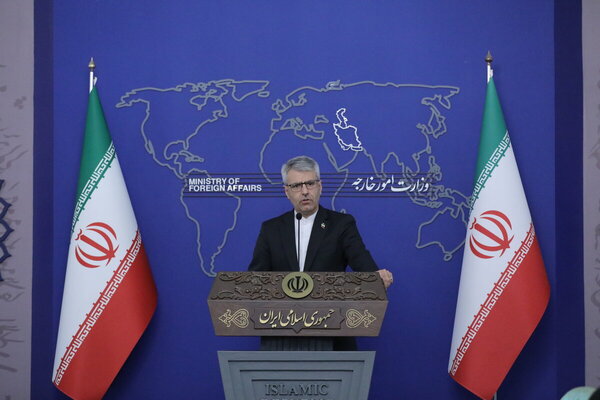
At a press conference with domestic and foreign media, Foreign Ministry spokesman Esmaeil Baghaei responded to a Nournews reporter’s question about the situation in the Strait of Hormuz, the conflicting Iranian and US accounts of maritime traffic, and reports of ships striking mines and US drones being shot down or brought under control in the country’s southern regions. He stated that, regarding the situation in the Strait of Hormuz, the General Staff of the Armed Forces and the military authorities are the competent bodies to comment, and they have already announced their positions on the matter.
Addressing reports of confrontations with US drones, he added that Iran consistently confronts intruding drones and will shoot down any drone that violates the country’s territorial airspace. This is entirely clear within the framework of defending Iran and its territorial integrity.
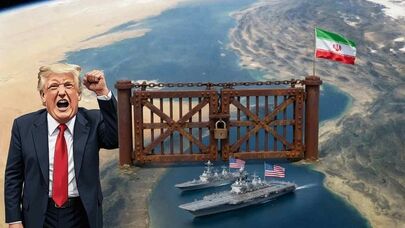
Reiterating Iran’s position on the Strait of Hormuz, Baghaei stressed that the situation in the waterway is clear. He noted that the Strait of Hormuz was open and secure before February 28, and that its current insecurity is a direct result of the US’s acts of aggression.
Regarding the conditions for ships transiting this strategic waterway, the Foreign Ministry spokesman said that vessels intending to pass through it must coordinate with the relevant Iranian authorities to ensure their security and safety.
He also pointed to the legal basis for Iran’s actions, noting that the measures taken by the Islamic Republic of Iran are based on international law and are intended to safeguard national security and fulfill the country’s responsibilities as a coastal state.
Referring to incidents involving some vessels, Baghaei stated that, unfortunately, ships that transit unsafe routes under pressure from, or influenced by, US parties are involved in accidents in many cases.
He concluded by stressing that as long as the US continues its interventionist and illegal actions, security and safety will not return to the waterway.
Iranian People’s Resistance Prevented the US Public from Being Sold the War as a Victory
Foreign Ministry spokesman Esmaeil Baghaei, responding to a question about the ministry’s assessment of public discontent in the US and the Republicans’ electoral defeat following the war against Iran, stated that the US ruling establishment’s acknowledgment that the war against Iran has caused public dissatisfaction and had far-reaching political and social consequences must be accompanied by an understanding of the message from the American people.
He stressed that what brought about this situation was not merely the US war, but also the Iranian people’s epic resistance and resilience. Had the Iranians not resisted, the US ruling establishment could have presented the war to its own public as a victory and a success. Therefore, the Iranian people are the victors in this battle.
Baghaei said that, as far as Iran is concerned, there is no difference between the political parties and factions in the US. Iran has suffered at the hands of both sides of the US political spectrum over the past 50 to 60 years. What matters is that the country's ruling establishment understands the message of the American people.
The Foreign Ministry spokesman stressed that the US ruling establishment must fully understand how costly it can be for the country to align itself with the ambitions of a warmongering regime responsible for mass killings.
He concluded by noting that the consequences of the illegal war and military aggression against Iran have not been confined to the region, but have also disrupted the global economy and international norms.
Iran Is Closely Monitoring Developments in the US Project in the Caucasus
The Foreign Ministry spokesman, responding to a question about the trilateral meeting between Armenia, the Republic of Azerbaijan and the US, and Iran’s position on the regional connectivity project, stressed that Iran welcomes the removal of obstacles to transport routes, but such projects must not lead to changes in internationally recognized borders or the region’s geopolitics.
Referring to Tehran’s concerns about the presence of foreign forces, particularly US forces, in the region, Baghaei said Iran’s concerns had been promptly conveyed to the Armenian side. In response, assurances had been given that the project would not alter borders or the geopolitical landscape, that Armenian companies would be responsible for construction, and that no US military forces would be deployed.
He added that despite its good relations with Armenia, Iran is following developments vigilantly and will clearly communicate its concerns to the relevant parties if necessary.
Ending Sanctions and Halting War Are Preconditions for Starting Negotiations; Iran’s Two-Day Proposal Remains on Table
The Foreign Ministry spokesman, responding to the US claim that Iran’s demands are unreasonable and unacceptable, stressed that Iran’s demand for an end to illegal sanctions, a halt to the naval blockade and a ceasefire on all fronts consists of reasonable demands grounded in the rights of the Iranian people.
Criticizing Washington’s position, he stated that perhaps, from the US perspective, Iranians are considered reasonable only when they give up pursuing their rights and interests. But what is unreasonable about asking the US to first lift its illegal sanctions and end the naval blockade before any negotiation process can begin?
Referring to the US attack on Iran during negotiations, Baghaei added that the US action was illegal and criminal by any international standard or norm. The country has attacked Iran twice in the middle of negotiations in less than nine months, and even the agreement reached under the Islamabad understanding lasted no more than two weeks.
Regarding Iran’s proposed plan, known as the two-day proposal, the Foreign Ministry spokesman said it remains on the table and demonstrates Iran’s goodwill. If Iran’s demands are met within two days, security will return to the Strait of Hormuz, creating the conditions for the start of a positive process and the establishment of security in the Persian Gulf region.
Iran Has Not Suspended Its Safeguards Obligations; Inspection Conducted at Bushehr Nuclear Power Plant
Esmaeil Baghaei, stressing that Iran remains a member of the Treaty on the Non-Proliferation of Nuclear Weapons (NPT) and continues to abide by its Safeguards Agreement, stated that Iran has not suspended the implementation of its obligations. However, the US and the Zionist regime’s attacks on the country’s nuclear facilities have disrupted the normal conditions for implementing safeguards arrangements.
Referring to the need for the aggressor parties to be held accountable for the consequences of their actions, he added that as long as the conditions imposed on Iran persist, cooperation under normal circumstances will not be possible.
Baghaei also criticized the positions taken by the Board of Governors and the Director General of the International Atomic Energy Agency () regarding the attacks on Iran’s nuclear facilities, saying that these positions have affected trust and professional cooperation.
The Foreign Ministry spokesman went on to announce that an inspection had been conducted at the Bushehr Nuclear Power Plant in recent days. He stressed that Iran’s mission in Vienna also continues to maintain regular and professional communication with the agency.
Regarding reports that Iran had submitted a new nuclear proposal to the US, he said that, as previously announced, Iran’s proposal remains on the table.
US Pressure Cannot Weaken the Historic Ties Between Iran and Iraq
Esmaeil Baghaei, reacting to reports of a delegation from the Iraqi presidency traveling to Tehran and Baghdad’s proposal to establish a committee comprising the foreign ministers of regional countries to hold talks with Tehran and Washington, stressed that the exchange of political, economic and trade delegations between Iran and neighboring countries is normal and should not be considered unusual.
Referring to the increased media attention given to these visits under current circumstances, he added that disruptions to flights and restrictions resulting from US actions have brought such exchanges into greater focus than before, whereas cooperation with neighboring countries has continued at various levels all along.
Regarding US pressure on Iraq to close its borders with Iran, Baghaei stressed that no matter how intense the pressure becomes, it cannot and must not weaken the deep ties between Iran and Iraq. Iran and Iraq are neighboring countries, and the people of both countries know that others come and go, but neighboring nations must live alongside one another.
The Foreign Ministry spokesman recalled Iran’s support for the Iraqi people during the period of severe UN sanctions and the US-led coalition’s attack, saying that Iran did not abandon the Iraqi people under those circumstances and stood by them.
He expressed confidence that dialogue between Iran, Iraq and other neighboring countries, based on shared interests and regional concerns, would prevail over pressure and threats originating outside the region.
Israel’s Prevention of Humanitarian Aid from Entering Is Part of Its Campaign of Genocide Against Palestinians
Foreign Ministry spokesman Esmaeil Baghaei, referring to the continuing humanitarian catastrophe in the Gaza Strip and the West Bank, stated that despite the signing of the Sharm el-Sheikh memorandum of understanding several months ago, the Zionist regime is not even honoring that understanding, which was initiated and proposed by the US.
Referring to the difficult living conditions of displaced Palestinians during the winter, he added that the people of Gaza are deprived of even the most basic necessities of life and are struggling with cold weather, rainfall and numerous other hardships. Preventing the entry of basic supplies and medicines is part of the Zionist regime’s campaign of genocide against Palestinians.