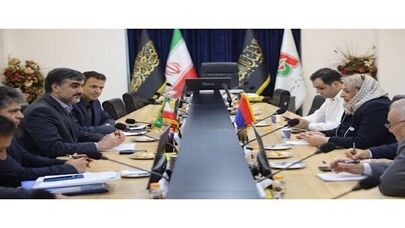
The Armenian parliament's approval of the Trump corridor agreement and the launch of trilateral working groups involving the US, Armenia, and Azerbaijan to advance the project have once again raised a strategic question in Tehran: Is Washington seeking to establish a long-term foothold in one of the most geopolitically sensitive areas bordering Iran under the guise of developing transit infrastructure?
On October 28, 2026, the Armenian parliament approved a framework agreement with the US on the project known as the “Trump Route for International Peace and Prosperity” (TRIPP), with 63 votes in favor and 32 against. A few days later, on November 7, representatives of the three countries officially began work through joint technical working groups to advance the project. The initial focus of these groups is on transportation and electricity transmission, indicating that the initiative is moving beyond political agreements toward infrastructure planning and implementation.
However, the significance of this development for Iran cannot be reduced simply to the construction of a road or railway connecting Azerbaijan to Nakhchivan. The main issue is the identity of the actor that will take charge of managing and developing this route, as well as the consequences of its long-term presence in a region that, from the perspective of Iran's national security, forms part of the country's strategic depth and is one of its most sensitive geopolitical areas. What is taking shape today in southern Armenia is not merely a construction project; it could become a platform for redefining the balance of power in the South Caucasus.
From a Transit Project to the Consolidation of US Influence in the Caucasus
Under the agreement between Washington and Yerevan, a joint company called TRIPP Development is to be established, with the US side holding a 74% stake and Armenia owning the remaining 26%. The initial cooperation period has been set at 49 years, with the possibility of extending it for another 50 years. This is therefore not a short-term investment or a limited construction contract. Rather, a framework is taking shape for a decades-long US economic and managerial presence in southern Armenia.
The fundamental point is that, in geopolitical calculations, the economic presence of major powers is never entirely separate from their security and strategic considerations. A company tasked with developing, managing, and operating transportation, energy, and communications infrastructure in a sensitive region gradually gains access to networks of information, communications, logistical capabilities, and institutional relationships. This becomes particularly significant when the US government is the company's principal shareholder.
The development of such a structure creates the conditions for establishing security arrangements, employing private security contractors, gaining access to sensitive infrastructure, and expanding the presence of American experts and institutions. Tehran's concern is not simply the possible deployment of US military forces. The issue is the emergence of a durable infrastructure of influence adjacent to Iran's borders, one that could serve purposes extending beyond its original economic objectives in times of crisis.
This concern has taken on greater significance in light of the recent military confrontation between the US and Iran during the Ramadan War. After such an experience, the long-term presence of structures affiliated with the US government in one of the country's most important border regions cannot be viewed solely through an economic lens. Washington is speaking of expanding regional connectivity at a time when its geopolitical rivalry with Iran remains one of the main components of its regional policy.
Iran-Armenia Border: Tehran's Geopolitical Red Line
The significance of these developments becomes clearer when one considers the geographical position of Armenia's Syunik Province. This region runs along the Iran-Armenia border and constitutes Iran's only direct land crossing into Armenia and, from there, access to parts of the Caucasus and routes connecting to Europe. Any change in the region's security, administrative, and geopolitical arrangements would directly affect Iran's strategic position.
For Tehran, the issue is not simply whether Azerbaijan can connect to Nakhchivan through Armenian territory. Iran is not opposed in principle to developing transportation routes or expanding regional trade. The problem begins when a power from outside the region, with a record of security and military confrontation with Iran, seeks to establish a long-term institutional and economic position near the country's northwestern borders under the cover of such a project. For this reason, a distinction must be made between regional connectivity based on the sovereignty of the countries in the region and a project whose management and direction depend on an outside actor.
On the other hand, it should not be forgotten that one of Washington's geopolitical objectives in developing new routes through the South Caucasus is to increase its role in the East-West transportation network and reduce these routes' dependence on the transit capacities of Iran and Russia. Under such circumstances, the Trump corridor could become a tool for gradually changing Iran's position in the region's geoeconomic equations, particularly if its development is accompanied by energy, telecommunications, and logistics infrastructure managed by the American company.
Statements by Iranian officials also show that Tehran is not indifferent to the project's security implications. Khalil Shirgholami, Iran's ambassador to Armenia, previously stressed that preserving Armenia's territorial integrity and sovereignty and preventing a US military or security presence in the region were two fundamental conditions for Iran's acceptance of the plan.
Reports published about the negotiations and implementation arrangements for the project have also indicated that the possibility of using private security forces to protect the infrastructure of the development company has been raised. This makes transparency about the nature and scope of such a presence all the more necessary.
Indeed, the Ramadan War should provide an important strategic lesson for Iran's foreign and national security policies: security threats do not necessarily begin with the formal establishment of military bases. Sometimes, the creation of a network of economic, communications, and logistical infrastructure under the management of a foreign power gradually expands that power's capacity to exert influence in a sensitive geographical area. Tehran therefore cannot afford to wait until an economic presence evolves into security arrangements before deciding how to respond to its consequences.
From this perspective, safeguarding the security of the Iran-Armenia border is as important to the Islamic Republic as ensuring the security of the Strait of Hormuz. Just as Tehran will not allow the security and sovereignty it exercises over the strategic waterway of the Persian Gulf to become a tool of pressure in the hands of powers from outside the region, any attempt to establish US-affiliated security and military structures near Iran's borders in the country's northwest will also meet with a serious response from Tehran. This is not a temporary diplomatic disagreement, but part of Iran's national security doctrine for preserving the geopolitical balance around the country's borders.
Ultimately, Armenia must also understand that becoming an arena for competition among powers from outside the region will not necessarily bring it lasting security. Yerevan has the right to expand its economic and political relations with the US, but that right cannot come at the expense of disregarding the security concerns of neighboring countries or altering the region's strategic balance. Iran has consistently supported Armenia's sovereignty and territorial integrity, and this support is closely linked to the security interests of both countries.
The Trump corridor becomes a national security issue for Iran when the US presence in the project goes beyond investment and infrastructure development and leads to the establishment of security capabilities and strategic influence near Iran's borders. Tehran cannot remain passive in the face of such a development, because safeguarding the geopolitics of the country's northwestern borders, just like protecting Iran's position in the Persian Gulf and the Strait of Hormuz, is one of the fundamental pillars of its national security.
The original article was first published in the Persian newspaper Farhikhtegan.