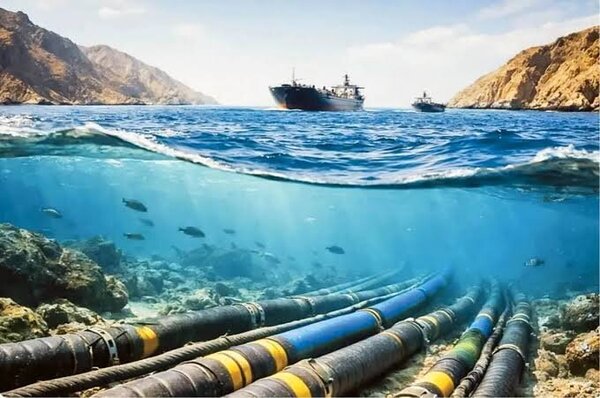
The Persian Gulf is not merely an energy transit corridor. Its seabed is also home to undersea fiber-optic cables that connect the surrounding countries to the global data network. These cables carry internet traffic, telephone calls, information exchanges, financial transactions and corporate communications. A map of regional routes shows several major systems, each with a different reach and function, that together form the Persian Gulf’s digital links with Asia, Africa and Europe.
The Gulf Bridge International (GBI) cable connects the countries along the Persian Gulf and extends through Iraq to the Mediterranean and Europe. The TGN-Gulf network is the system most widely used by financial institutions, companies and stock exchanges across the region. Any disruption to it could therefore destabilize financial and commercial communications. The FALCON network, the region’s most extensive communications system, links Arab countries through the Red Sea and also provides connections with Egypt and India.
The Asia-Africa-Europe 1 (AAE-1) cable is approximately 25,000 kilometers long and is one of the major routes for carrying data traffic. It connects Asia and Europe through the Persian Gulf. The SEA-ME-WE 5 and 6 cables also extend from France in the west to the Indian Ocean, passing through routes linked to the Persian Gulf, the Red Sea and the Suez Canal. The POI cable is a bilateral undersea link between Oman and Iran, connecting the port of Chabahar to Oman. The 2Africa cable is also identified on the map as the world’s largest undersea cable project.
Damage to a single cable does not necessarily cut off internet access in one country or across the world, as some traffic can be rerouted through alternative paths. However, the simultaneous disruption of several routes, or reduced capacity on alternative routes, can slow internet speeds, increase latency and disrupt access to foreign services. The consequences could become apparent in digital banking, interbank communications, payments, stock exchanges, cloud services, data centers, artificial intelligence, online education and communications among ordinary citizens.
Trade and transportation are not immune either. The exchange of customs documents and bills of lading, as well as coordination among shipping companies, insurers, ports and supply chains, could slow down or come to a halt. Oil and gas companies and public utilities could also face difficulties with data communications and cross-border coordination, although a cable outage in itself does not mean that energy production or exports would stop.
During periods of tension and military conflict, the severity of a crisis would depend on the location of the damage, the number of cables severed, the capacity of alternative routes and the time required for repairs. Repairing a cable requires a specialized vessel, technical equipment and safe access to the seabed. Maritime insecurity, mines or restrictions on navigation could delay repair operations and increase costs. The security of undersea cables is therefore an integral part of the region’s economic and digital security.