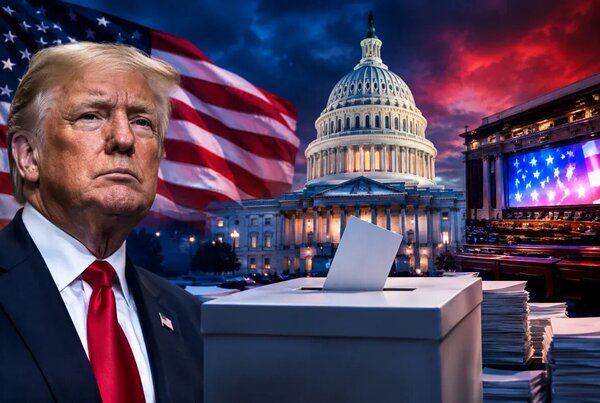
Nournews: There are now clear signs that Americans have come to recognize that the source of the dangers threatening their lives and creating psychological, social, and economic insecurity lies in Washington, not in Tehran, the Persian Gulf, or the Strait of Hormuz. This was among the most valuable outcomes of the US congressional elections.
The results of these midterm elections also offer an important lesson: money may be able to buy media outlets, enlist algorithms in its service, and even bring governments under its influence. But there is one thing it cannot permanently possess: the human conscience, experience, and will. This may be the most important lesson to be drawn from recent political developments in the United States—a lesson that goes far beyond one party defeating another and is far more significant than a shift in the balance of power in Congress.
Biden's Warning About the Rise of a Techno-Oligarchy
In the US midterm elections, Democrats managed to win majorities in both chambers of Congress, despite Donald Trump enjoying the backing of some of the wealthiest and most influential figures in finance and technology, including Elon Musk. This outcome should not be interpreted too broadly as a victory for democracy over oligarchy or as the end of billionaires' influence in American politics. Yet its important message cannot be ignored: economic and media power, even on an enormous scale, does not necessarily translate into control over the public will. The problem begins when wealth ceases to be merely a means of production and investment and instead seeks to become a force capable of determining the political destiny of societies.
In his farewell address in January 2025, Joe Biden warned of the emergence of a dangerous oligarchy built on the concentration of wealth and technological power. His warning was not simply a partisan criticism of his political rivals. Rather, it pointed to a fundamental challenge facing contemporary democracy: the unprecedented concentration of economic, media, and technological power in the hands of a small number of individuals.
In the past, industrial tycoons could exert influence over governments and economic policies. Today's oligarchs, however, have access to far greater resources. In addition to financial capital, they may own communications infrastructure, social media platforms, artificial intelligence technologies, data-processing systems, and extensive tools for understanding and analyzing human behavior. This transformation has given rise to a new form of power—one that influences not only the economy but also the production and distribution of information and even the way public perceptions are shaped.
The relationship between Elon Musk and Donald Trump should be examined in this context. During the 2024 election and the subsequent 2026 electoral contests, Musk played a role in supporting the Republican political camp by committing enormous financial resources and leveraging his media platforms. This alliance is a notable example of the convergence of technological and economic capital with political power—a development that raises serious questions about conflicts of interest, the independence of public institutions, and the limits of wealth's influence in a democracy.
Nevertheless, there is one fundamental reality that the wealthy and powerful in the technology sector should not underestimate: human society cannot be reduced to a passive mass devoid of independent will. People are not merely recipients of political messaging. They experience, compare, remember, recognize contradictions, and form judgments based on what they encounter in their everyday lives.
A social media platform may be able to direct the attention of millions of people toward a particular issue. Algorithms may place content tailored to individuals' interests and sensitivities before them. Vast wealth may profoundly influence the political playing field. But none of these capabilities guarantees that people will ultimately think and decide in the way their owners want them to.
There is a significant gap between engineering public opinion and securing lasting control over society's conscience. People may be influenced by propaganda for a time, but their lived experiences, economic hardships, sense of injustice, observations of those in power, and the gap between political promises and reality can gradually create a different picture in the public mind.
An information technology system may be capable of unleashing an uncontrollable wave of perception-shaping narratives, persuading American citizens that Iran is a global menace and a threat to the planet. But people weigh all that information against their own experience and instincts, placing it alongside what they have personally witnessed as a result of their leaders' decisions. Ultimately, they may conclude that the warmongering, populist occupant of the White House must be brought down from his position of power.
It is from this perspective that the recent US elections assume their significance. The massive financial investments made by some billionaires to preserve the Republican majority in Congress failed to guarantee the outcome they wanted. Of course, it would be wrong to claim that American voters supported Democrats solely to oppose the technology oligarchy. Electoral motivations are complex and multifaceted. But the results demonstrated that even enormous financial and media resources do not amount to ownership of the people's votes.
The Risk of a Democratic Oligarchy Reemerging
Nevertheless, perhaps the most significant analytical mistake would be to regard the election results as the end of an era or the definitive defeat of the wealth-and-technology oligarchy. An oligarchy is not a single individual, a political party, or even a particular administration. It is a power structure capable of reproducing itself.
If a billionaire fails to secure victory for a particular party, that does not mean his economic power has come to an end. If an administration changes, technological infrastructure and concentrated ownership do not necessarily change with it. If a social media platform comes under public criticism, its owner's economic and informational power may remain intact.
Indeed, the oligarchy may return after every political setback with a new face, more advanced tools, and increasingly sophisticated methods. It may shift its support from one political figure to another, move from overt propaganda to subtle information manipulation, or abandon direct influence over government in favor of controlling vital economic and communications infrastructure. In other words, a change in the parliamentary majority does not necessarily mean a change in the underlying structures of ownership and power in the United States.
For this reason, the central issue is not simply defeating a political faction at the ballot box. It is establishing lasting mechanisms to prevent the concentration of economic and technological power. These include financial transparency, antitrust measures, independent regulatory institutions, accountability for major technology companies, and safeguards for the free flow of information. Without such reforms, what has been pushed back in one election may return tomorrow through another channel.
The recent US elections are neither the end of oligarchy nor conclusive proof that public awareness has triumphed over the power of capital. They are, however, an important indication of the limits of economic power in shaping society's political will.
The elections serve as a reminder that no amount of wealth, however immense; no media network, however extensive; and no intelligent technology, however advanced, can guarantee that people will forever act in accordance with the wishes of those who own and control these instruments.
The oligarchy of wealth and technology may influence the political arena, but it cannot own the course of history, society's collective memory, or its conscience.