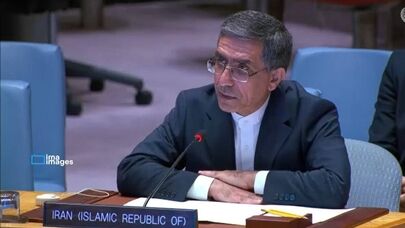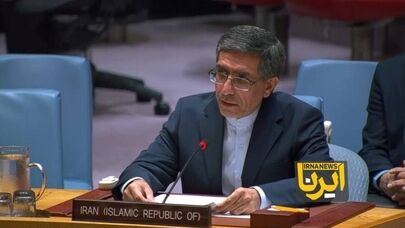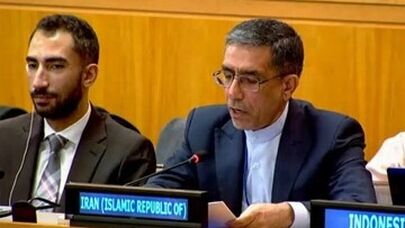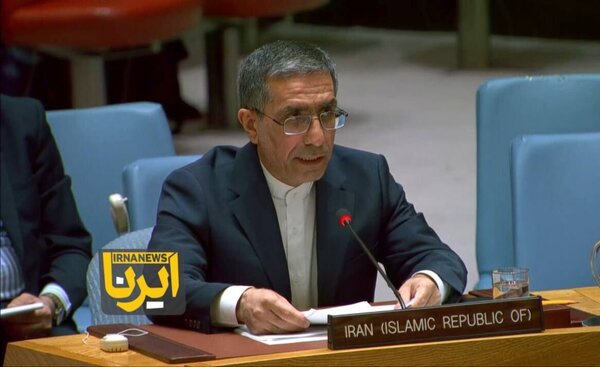
On Tuesday, Iran’s Ambassador to the United Nations addressed a UN Security Council meeting.
Criticizing Western nations regarding their response to acts of aggression against Iran, Ambassador Darzi noted that they have remained silent in the face of such aggression—which includes threats of widespread destruction, threats against civilian infrastructure, and attacks on peaceful nuclear facilities.
The Iranian envoy said that these horrific crimes demand accountability and the punishment of the perpetrators, not silence, asking why have the Western members of this Council remained silent?
The answer is simple: because the perpetrators and aggressors are their allies, and political loyalty has been prioritized over accountability and justice, he responded.
The full text of the statement by Ambassador Darzi is as follows:
In the Name of God, the Most Compassionate, the Most Merciful
Statement by
H.E. Mr. Gholamhossein Darzi
Ambassador and Chargé d'Affaires
of the Islamic Republic of Iran to the United Nations
Before the UNSC Briefing
New York, 27 October 2026
Mr. President,
At the outset, we thank Russai and China for their reaction to this illegal meeting and thanks Pakistan and Somalia for their abstention vote to the meeting.
We support the positions expressed by Russia and China and categorically object to the convening of this meeting, which lacks any valid basis.
Iran’s position is clear, consistent, and has been officially communicated to the Security Council.
Resolution 2231 expired on 18 October 2025, bringing the Security Council’s consideration of the nuclear issue under that resolution to a definitive end.
The legal effects are unambiguous: as of that date, resolution 2231 ceased to have any legal effect or operative mandate. The agenda item “Non-proliferation” was accordingly removed from the list of matters before the Council in this context.
There is, therefore, no basis whatsoever for convening this meeting under the agenda item “Non-proliferation”.
Mr. President,
Eighteen months have passed since the aggression by two possessors of nuclear-weapons against Iran, which was met with appalling indifference and inexcusable inaction of the Security Council.
The principal aggressor is itself a permanent member of this Council.
Eighteen months have passed since the betrayal of diplomacy by the United States, which twice resorted to military aggression against Iran in the midst of diplomatic negotiations.
Eighteen months have passed since the United States and the Israeli regime launched a multifaceted campaign of terrorism and coercion against the Iranian people —from armed aggression and war crimes to internal sabotage to waging media and economic warfare.
The collective punishment of a nation of 90 million through deliberate infliction of economic hardship on the entire civilian population constitutes the latest chapter of this sustained, relentless 18-month aggression.
More than 4,000 civilians, including 254 children and 251 women, have lost their precious lives in these brutal wars. They are human lives destroyed. Each of them was a life. Children are robbed of their futures, and families are forever shattered.
The massacre of 168 students and teachers in Minab, the attack on Lamerd stadium, the bombing of homes in Qeshm, and the deadly strike on a wedding in Kuhestak, Sirik are only a few examples of these heinous crimes.
These are war crimes and crimes against humanity.
The Security Council's indifference in the face of threats to annihilate a civilization, threats to use weapons of mass destruction against Iran, and threats to destroy civilian infrastructure has been astonishing— particularly in light of all the crimes that were actually committed by the aggressors during this period.
There seems to be an attempt to excuse, normalize, or render lawful deliberate targeting of civilians and civilian objects, as well as threats to use prohibited methods or means of warfare.
The most fundamental principles of international law and the Charter of the United Nations, including the core principle of non-aggression, have been flagrantly violated throughout these eighteen months by the U.S. and the Israeli regime.
Mr. President,
Since the United States and the Israeli regime launched their wars of aggression against Iran on 13 June 2025 and 28 February 2026, Iran’s peaceful nuclear facilities, under IAEA safeguards, have been repeatedly attacked.
In their war of aggression on Iran, the aggressors continued these attacks:
On 13 June 2025, Uranium Conversion Facility and the Fuel Plate Fabrication Plant
On 18 June 2025 centrifuge production sites in Tehran and Karaj were attacked.
On 19 June, the Arak Heavy Water Research Reactor was attacked.
On 21 June 2025 the President of the United States declared that” Iran's key nuclear enrichment facilities have been completely and totally obliterated”.
On 1 March: Natanz nuclear facility attacked twice.
On 17 March: A structure just 350 metres from the operational Bushehr Nuclear Power Plant was attacked.
On 21 March: Several locations within the Natanz nuclear facility were bombed.
On 24 March: A projectile struck within the wider perimeter of the Bushehr Nuclear Power Plant site.
On 27 March: The Bushehr Nuclear Power Plant site was attacked for the third time.
On 27 March: The Heavy Water Production Plant at Khondab-Arak was attacked.
On 27 March: The Ardakan-Yazd Uranium Processing Site was bombed.
Repeated attacks near the operational Bushehr Nuclear Power Plant are particularly alarming.
Such strikes create a grave risk of radiation release, with potentially devastating consequences.
These attacks flagrantly violate Security Council resolution 487 (1981), relevant IAEA decisions and resolutions, and the fundamental principles and rules of international humanitarian law.
What, then, has been the Security Council’s response to these grave violations?
It has been silence. Silence in the face of aggression. Silence in the face of threats of mass destruction. Silence in the face of threats against civilian infrastructure and silence in the face of attacks on peaceful nuclear facilities.
These atrocious crimes demand accountability, not silence.
Why do Western members of this Council remain silent? The answer is simple: the perpetrators and aggressors are their allies, and political loyalty takes precedence over accountability.
To be fair, however, the Western members of the Council have not been entirely silent.
Since Israel typically carries out their dirty job, they have chosen to direct their accusations at Iran rather than the Israeli apartheid regime or the United States.
Mr. President,
Today's meeting is yet another instance of hypocrisy that has become an integral feature of these countries' foreign policy.
Today’s meeting is an illustration of an established double standard —in which the aggressor is shielded with impunity, the victim is placed under criticism, and the language of non-proliferation is cynically appropriated to advance geopolitical objectives.
The central focus of today’s meeting must be the United States’ unlawful use of force and ongoing aggression against Iran, the attacks on its safeguarded nuclear facilities, and the continuing U.S. and Israeli threats to destroy Iran’s civilian and critical infrastructure. These acts pose a grave threat to international peace and security.
The U.S. President’s repeated threats must be taken seriously. It must be assessed and addressed in the context of the US and Israeli wars of aggression against Iran and their deliberate attacks on civilians and critical infrastructure.
Threatening to terrorize a population and deliberately destroy infrastructure indispensable to civilian survival is not legitimate political rhetoric. It constitutes grave violations of international humanitarian law, severe, potentially long-lasting humanitarian and environmental consequences, and engages further responsibility of the United States.
The United States and the Israeli regime have repeatedly demonstrated disregard for their obligations under international law, including the four Geneva Conventions of 1949 and customary international humanitarian law.
In view of the gravity and urgency of these threats, the Islamic Republic of Iran, in its letters and communications called upon the Security Council and the Secretary-General to condemn these threats to international peace and security and take immediate and appropriate measures within their respective mandates.
Regrettably, the Council continues to respond with inaction and deafening silence in the face of explicit threats against an entire nation and its civilian population.
Mr. President,
Today's meeting is a politically orchestrated attempt to construct a pretext for pressure against Iran, distort the factual record, and divert attention from the aggression committed against it.
At the very least, the Western members of the Security Council are well aware that Iran's nuclear program has never posed a threat to international peace and security.
They know very well that the nature and essence of Iran's nuclear program has always been peaceful.
Therefore, these politically motivated allegations have no bearing on Iran's peaceful nuclear activities, which have been conducted entirely within the framework of the NPT and its applicable safeguards obligations. No one should be deceived any longer by these crying wolves.
If you have genuine non-proliferation concerns, just look slightly to the west in our region.
The Israeli regime, possessing approximately 200 nuclear warheads, remains outside the IAEA safeguards and bears a record of committing all major international crimes, should be the real cause for concern.
Israel possesses nuclear weapons, yet your concern is the absence of inspectors in Iran.
Israel maintains clandestine programs for developing all kinds of weapons of mass destruction while it is party to none of the disarmament conventions —yet your concern, Western members of the Council, is the lack of inspections in Iran?
As President Pezeshkian stated in his address to the United Nations General Assembly on 24 September, and I quote: “The atomic bomb is in Israel, but the inspectors are in Iran! Israel kills, yet Iran is sanctioned! That is the tragedy.” End of quote.
What kind of non-proliferation policy is this? What kind of legal consistency allows a rogue regime in our region to possess nuclear weapons outside the NPT framework, evade meaningful international scrutiny and accountability, while Iran, a responsible NPT State Party, is subjected to relentless political pressure?
This is precisely the question that Council members should first ask themselves and put to the IAEA and its Director General as well.
If you are unable to stand on the right side of history, at least do not stand on the wrong side.
If you do not dare to defend the United Nations Charter and international law, at least do not support their violators.
If you lack courage to support the victim of an aggression, at least do not defend the aggressor.
Mr. President,
For over five decades, Iran has been a responsible party to NPT and has championed the establishment of a nuclear-weapon-free zone in the Middle East and continues to advocate for this noble objective.
Guess who has consistently opposed the establishment of a nuclear-weapon-free zone in the Middle East? The Israeli regime and the United States!
The misuse of the Security Council to advance geopolitical objectives under the guise of non-proliferation concerns is regrettable.
The politicization of the IAEA and its Secretariat, and the distortion of the non-proliferation regime to advance geopolitical objectives, is equally deplorable.
The credibility of the Security Council cannot survive such blatant double standards.
The legitimacy of the non-proliferation regime cannot be preserved through politicization.
The Security Council is not an instrument for legitimizing aggression, manufacturing allegations, or applying political pressure against the victims of aggression.
Mr. President,
The IAEA is not a vehicle for scoring geopolitical goals.
We call upon the Security Council to discharge its responsibilities impartially, to confront the threats and acts of aggression directed against Iran, and to uphold the Charter.
The choice before this Council is straightforward: uphold international law universally, or further undermine the credibility of the very international legal order it was established to protect.
I thank you.