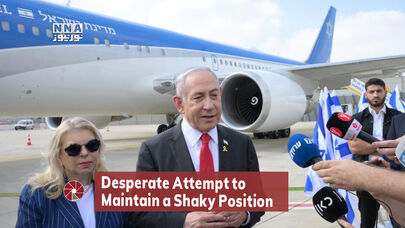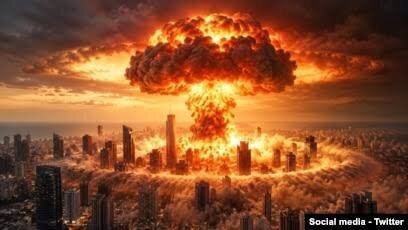
Two days before Israel’s parliamentary elections, Israeli Prime Minister Benjamin Netanyahu reposted a social media message featuring an AI-generated image of a nuclear explosion over Tel Aviv, warning voters that choosing a leader incapable of confronting Iran could expose Israel to the threat of a “second Holocaust.” In the message, he downplayed Israel’s domestic disputes in the face of what he described as the “critical mission” of confronting Iran, while pointing to the limited time remaining in Donald Trump’s presidency as an opportunity to complete that mission.
More than a security warning, the move offers a clear illustration of the electoral strategy of a prime minister seeking to tie his political future to what is arguably Israeli society’s greatest security fear.
Everything Sacrificed for Re-election
Netanyahu’s message is not solely about Iran. He is also asking voters to set aside domestic issues and make their political choices based on a terrifying vision of the future. Questions about the government’s responsibility for the October 7 security failure, demands for an independent inquiry, disputes over military service for ultra-Orthodox Haredi men, and other domestic controversies are portrayed in the reposted message as nothing more than a “smokescreen” designed to distract public attention from Iran.
In doing so, the Israeli prime minister is attempting to shift the election agenda away from his government’s record and toward an issue on which he has long claimed to possess unique experience and expertise: confronting Iran.
But why does this shift in the political agenda matter so much at this particular moment? The answer lies in Netanyahu’s own political position. Recent polls, despite differences in their projections of seat distributions and the balance between political blocs, indicate that the formation of Israel’s next government remains uncertain. Some polls put Netanyahu’s bloc at around 48 to 51 seats, while others project a stronger position for his camp.
The election outcome, therefore, cannot be taken for granted. Yet the difficulty of securing a majority of 61 seats and the need to build a governing coalition have increased the political pressure on Netanyahu.
The situation becomes even more sensitive when street protests and demands for accountability over the October 7 security failure are taken into account. A protest in Tel Aviv on October 24, calling for a state commission of inquiry into the failure, demonstrated that questions about the government’s political responsibility remain central to the electoral contest. Independent sources put attendance at more than 100,000 people. Netanyahu’s opposition to establishing an independent commission has not prevented the demand from remaining a prominent issue in Israeli public and political debate.
Against this backdrop, emphasizing the Iranian threat serves a dual purpose. On the one hand, Netanyahu is seeking to mobilize Israeli voters’ security concerns to his advantage. On the other, he is attempting to push questions about the government’s responsibility and his own performance to the margins.
When an election is reduced to a choice between “survival” and “annihilation,” there is little room left to scrutinize the government’s record, demand accountability for past failures, or assess alternative political options.
From Claims of Military Victory to Nuclear Warnings
One notable aspect of Netanyahu’s message is his reference to the time remaining in Trump’s presidency as a limited window of opportunity to, in the original author’s words, “finish the job in Iran.” This emphasis makes the connection between Netanyahu’s security strategy and Washington’s support more explicit.
Netanyahu is not merely portraying Iran as an existential threat; he is also suggesting to voters that seizing the current opportunity requires a prime minister who can maintain a close and direct relationship with Trump. In this narrative, ties with the US president become part of the election campaign, as though Israel’s security in the face of Iran depends above all on the continuation of the personal relationship between Netanyahu and Trump.
However, the most important question raised by Netanyahu’s latest message is not simply his electoral use of the Iranian threat. It is the gap between his earlier claims of military success and his current warnings.
Netanyahu has repeatedly claimed that US and Israeli strikes destroyed or severely weakened Iran’s nuclear program. Yet he has now reposted an image of a nuclear explosion over Tel Aviv and warned of a “second Holocaust,” once again placing the danger of Iran acquiring nuclear weapons at the center of public attention.
The contrast between claims of military victory and warnings of an existential catastrophe raises serious questions about the extent to which the stated objectives of the strikes have been achieved and how Netanyahu actually assesses the current situation.
If Iran’s nuclear program has been weakened to the extent claimed by the Israeli prime minister, why invoke the prospect of Israel’s nuclear annihilation so forcefully on the eve of an election? Does the warning reflect a new assessment of the security situation, or is it an attempt to return the Iranian threat to the top of the electoral agenda?
The timing of the message, the way the threat is framed, and the effort to link Israel’s security to Netanyahu’s re-election all suggest that the warning cannot be analyzed separately from domestic political competition.
From this perspective, the amplification of the Iranian nuclear threat should be examined in the context of the political exploitation of a longstanding strategic concern. The image of a nuclear explosion over Tel Aviv confronts viewers not with a technical, evidence-based assessment of Iran’s nuclear status, but with a depiction of a potential catastrophe.
The use of such an image in the final days of an election campaign illustrates how a security concern can be presented in its most extreme and fear-inducing form to influence voter behavior.
In this context, remarks by former US President Barack Obama during a recent campaign speech in Ohio are also noteworthy. Defending the 2015 nuclear deal, Obama recalled that the agreement had provided a diplomatic means of preventing Iran from acquiring nuclear weapons by restricting its nuclear program and establishing monitoring mechanisms—a path that, he argued, did not require firing a missile.
This experience highlights an important distinction: preventing Iran from acquiring nuclear weapons, assessing the actual capabilities of its nuclear program, and claiming that Israel faces an imminent threat of annihilation are three related but distinct issues that should not be conflated. An image of a nuclear explosion is not, in itself, a substitute for technical evidence about the status of Iran’s nuclear program.
Israel’s Security or Netanyahu’s Political Survival?
It should not be forgotten that Israel’s security concerns over Iran’s nuclear program have long been a feature of Israeli policy and cannot be explained solely by domestic political competition. The central issue at this juncture is the timing, intensity, and framing of those fears—particularly when Netanyahu links the election of his rival to the possibility of Israelis’ physical destruction and dismisses domestic disputes as insignificant distractions.
From this perspective, a prime minister facing demands for accountability over October 7, protests by opponents, legal cases, and a difficult struggle to assemble the next governing coalition is attempting to place all these questions under the shadow of a greater threat. His insistence that political opposition to him should not stand in the way of choosing a leader capable of confronting Iran reveals how deeply his own political future has become intertwined with the electoral battle.
It is clear that Netanyahu’s latest message is about more than Iran; it is also about Netanyahu himself. He is seeking to convince voters that Israel’s security and his continued leadership are inseparable, as though his departure from office would, in itself, close the window of opportunity to confront Iran.
This is where a strategic issue becomes a tool for political survival. Netanyahu is attempting to present himself not merely as an election candidate, but as the only reliable option for guaranteeing Israel’s security.
Although Israel’s major political forces broadly share their opposition to the Islamic Republic of Iran, Netanyahu is seeking to elevate the Iranian threat to such an extent that the distinction between himself and his rivals becomes a matter of existential importance. In this framework, the issue is not simply opposition to Iran, but the claim that only he can bring the confrontation to the outcome Israel seeks.
The issue is not whether the Islamic Republic of Iran has plans to retaliate against Israel or whether security concerns in this regard exist at all. Rather, at a time when Netanyahu’s prospects of securing a parliamentary majority remain highly uncertain, he is attempting to establish a direct link in voters’ minds between Israel’s survival and their choice of him as prime minister.
The strategy depends on amplifying the Iranian threat and presenting it as an existential danger that, supposedly, only the continuation of Netanyahu’s leadership can counter.
The more uncertain Netanyahu’s domestic political position becomes, the greater the electoral value of linking Israel’s future to confrontation with Iran. In this sense, the increasingly forceful warnings about Iran in the final days of the campaign reflect not only security concerns, but also Netanyahu’s efforts to turn those concerns into political capital.
The Iranian threat may constitute a genuine element of Israel’s security calculations. Yet the way it is being deployed in the election campaign suggests that it is simultaneously serving as a tool to reshape the public agenda, ease pressure for accountability over the government’s record, and bring security concerns, electoral competition, and the struggle to retain political power into a single political narrative.