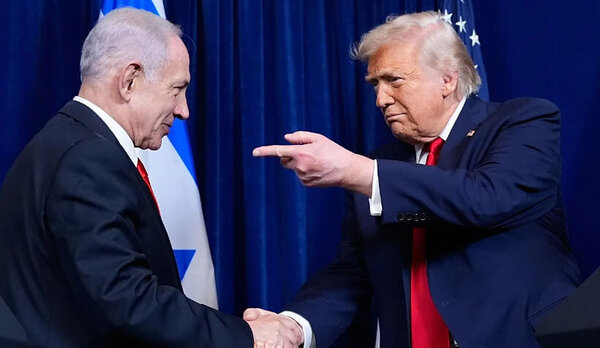
Nournews: Donald Trump’s open endorsement of Benjamin Netanyahu ahead of Israel’s election, as the U.S. president grapples with the political and economic consequences of the war with Iran and mounting electoral pressure at home, raises a question that goes beyond the close relationship between Washington and Tel Aviv: Could Trump’s support for Netanyahu’s electoral victory be accompanied by an expectation of a new military achievement against Iran—one that could shift the political climate in the U.S. president’s favor before the midterm elections?
This question lies at the heart of a hypothesis put forward by Danny Citrinowicz, the former head of the Iran branch of Israeli military intelligence, who has expressed concern over Trump’s recent remarks. Citrinowicz has suggested that Netanyahu may have offered to launch another joint military operation against Iran in exchange for the U.S. president’s political support. Although there is no evidence so far that such an agreement actually exists, examining its possible political and strategic logic could shed new light on current developments.
Two Elections, One Possible Calculation
In a recent message, Trump described Netanyahu as a courageous leader and a great partner in confronting the Islamic Republic, stressing the need to complete operations against Iran. Coming ahead of Israel’s election, this statement amounts to more than an expression of support for a foreign ally. It could help reinforce a narrative portraying Netanyahu as the guarantor of Israel’s security against the Iranian threat and a leader with Washington’s direct backing.
The significance of this support for Trump, however, may extend beyond the outcome of Israel’s election. The U.S. president is approaching the November 3 midterm elections, the results of which could reshape the balance of power in Congress and affect his administration’s ability to advance its agenda.
Under these circumstances, the war with Iran has become a major test of the U.S. administration’s performance. Economic costs, pressure on household budgets and concerns that the conflict could drag on have fueled public questions about the war’s ultimate gains and whether they justify the price already paid.
In this climate, securing an outcome that Trump could present as a decisive victory could carry significant political value. This is where the possibility of a connection between the two elections emerges: Trump could help strengthen Netanyahu’s electoral position, while Netanyahu, by helping pave the way for a military achievement against Iran, could assist Trump in rebuilding his political standing in the United States.
This is the possible logic behind a win-win deal—a scenario in which two leaders who launched a war promising victory over Iran, but have so far failed to achieve their stated objectives, could derive different political benefits from a shared development.
What Could Netanyahu Offer Trump?
Under this hypothesis, Netanyahu would not simply be a beneficiary of Trump’s support; he could also play an active role in the U.S. president’s political calculations.
If Netanyahu wins Israel’s election, Trump could portray the outcome as evidence of the success of his relationship with Washington’s key regional ally. But a more consequential gain for him could come on the military front: an outcome against Iran that could be presented as proof that the war’s objectives had been achieved and that the United States had secured a strategic advantage.
If such an outcome materialized, it could give Trump an argument against critics who regard the war as costly and lacking a clear result. He could claim that the sacrifices and expenses had ultimately produced a tangible achievement.
For Netanyahu, a new military operation could also be incorporated into his government’s security narrative, which emphasizes the need for continued confrontation with Iran and the importance of his leadership in that effort.
Nevertheless, a distinction must be drawn between this possible political logic and the existence of an actual agreement. Trump’s remarks and Citrinowicz’s hypothesis alone do not establish that Netanyahu has pledged to launch a new military operation or that Trump’s electoral support is conditional on such a commitment.
Trump’s Contradiction: Escaping a Crisis by Escalating It?
The most significant issue in this scenario is the contradiction embedded in Trump’s possible calculations.
If the war with Iran has become a political liability for the U.S. administration because of its economic and cost-of-living consequences, reducing tensions and reaching a lasting agreement would logically help ease the pressure. But if the Trump administration cannot present the results of previous operations as a victory, the temptation to secure a new military achievement could grow.
In that situation, a war whose costs have become an electoral problem could turn into an instrument for trying to solve that very problem—a cycle that could intensify the crisis rather than bring it to an end.
The achievement Trump needs, however, would not necessarily have to be military. He could also present a diplomatic agreement, a reduction in tensions or a limited outcome as a success. But if decision-makers conclude that only a major military victory could change the political climate, the risk of electoral calculations becoming entangled with security considerations would increase.
This matters because there is no guarantee that a new military operation would produce a limited and controllable outcome. Iran’s response, the potential expansion of the conflict and the consequences for energy markets could impose further costs on the U.S. and regional economies—precisely the kind of consequences Trump is already under pressure to manage.
War as an Electoral Tool
Against this backdrop, Trump’s remarks should be examined within a broader context. On the one hand, he is helping strengthen Netanyahu’s electoral position; on the other, he is insisting that operations against Iran must be completed at a time when his administration faces serious questions about the war’s results.
The timing of the Israeli and U.S. elections does not, by itself, prove that a deal exists. It does, however, raise the question of whether the two leaders’ electoral interests could converge in a way that increases the likelihood of military confrontation.
Assessing this hypothesis requires examining subsequent military developments, the two sides’ official positions and any potential evidence of new coordination. Changes in the war’s stated objectives, indications that preparations for another operation are underway, or independent information about reciprocal commitments could help clarify the issue.
Could Elections Become a Catalyst for War?
Citrinowicz’s hypothesis, although still unproven, raises an important strategic question: Are Trump’s support for Netanyahu and his possible need for a pre-election achievement in the United States linked through a shared political calculation?
Under this scenario, Netanyahu would benefit from Washington’s political backing to strengthen his position in Israel’s election, while Trump would hope to secure a military outcome against Iran that he could present as a victory for his administration.
The greatest danger emerges when war is managed not on the basis of an independent assessment of threats and security objectives, but as a tool for compensating for leaders’ electoral weaknesses. Under such circumstances, what counts as a political gain for one leader and an electoral success for the other could plunge the region into another cycle of instability.
The issue now is not simply whether Trump is helping Netanyahu win or whether Netanyahu is benefiting from Trump’s support. The more consequential question is whether both leaders, by pursuing such a course, would factor the costs of a new war into their calculations—and risk pushing their own political positions into an even deeper crisis than the one they already face.