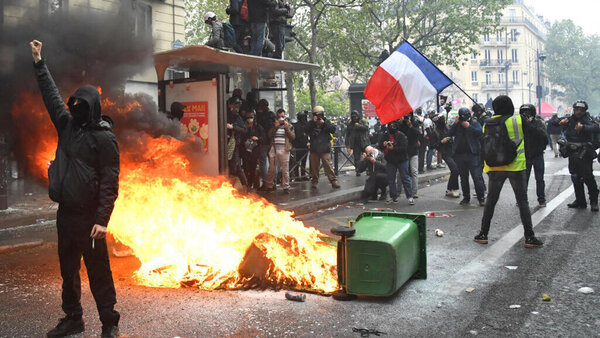
On Saturday, the streets of France witnessed one of the largest waves of protests in recent years. Hundreds of thousands of people took to the streets in cities across the country, more than 1,000 people were arrested, and dozens of police officers were injured. What makes the French protests particularly significant this time, however, is not merely the intensity of the clashes. Similar signs of discontent leading to social unrest are emerging simultaneously in Italy, Belgium, Portugal, Germany and even Albania. The underlying issues, ranging from the cost of living and housing to education and wages, may appear different on the surface, but at a deeper level they raise a common question: Why has the quality of life of European citizens fallen short of what they expect from their economic and political systems?
It may be a mistake to view what is happening across Europe these days as merely a series of scattered protests against rising prices or austerity policies. It is still too early to speak of a single, pan-European protest movement; the demonstrations in each country have their own distinct political and social roots. Nevertheless, the timing of these protests and the considerable overlap in their demands suggest that Europe is facing a shared problem, one that began in the economic sphere but is now extending into politics and public trust.
France is the most prominent example. The recent protests began with demands from school and university students over conditions in educational institutions, but they soon became linked to the cost of living, purchasing power, public services and the government’s austerity budget. Trade unions, workers and supporters of the Yellow Vest movement also joined the protests. This social composition is more significant than the number of demonstrators because it shows that groups whose demands do not necessarily overlap under normal circumstances have now converged around a common concern: the cost of living has risen, but incomes and the quality of public services have not kept pace.
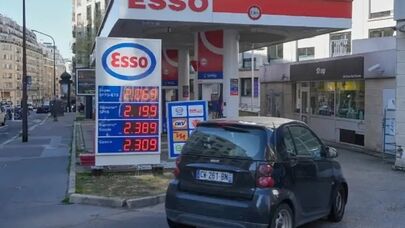
This is where a distinction must be made between “rising prices” and a “cost-of-living crisis.” Rising prices are an economic issue. But when citizens feel that, despite working, paying taxes and trying to maintain their standard of living, they still cannot afford adequate housing, a good education or a predictable life for their families, the issue enters the political sphere. The question is no longer simply why prices have risen; it is why the political system cannot create conditions that allow citizens to plan for their future. This shift in the question is precisely where an economic crisis can turn into a crisis of trust and legitimacy.
Developments in Portugal, Italy and Belgium are also significant from this perspective. In Portugal, the housing crisis has become one of the main sources of public discontent. Sharp increases in rents and property prices, particularly in Lisbon and Porto, have placed young people and the middle class under pressure. Protest tents in the streets of Lisbon are more than an image of political dissent; they reflect a society in which a segment of the younger generation feels that even having a job no longer guarantees access to adequate housing.
In Italy, too, the cost of living, education and purchasing power have become intertwined. In Belgium, rising education costs and university reforms have sparked student protests, but the demands have quickly expanded to encompass broader social issues. Even in Germany, which remains more economically stable in many respects, student protests over educational opportunities have become linked to economic concerns and the future of the pension system.
It would therefore be inaccurate to say that all these protests are the same. But it is fair to say that different crises are generating a shared sentiment: the feeling that everyday life is falling behind the expectations European citizens have of their governments, their economies and their futures. This may be more significant than the street violence itself.
Over the past several decades, Europe built a relatively clear social contract: citizens pay taxes and abide by the law, while the state guarantees welfare, education, health care, social security and opportunities for advancement. This contract was one of the main foundations of Europe’s political stability. Today, however, a considerable segment of society feels that this arrangement no longer works as it once did.
As a result, European governments face a serious contradiction: society demands more public services and broader social protection, but governments lack sufficient resources to provide them and, in many cases, are compelled to cut spending. This is where a classic governance deadlock emerges. The government says it lacks the resources; society responds that it can no longer bear the cost of the government’s resource shortages. If the government spends more, the debt crisis deepens; if it cuts spending, social discontent grows. This situation confronts Europe with a problem that goes beyond budgets: How can the social contract be redefined when economic resources have become more limited?
The experience of France’s Yellow Vest movement is an important example of this trend. The fuel tax increase introduced in 2018 appeared, on the surface, to be a limited economic measure. Yet it became a symbol of perceived social injustice and triggered protests that went far beyond the original issue. Today, a combination of pressures, ranging from housing and wages to education and public services, is creating similar conditions.
But the problem is not confined to France. If similar grievances persist simultaneously across several European countries, the European Union will face a challenge greater than the sum of its national crises: a social crisis of the European model of governance. This does not necessarily mean the collapse of the European Union or its political systems. Europe still has powerful institutions, major economies and substantial governance capacity. But no political system can remain stable through economic strength alone. Stability depends on whether opportunities are perceived to be distributed fairly and whether citizens believe in their future. The main danger facing Europe is not the fires in its streets, but the gradual erosion of trust.
What is visible today in the streets of Paris, Milan, Lisbon, Brussels and other European cities appears, on the surface, to be a series of slogans, clashes, fires and police confrontations with protesters. At a deeper level, however, a much more serious question is taking shape: Can Europe still guarantee the same level of prosperity, social security and opportunities for advancement to the next generation that it promised over the past several decades?
Europe’s current crisis may have begun in the economy, but if no adequate response is found, it will ultimately reach the political sphere. The most dangerous stage comes when citizens lose faith not only in politicians but also in the future those politicians promise. At that point, the issue is no longer simply a street protest; it concerns society’s relationship with the political order itself.