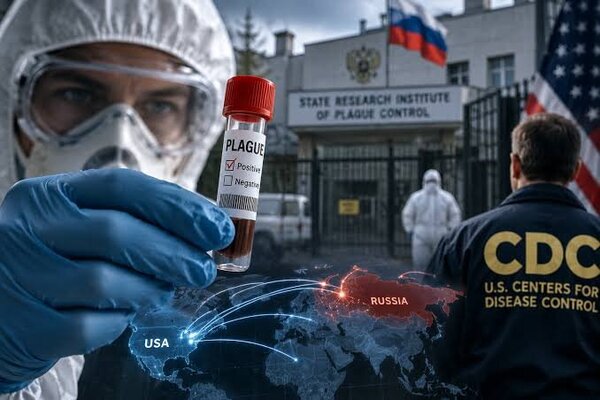
The death of a 28-year-old employee at Russia’s Irkutsk Anti-Plague Research Institute remains medically and causally unclear. But something more significant than the incident itself is now taking place: the term “biological weapon” has entered the case with notable speed.
This is despite the fact that no independent evidence has yet been released showing that the incident resulted from the production, testing or use of a biological weapon. Even US President Donald Trump, responding to a journalist’s question about whether the plague in Russia could be a biological weapon, said: “We don’t think so. We’ll find out very soon.” He also referred to Russia’s position that the situation was under control.
On the surface, Trump’s response rejects the biological-weapons claim. But the question itself carries an important media message.
When a journalist asks the US president about a possible link between a medical incident in Russia and a “biological weapon,” the concept enters the news frame before it has been proven. From that point onward, the audience is hearing not only about a death at a research facility, but also about the possibility of a “Russian biological weapon.”
This raises the fundamental question: Why was the issue of biological weapons introduced in the first place?
At a research facility that works with pathogens, investigating the possibility of contamination, laboratory error, a safety breach or even the release of a pathogen is entirely logical. Such investigations are part of biosafety requirements. But a laboratory incident is not the same thing as a biological weapons program.
To turn a medical or laboratory incident into a biological-weapons case, there would need to be evidence of military intent, the production or stockpiling of weapons, an organized program, or the use of a pathogen as a weapon. No such evidence has so far been presented regarding the Irkutsk incident.
Nevertheless, the political environment between Russia and the West is already conducive to such a connection.
Washington has for years accused Russia of maintaining offensive biological capabilities, while Moscow has rejected those accusations. The Ukraine war, meanwhile, has seen one of the most serious media disputes between Russia and the US over biological laboratories. Now an incident has occurred inside Russia, at a research facility associated with plague, and it is natural that the history of this dispute would once again return to the media spotlight.
But this is precisely where a distinction must be made between “background” and “evidence.”
The history of the Soviet biological program or US accusations against Russia does not, by itself, prove that the Irkutsk incident was part of a weapons program. Likewise, the fact that a research facility is exposed to pathogens does not mean that it is producing weapons.
In fact, what has now become important is not only the nature of the incident, but also the process of constructing a narrative around it.
A suspicious death;
a sensitive research facility;
uncertainty over the cause of illness;
a question about biological weapons;
the US president entering the discussion with his response;
and then a return to the longstanding case of Russia’s biological programs.
This chain, even without any individual link proving the existence of a biological weapon, can produce a security narrative.
More importantly, in information warfare, the question itself can sometimes be part of the process of creating a news narrative. Trump’s answer may be “no,” but a media headline can still be built around “Russian biological weapons.” In this way, a concept that was previously a hypothesis or possibility gradually enters the audience’s news memory. The important question here is: Why should an incident whose exact cause remains unclear so quickly be defined within the framework of “biological weapons”?
This question becomes even more significant when we consider that the conflict between Russia and the West is not being fought solely on the military battlefield. A significant part of it is unfolding in the arena of narratives, public perceptions and the definition of threats. In such an environment, an ambiguous incident can quickly be interpreted through the framework of previous disputes.
From this perspective, the Irkutsk case is still less a proven biological-weapons case than a test of how security narratives take shape amid the Russia-West conflict.
Yet one media reality has already emerged: before it was established that the Irkutsk incident involved a biological weapon, the phrase “biological weapon” had already become part of a journalist’s question to the US president.
And perhaps that is the central question: Did evidence of a biological-weapons program emerge first, followed by questions about it, or was an ambiguous incident first placed within the “biological weapon” frame, with the evidence needed to support that narrative now being sought?
The answer to that question could determine whether Irkutsk is merely a medical incident or the beginning of a new chapter in the war of narratives between Russia and the West.