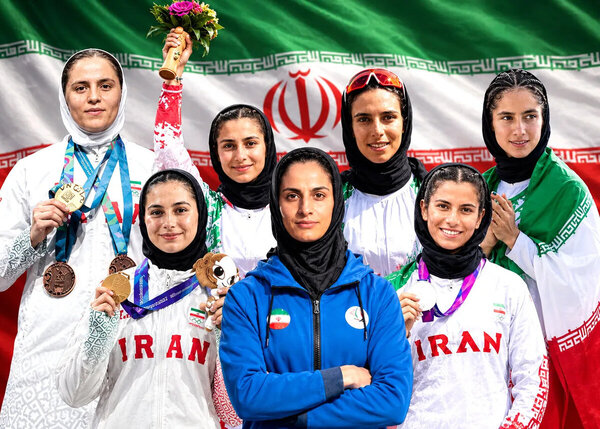
Three gold medals in a single edition take on greater significance when placed alongside the history of Iranian women’s participation in the Asian Games. Before the Nagoya Asian Games, Iranian women had won a total of four Asian Games gold medals. In this one edition alone, three more golds were added to that tally. Saghar Moradi won gold in taekwondo, while Fatemeh Mojallal and her rowing teammate also took gold. Alongside them, Iranian women athletes in several other sports won their first-ever historic medals. Three gold medals in one edition amount to 75 percent of all the gold medals Iranian women had won across every previous edition of the Asian Games.
But Nagoya’s significance goes beyond this figure. In the overall performance of Iran’s delegation, women won medals in several sports where there had previously been no such achievement. Women’s weightlifting secured its first historic medal, Iranian women won a team medal in kata, and a historic medal was also won in athletics. In other words, this is not simply a matter of increasing the medal tally; the scope of women’s participation in elite sports in Iran is expanding.
Placing this alongside the results of the 1405 university entrance exam paints an even more striking picture. In the arts group, all five top rankings went to female students. In foreign languages, four of the top five rankings belonged to girls, while in the humanities, girls accounted for a significant share of the top rankings. On one side, Iranian girls and women have stood on Asian Games podiums; on the other, in a completely different arena, they have ranked among the top performers in one of the country’s most important educational examinations.
The distance between these two arenas is considerable. One is elite sports, while the other is education and academic competition. But their common denominator cannot be overlooked: a generation of Iranian women and girls is demonstrating capabilities that can no longer be defined as peripheral to the country’s social developments. Iran’s problem today is not a shortage of female talent. That talent has been demonstrating itself for years in universities, research, medicine, education, the arts, sports, entrepreneurship and many other fields. The more important issue is how to turn this talent into an asset for Iran’s development.
In fact, Nagoya can be viewed from this perspective not merely as a sporting success, but as a “social data point.” When women achieve championship victories in a sport in which Iran had previously won no medal, when they rank at the top of academic competitions, and when they are increasingly present in specialized and professional fields, the message is not simply that society should applaud them. It means that national policymaking must incorporate this change into its calculations.
The issue of women is no longer merely a women’s issue; it is an issue of Iran’s development capacity. This is important because, in today’s world, development depends more than ever on human capital. Natural resources, geographic position and even financial capital cannot produce sustainable development without capable human resources. Countries need all of their talent to compete economically, scientifically and technologically. If half of a society’s educated, skilled and capable population cannot participate in the economy, science, culture, management and decision-making in line with its potential, part of the national capital effectively remains unused.
Iran is no exception. In fact, given demographic conditions, the need to increase productivity, the migration of part of the skilled workforce, the need to develop a knowledge-based economy and the economic challenges ahead, making use of all of the country’s human potential has become even more important. From this perspective, the issue of women should not be explained solely in legal or cultural terms. It is also an economic and developmental issue.
For years, investment has been made in expanding girls’ education, developing universities and training skilled women. The result is before our eyes today. Girls who rank at the highest levels in academic examinations go on to become doctors, engineers and researchers, win historic medals in elite sports, and make their mark in cultural, artistic and professional fields. This human capital was not created overnight; it is the product of decades of expanding education and social change.
It is therefore natural that the next stage of development should not simply be an increase in the number of educated women. The next stage must be turning this education and talent into social, economic and managerial roles. This is precisely where policymaking must align itself with changes in society. In recent years, steps have of course been taken to increase women’s participation in certain managerial, political, social and sporting fields. In women’s sports, the development of infrastructure, the formation and strengthening of national teams, and the increased international presence of female athletes have also created conditions for talent to emerge, the results of which we are seeing today in Nagoya. This experience shows that when opportunity and planning are combined with talent, the result can go far beyond expectations.
The reality is that Iranian society has moved far ahead in this area of many longstanding assumptions. An Iranian girl today is not striving merely to enter university or obtain a degree. She wants to be a professional athlete, a researcher, a doctor, an artist, a manager, an entrepreneur and an active participant in emerging fields of technology and the economy. This change cannot simply be created by decree, nor can it be stopped by decree, because a significant part of it is the product of profound social, educational, technological and generational transformations. The central issue for governance, therefore, is to address this transformation as a social reality.
The sooner policymakers accept this reality and establish clear, legal pathways that are consistent with the country’s needs, the greater the opportunity to turn this social transformation into a development asset. Conversely, if the gap between women’s capabilities and the opportunities available to them to play a role continues to widen, the country will face an imbalance: a generation far more capable than those before it, but with capabilities that do not necessarily have the opportunity to emerge to the extent of its talent. And this is not merely a women’s issue; it is an issue of national productivity. The question, however, is whether the country’s social and economic structures are ready to make use of this capital.
The answer to this question is highly important, because women’s new roles in Iran are not shaped solely by decisions made by those in power. Society is moving along its own trajectory. Education, technology, urbanization, changes in family structure, rising age at marriage, university education and transformations in the labor market are all redefining women’s roles. Iranian women will therefore take on new roles in the years ahead, whether this process is accompanied swiftly and willingly by policymakers or policymaking eventually catches up with these changes after a delay.
The prudent approach for governance is not to prevent this transformation, but to understand it and turn it into an opportunity. Development-oriented governance sees women not merely as subjects of policymaking, but as part of the capacity for policymaking and development. Rather than viewing the success of a female athlete or student simply as an individual achievement, it should look at the human capital behind that success and consider how it can be harnessed on a larger scale.
In this sense, the three gold medals in Nagoya are not merely three medals. Just as the top rankings achieved by girls in the university entrance exam are not merely a handful of rankings, these are signs of a change in the structure of Iran’s human capital. Medals will eventually be removed from display cases, and records will eventually be broken. But if one lasting lesson is to remain from Nagoya, it should be this: Iran can no longer speak about its women merely as recipients of policies; women themselves are part of the force shaping Iran’s future.
The issue today is no longer whether Iranian women “can” or cannot. They have answered that question time and again in classrooms, universities, laboratories, stadiums and arenas of competition. The question today is whether social, economic and governance structures can adapt themselves to this new reality. Iran needs all of its capable women and men for development; and perhaps one of the most important requirements for development in the coming decade is to turn “women’s ability to achieve” into “women’s participation and contribution.”