The United Arab Emirates should no longer be categorized in Iran’s strategic calculations simply as a southern neighbor, a trading partner or one of the members of the [Persian] Gulf Cooperation Council. In recent years, Abu Dhabi has gradually assumed a different position in the region’s security architecture, one in which close ties with Washington, strategic cooperation with Tel Aviv, its role in energy and shipping networks, and its geographic proximity to Iran have become interconnected. The 40-day war made this shift more apparent, while the June 17 case, the Salalah affair and Netanyahu’s recent visit to Abu Dhabi completed its political dimensions.
The 40-day war was the point at which the UAE’s real position emerged from behind the scenes. During the war, the small Gulf sheikhdom faced an unprecedented volume of attacks from Iran. According to a US Congressional report, nearly half of Iran’s attacks on the Arab Persian Gulf states targeted the UAE, making it the most heavily targeted member of the [Persian] Gulf Cooperation Council.
The answer to why this happened, however, must be sought in the security map of the southern Persian Gulf. The UAE hosts US military infrastructure, is one of Washington’s main regional partners and, even before formally joining the Abraham Accords, had been a security, intelligence and technology partner of Israel. Thus, in Tehran’s wartime calculations, there is effectively little meaningful distinction between the “UAE” and the “US-Israeli security network in the UAE”.
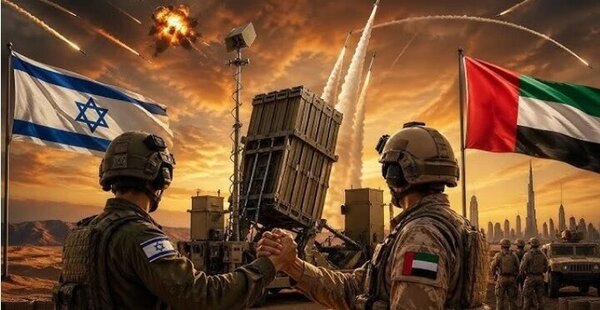
In Iran’s official account, some of the targets of attacks on the UAE were US and Israeli military and security facilities and infrastructure in the region. There have also been reports concerning the presence of intelligence and security personnel at some targets, although fewer details have been made public. But even without relying on this aspect, what happened publicly is significant: during the war, Israel deployed Iron Dome systems and its forces to the UAE to protect the country.
Axios reported that Israel transferred an Iron Dome battery, along with its personnel, to the UAE, in what was the first deployment of the system to a country outside Israel and the US. A US Congressional report also reported the deployment of at least one Iron Dome battery with Israeli operators in the UAE.
The picture has a clear implication: during the war, the UAE was not merely a country under attack; it had become part of Israel’s operational security environment.
But the story is not only about security. The more significant contradiction lies elsewhere: the same country that has assumed an important position in the security architecture opposing Iran has also been one of Iran’s most important economic partners.
This duality was possible for years. Extensive trade, the presence of Iranian companies and investors in the UAE, the role of its ports and financial network, and the dependence of part of Iran’s trade on routes through the UAE are undeniable economic realities. But the war showed that this economic reality cannot automatically be interpreted as strategic trust.
From this perspective, the June 17 case becomes significant.
According to published reports, on that date, amid the war between Iran and the US, a confidential meeting was held in Manama with the participation of Mohammed bin Zayed, CENTCOM Commander Admiral Brad Cooper, a senior Mossad adviser and Marco Rubio joining online. According to these reports, preventing the consolidation of an understanding between Iran and the US and the issue of arrangements for Hormuz were among the topics discussed. But the significance of the case lies in the framework it reveals: Abu Dhabi does not define itself merely as a consumer of decisions made by Washington and Tel Aviv; rather, it seeks to play a role in shaping the strategic environment surrounding Iran.
The Salalah meeting and the UAE’s role, with Israel’s involvement in disrupting it, carried this dynamic into the Hormuz arena.
Iran, Iraq and the GCC countries, with the exception of Bahrain, were due to discuss arrangements related to shipping through Hormuz. However, on the eve of the meeting, it was postponed following joint pressure on Oman from Washington, Tel Aviv and Abu Dhabi. Reuters reported that the meeting had been designed to discuss possible agreements concerning the strategic Strait of Hormuz. Other reports also pointed to disagreements over the wording of the proposed agreement and concerns about the creation of new arrangements in Hormuz.
The issue here is not simply a postponed meeting. Hormuz is becoming an arena of competition over a new security and trade architecture for the region. And because of its ports, energy infrastructure, alternative routes and position in the southern Persian Gulf, the UAE cannot accept a situation in which Iran’s role in shaping the emerging process becomes central and strategic. For this reason, within the framework of joint cooperation with Israel and Washington, it has actively moved to prevent the meeting from taking place.
This is why Netanyahu’s visit to Abu Dhabi should also be viewed as part of the same chain of events.
Netanyahu arrived in Abu Dhabi on September 27 at the invitation of Mohammed bin Zayed. Reuters reported that his meeting with the UAE president lasted about six hours, with Iran discussed alongside bilateral relations and regional issues.
The timing of the visit is particularly significant. Netanyahu travelled to Abu Dhabi after setting out his strongly worded positions on Iran at the UN General Assembly, arriving in the same country that, at the southernmost edge of Iran’s surrounding environment, has maintained economic relations with Tehran while establishing the deepest security ties with Israel among the Arab states in recent years.
Regardless of the issues discussed between the two sides and, reportedly by Israeli media, the possible participation of representatives from several other Arab countries, the visit itself carries a clear political and security message: Israel’s threats against Iran at the UN immediately moved into direct consultations in one of the region’s most important Arab capitals.
This is the point at which Iran needs to redefine its assessment of the UAE’s position.
Abu Dhabi today is not merely Iran’s southern neighbor; it is a country that, at the most sensitive juncture, has elevated its cooperation with Iran’s principal adversary to an overt and operational level. That adversary is engaged in war with Tehran and has also openly spoken at the UN General Assembly about changing Iran’s political system. The UAE has not distanced itself from this cooperation. Rather, by hosting Netanyahu and continuing security and strategic coordination with Israel, it has made its position in this equation even clearer.
Relations with Abu Dhabi, therefore, can no longer be defined solely in terms of neighborhood, trade and economic interests. Strategic trust should be based on conduct, not geography. If the UAE has chosen cooperation with the US and Israel on the region’s most important security issue, and has also positioned itself against Iran’s role in the Hormuz issue, that choice should also be reflected in the way Tehran and Abu Dhabi manage their relations. The issue is not cutting ties or closing economic channels; it is ending the separation between the UAE’s security conduct and its economic relations with Iran.
The 40-day war, the June 17 case, the Salalah affair and Netanyahu’s visit are not four separate events. They are pieces of a picture showing that the UAE is consolidating its position as the southern link connecting Washington and Tel Aviv to Iran’s surrounding environment.
The UAE has made its choice; Tehran should also take that choice into account in its calculations. Neighborhood alone does not create strategic immunity, and economic interests should not become a shield for overlooking security conduct.