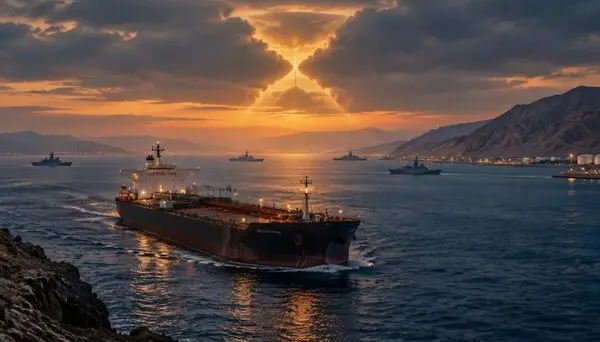
In recent days, widespread reports about the possible deployment of a convoy of Iranian oil tankers toward export destinations and an attempt to break the U.S. naval blockade have carried messages far beyond routine news about commercial and maritime movements. They point to a new phase in the confrontation between Tehran and Washington. Although no Iranian official announced a decision to dispatch an oil tanker convoy, and the reports were subsequently met with denials, the significance of this wave of coverage should not be judged solely by whether a specific operation was confirmed or denied.
The Blockade: Continuing the War by Other Means
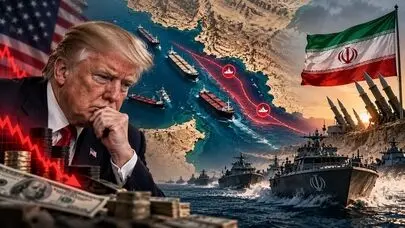
Trump’s shift from direct military confrontation to a naval blockade, following the emergence of the military, economic and political costs of confrontation with Iran, does not mean the war is over. Rather, it represents an attempt to continue the same war through different means and at a lower cost to Washington.
Having experienced operational and political setbacks in its military confrontation with Iran, Trump wants to target the country’s economic lifelines without entering another large-scale conflict. By draining financial resources, putting pressure on foreign trade and restricting oil revenues, Washington seeks to undermine Iran’s capacity to withstand the pressure.
In effect, Trump has concluded that while he may be unable to achieve his objectives through military action, he can pursue the same goals through a blockade over a longer period, shifting a substantial share of the costs onto Iran. This is what makes the blockade a strategic threat. Unlike military conflict, whose costs are immediate and visible to both sides, economic pressure can gradually and quietly inflict deeper damage on national capabilities and people's livelihoods.
Iran’s Decision Countdown
Recent developments, however, have also revealed an important reality: Iran’s decision to break the blockade can be likened to an hourglass whose upper chamber is steadily emptying under mounting public pressure.
The widespread circulation of reports about oil tankers, domestic reactions and international media attention have shown that calls to end the blockade are gradually moving beyond military and expert discussions to become a matter of public demand.
Even if this media momentum does not signal the issuance of an operational order, it indicates that the social and political groundwork for such a move is gaining strength. In other words, every day the blockade remains in place without a clear prospect of its removal, the upper chamber of the hourglass loses more sand, bringing zero hour closer.
All parties must take this countdown seriously: the United States, which designed and is enforcing the blockade; mediators who continue to call for negotiations and give diplomacy more time; and regional countries that believe they can capitalize economically on the current situation.
Washington and the Mediators: Whose Side Is Time On?
Diplomacy can only be effective when it leads to a genuine change in circumstances. If the mediators’ mission is reduced to relaying messages, calling for restraint and buying time, its practical outcome will be nothing more than entrenching the blockade. Such a process will not help resolve the crisis; instead, it will effectively manage time in Washington’s favor and at Iran’s expense.
Mediators must understand that the window for diplomacy is not unlimited. Iran cannot be expected to tolerate the current situation indefinitely, relying solely on political promises while its oil exports and economic interests are being targeted. Any diplomatic initiative that fails to bring about the actual lifting of the blockade will face a new reality and a shrinking scope for political maneuver.
UAE and Saudi Arabia: Partners in the Blockade Cannot Remain Bystanders
A more serious warning is directed at the United Arab Emirates and Saudi Arabia. The two countries cannot participate in arrangements that effectively contribute to prolonging the blockade and restricting Iran’s export capacity and resilience, while expecting to remain immune to the resulting security and economic consequences.
The UAE, which is seeking to profit from the current circumstances through various oil-smuggling routes, must understand that capitalizing economically on the blockade of Iran will not come without a cost, particularly if it involves facilitating the circumvention of restrictions or cooperating in their enforcement.
Saudi Arabia, meanwhile, cannot rely on the Yanbu pipeline to transport oil to the Red Sea, effectively bypassing the restrictions associated with the Strait of Hormuz, while remaining indifferent to the security consequences of the blockade policy.
Tehran’s message to Riyadh and Abu Dhabi must be unmistakable: regional security is an interconnected equation. No country can play a role in the economic blockade of Iran, benefit from it, and at the same time expect the security of its export routes, energy infrastructure and economic interests to remain outside the equation. Direct or indirect participation in the blockade will also make these countries accountable for its consequences.
Zero Hour: The End of Strategic Patience
The main question now is not when the Iranian oil tanker convoy will set sail, or even what strategy Iran will adopt to break the blockade. The real issue is that no one should assume the blockade can become a permanent reality imposed on Iran without consequences.
Tehran has both diplomatic channels and the necessary preparations for action on the ground at its disposal to bring this situation to an end. What is clear, however, is that the continuation of the status quo is turning into a powder keg that could explode at any moment, plunging the region into unpredictable circumstances.
Trump must not assume that by transforming the war from a military confrontation into economic pressure, he can reverse his previous setbacks. Mediators must not confuse the limited window for diplomacy with a delaying tactic, and regional countries must not prioritize short-term economic calculations over long-term security considerations.
The blockade’s hourglass is approaching zero. The exact moment may not yet be known, but recent developments have shown that the sand is falling faster. Everyone must understand the message: the blockade is a continuation of the war, and Iran will no longer remain a passive observer.