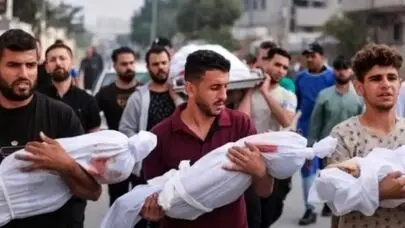
A widening gap has emerged between the “paper ceasefire plan” and the “bloody reality on the ground” in the Gaza Strip, reflecting more than 13 months of humanitarian catastrophe. Displaced residents had barely begun to recover from autumn floods and the bombing of Nasser Hospital when the renewed advance of Israeli tanks forced them into yet another round of displacement.
On Wednesday, November 18, 2026, Israeli army tanks and engineering units entered areas east of the Nuseirat refugee camp and north of Al-Bureij for the first time since the fragile ceasefire took effect in October 2025. The unprecedented advance, accompanied by artillery shelling and heavy gunfire, moved toward the main Salah al-Din Road, Gaza’s north-south artery. By advancing west of the Yellow Line, Israeli forces blocked civilian movement and forced numerous Palestinian families living in nearby shelters and tents to flee once again.
More than a year after the ceasefire agreement, analytical reports and satellite imagery indicate that Israel has gradually expanded the area under its military control from an initial 53 percent to approximately 70 percent of the Gaza Strip. This has been achieved through the repeated westward relocation of the Yellow Line’s concrete barriers, which were established last year as a buffer marking the separation of occupied areas from the rest of the territory.
Further reports published on Thursday, November 19, revealed that Israeli engineering units had demolished several residential buildings and other structures during their operation east of Nuseirat and north of Al-Bureij. Throughout the Gaza war, the Nuseirat camp had been one of the few areas not subjected to extensive ground operations. Tens of thousands of displaced people from northern and southern Gaza had sought refuge there, making the sudden Israeli advance a source of unprecedented concern.
Just two days before the ground operation, on Monday, November 16, Israeli military quadcopters dropped hundreds of leaflets over Al-Bureij, Nuseirat and several other areas, seeking to recruit intelligence informants. The leaflets included contact numbers for Israeli security officers, with each one accompanied by a cigarette or a small packet of coffee. In what appeared to be a psychological warfare campaign aimed at exploiting residents' deprivation to recruit collaborators, the Israeli military distributed scarce commodities such as cigarettes and coffee from the air, even as it continued to prevent essential supplies, including milk for children, from entering through land crossings.
These developments on the ground indicate that although the October 10, 2025 ceasefire reduced the intensity of widespread bombardment, it has effectively failed to end the war and killing in Gaza. The provisions of Trump's 20-point peace plan are being violated on a daily basis. According to figures from Gaza's Health Ministry and reports by international organizations, Israeli airstrikes, drone attacks and artillery shelling have continued over the past 13 months. At least 1,658 Palestinians have been killed and approximately 6,000 others injured in more than 6,000 reported ceasefire violations. These figures suggest that the ceasefire has merely provided a new name and cover for the continuation of the war.
Moreover, international monitoring organizations say Israel has effectively obstructed the implementation of the peace plan's second phase by impeding humanitarian aid deliveries and refusing to approve Palestinian police forces and the deployment of Palestinian technocrats. The deadlock has been further complicated by Israel's insistence that Hamas be fully disarmed before Israeli forces withdraw.
In this context, a coalition of five major humanitarian organizations — Oxfam, the Norwegian Refugee Council, the Danish Refugee Council, Save the Children and Refugees International — assessed the peace plan's first-year performance against 13 key benchmarks in a report published to coincide with the first anniversary of the adoption of UN Security Council Resolution 2803, which endorsed the Gaza peace plan. The coalition gave the plan a dismal score of just 4 out of 26, awarding it zero points in two critical areas: facilitating humanitarian aid and reconstruction.
The poor performance in humanitarian assistance stems from a deep gap between the commitments made under the agreement and the restrictions imposed at border crossings. Under the October 2025 ceasefire, at least 600 trucks carrying humanitarian aid and essential goods were supposed to enter Gaza every day — equivalent to approximately 232,800 trucks over the past 13 months. However, official figures from local authorities and leaked data from the Israeli military's Coordination of Government Activities in the Territories (COGAT) indicate that only around 77,600 trucks, or roughly one-third of the pledged total, were allowed into the Strip during this period.
The scale of the crisis becomes even clearer in the five aid organizations' report, which found that the average number of UN-coordinated aid trucks entering Gaza fell to between 37 and 49 per day in autumn 2026. Most of the already limited available quota has also been allocated to expensive commercial shipments. In addition, citing restrictions on so-called dual-use goods, Israel has blocked the entry of more than 150,000 emergency tents and reconstruction equipment ahead of the winter season. Medicines and medical equipment have accounted for only around 2 percent of recent UN shipments. According to the latest November 2026 report by the UN Office for the Coordination of Humanitarian Affairs (OCHA), stocks of 42 percent of essential medicines and 55 percent of chemotherapy drugs in Gaza have been completely depleted. As a result, the apparent gains of the ceasefire have done little to improve conditions for the 1.4 million displaced people living in deteriorating tents.
This policy of replacing free humanitarian assistance with commercial goods has trapped Gaza's economy in a dual crisis. On the one hand, according to data from Gaza's Ministry of Social Development, incoming aid meets only 15 percent of the population's actual needs, while more than 95 percent of residents are entirely dependent on humanitarian assistance. On the other hand, with more than 90 percent of households having lost their purchasing power and inflation reaching 206 percent, according to OCHA figures, even commercial goods available in local markets remain beyond the reach of ordinary residents.
According to the Gaza Chamber of Commerce, 95 percent of shipments authorized to enter the Strip consist solely of consumer goods, while production equipment and inputs account for just 5 percent. By banning the entry of raw materials, generators, spare parts and solar energy systems under its dual-use restrictions, and reducing the number of authorized importers in Gaza from more than 2,000 to just 10–13, Israel has effectively deprived the Strip of any meaningful prospect of reviving production, employment and reconstruction.
Meanwhile, with more than 90 percent of Gaza's population displaced and Israeli forces controlling approximately 70 percent of the territory, displaced residents have been forced into the remaining 30 percent, where they are living in extremely overcrowded conditions. Their shelters range from partially destroyed buildings, already at risk of collapse after years of bombardment and the continued absence of reconstruction materials, to tents along the coast and in low-lying areas that offer virtually no protection against strong winds and severe storms.
As another season of cold weather and torrential rain begins, tens of thousands of worn-out tents, riddled with holes from shrapnel and gunfire, have been inundated with water and mud. In addition to daily airstrikes and artillery attacks and the harsh winter conditions, Israeli naval vessels periodically open fire toward the coastline, leaving families with virtually nowhere safe to take shelter.
Rainwater has destroyed families' already meager supplies of flour, clothing, mattresses and blankets, while the ground surrounding their tents has turned into a swamp of water and sewage. With more than 150,000 emergency tents being held up outside Gaza's borders, these conditions have contributed to a sharp rise in respiratory illnesses and deaths from hypothermia, particularly among children and the elderly.
As the crisis worsened, a coalition of more than 50 countries and international organizations issued a statement at the United Nations headquarters in New York, calling for the immediate reopening of all border crossings and the unconditional removal of obstacles to humanitarian aid deliveries.
From the perspective of international humanitarian law, these restrictions constitute clear violations of Israel's legal obligations. Under Articles 55, 56 and 59 of the Fourth Geneva Convention, as well as the International Court of Justice's advisory opinion dated October 22, 2025, Israel, as the occupying power, is obligated not only to facilitate humanitarian relief operations but also to ensure that the civilian population has access to food, medical services, safe shelter and preventive public health infrastructure to protect against foreseeable winter hazards. Legal experts stress that these obligations must not be undermined through obstruction of reconstruction and temporary housing in a manner that turns them into instruments for imposing permanent displacement on Gaza's residents.
Amid mounting international pressure and the simultaneous ground operation in central Gaza, Israeli Defense Minister Israel Katz ruled out any prospect of an Israeli withdrawal from the Strip in the near future. Katz said Israel would not withdraw its forces from what he called “security zones” in Gaza, Lebanon and Syria. He made any withdrawal conditional on the complete dissolution and disarmament of Hamas, the disarmament of Hezbollah throughout Lebanon, and the removal of all threats posed by armed groups in Syria.
He also warned that if tensions escalated on regional fronts — particularly in the event of a renewed confrontation with Iran — the Israeli military was fully prepared to evacuate local residents, seize additional areas in Gaza, Lebanon and Syria, and incorporate them into its own “permanent security zones.”
These remarks, made amid the transitional period of Benjamin Netanyahu's interim government, point to Tel Aviv's efforts to permanently consolidate its military presence in approximately 70 percent of the Gaza Strip and bring the second phase of the peace plan to a complete standstill.
In response, Hamas spokesperson Hazem Qassem described the latest ground operation in central Gaza as a “continuation of systematic ceasefire violations” and an attempt to “destroy the remaining parts of Gaza and implement a plan for the forced displacement of Palestinians.” Criticizing Israel's disregard for the commitments made at the Sharm el-Sheikh peace summit and the efforts of countries mediating and guaranteeing the agreement, he accused the bodies tasked with monitoring the ceasefire — the Board of Peace — of failing to restrain Tel Aviv and effectively aligning themselves with its position.
Overall, developments in recent days indicate that more than a year after the ceasefire agreement was signed, Gaza remains trapped in a state of neither full-scale war nor genuine peace. The current fragile ceasefire has become little more than a cover for continued humanitarian devastation and the consolidation of new realities on the ground.