The widespread disruption to the US aviation network, which began on Friday, November 13, left thousands of flights canceled or delayed for three consecutive days, raising serious questions about the security and resilience of one of the country's most critical infrastructures. While US officials have attributed the initial incident to technical problems and outdated equipment, the speed with which this explanation was offered, the early dismissal of a possible cyberattack, and the fact that the root cause remains unclear have fueled alternative theories. Is Washington attempting to contain the scope of the official narrative to prevent a much larger vulnerability from coming to light?
A Crisis That Lasted Three Days
The incident began on Friday, November 13, when a disruption to the communications and air traffic control network of the Federal Aviation Administration (FAA) forced officials to issue a nationwide ground stop. The restriction remained in place for nearly five hours. Although flights subsequently resumed, the consequences of the incident did not end nearly as quickly.
According to FlightAware data, more than 11,500 flights across the United States were canceled or delayed on Sunday, November 15 alone. Around 2,100 flights were canceled, while another 9,400 experienced delays. The figures showed that restoring the aviation network to normal operations was far more challenging than resolving the initial disruption.
The Technical Explanation and a Costly Admission
In their initial statements, US officials identified aging communications infrastructure and outdated air traffic control equipment as the primary causes of the incident. US Transportation Secretary Sean Duffy said the communications network used to manage the country's airspace relies on technology dating back several decades. He also noted that problems had emerged during the transition from old copper lines to fiber-optic cables.
According to preliminary explanations, a router replacement operation at a remote facility in Arkansas, combined with a network communications disruption, triggered an unusually high volume of connection requests to other equipment. This caused instability across the communications network, disrupting communications with aircraft and affecting some radar data. US officials said the disruption was detected at 17 of the country's 22 air route traffic control centers.
However, what deserves even greater scrutiny than the technical failure itself is the nature and speed of the administration's acceptance of this explanation.
In his remarks, Duffy referred to infrastructure that still relies on 1980s technology, while the routers involved dated back to 2001. According to him, the equipment had effectively been considered obsolete since 2006.
This admission carries a considerable reputational cost for a country whose president speaks almost daily about America's greatness, power, technological advancement, and superiority over the rest of the world. Trump has consistently sought to portray the United States as a leading global power equipped with the most advanced technologies. Yet one of his cabinet members has now explained a national crisis by pointing to infrastructure that, in his own words, relies on technology dating back several decades.
Three Aircraft Carriers in the Region: A Show of Strength Abroad, a Crisis of Management at Home
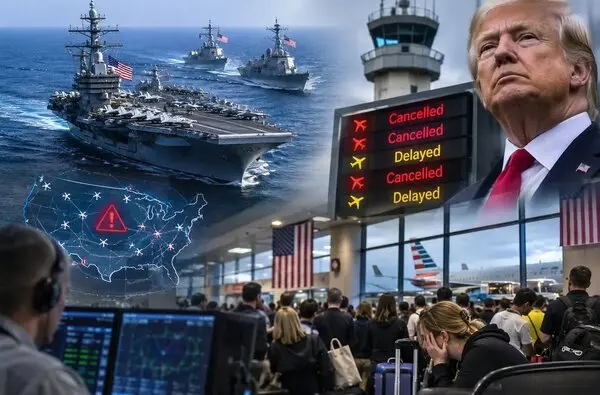
This contradiction becomes even more significant when viewed against the backdrop of the Trump administration's deployment of a third aircraft carrier to West Asia while the aviation crisis was unfolding at home. The USS Theodore Roosevelt entered the US Central Command (CENTCOM) area of responsibility on November 15, joining two other US aircraft carriers already operating in the region. The move came amid continuing military tensions and Washington's deliberations over its options regarding Iran.
Thus, an administration seeking to demonstrate its superiority and project power thousands of miles beyond its borders by relying on America's economic, technological, and military capabilities is simultaneously facing serious questions about its ability to safely manage one of its most important domestic infrastructures.
The issue is not simply a comparison between military capabilities and technical shortcomings. Rather, it is the growing gap between the image of a global superpower that Trump presents to the world and the vulnerabilities emerging within the United States itself. Deploying aircraft carriers and showcasing military strength cannot, in itself, replace accountability for the security of critical infrastructure and the ability to manage domestic crises.
Another question also arises: How can a country that claims to possess the world's most advanced technologies and the ability to conduct the most complex military operations struggle to manage a network on which the daily safety of thousands of flights depends?
Three Indicators and a Hypothesis That Cannot Be Ignored
The first indication is the administration's rapid and unusual acknowledgment of the country's outdated infrastructure. While aging equipment may well have contributed to the incident, emphasizing it as the primary explanation before technical investigations have been completed raises the possibility that the US government would rather admit to an obvious weakness than face the disclosure of something more sensitive.
The second indication is the early dismissal of the possibility of a cyberattack. At the initial stages of the incident, US officials said there was no evidence of a cyberattack or malicious foreign interference. However, the absence of preliminary evidence is not the same as definitively ruling out a security threat. This is particularly important given that technical and security investigations were still underway and the root cause of the incident had yet to be established. The question remains: What grounds did US officials have for their initial confidence in ruling out a cyberattack?
The third indication is the gap between the resolution of the initial disruption and the return of the aviation network to normal operations. Although the FAA announced that the system had stabilized on Friday evening and flights had resumed, the operational consequences of the incident continued for three days. Admittedly, a distinction must be made between continued cancellations and delays caused by the accumulation of disruptions and an ongoing technical failure in the network. Nevertheless, the persistence of the crisis demonstrated that the incident went far beyond a limited and temporary technical problem.
More importantly, Duffy subsequently acknowledged that the root cause of the incident had yet to be determined. He also said that similar operations had been carried out thousands of times without producing such disruptions. This makes the question of why a routine maintenance operation triggered an unprecedented crisis even more pressing.
The Cost of Admission or the Cost of Concealment?
Amid these uncertainties, the Trump administration has used the incident to call for an additional $50 billion in funding to modernize the air traffic control network. Meanwhile, congressional Democrats have raised questions about how previous appropriations were spent and why a substantial portion of the $12.5 billion approved in 2025 remains unspent.
This suggests that the US aviation crisis has evolved beyond a technical and security issue into a political and management challenge. However, the entire incident cannot be explained solely by pointing to disagreements over funding.
Under these circumstances, one hypothesis remains worthy of consideration: Has the US government chosen to acknowledge the outdated and deteriorating state of its infrastructure in order to steer public attention toward a known and relatively straightforward weakness, keeping the possibility of a much larger security vulnerability out of the spotlight, at least until its full dimensions become clear?
What Will Future Developments Reveal?
The immediate priority is to establish the root cause of the incident, publish the findings of technical investigations, and clarify the roles played by equipment, contractors, and the communications architecture of the US air traffic control network.
If investigations conclude that the incident was solely the result of aging infrastructure and technical failure, Washington will have to explain how such a malfunction managed to disrupt operations at 17 air traffic control centers. However, if other aspects of the network's vulnerabilities or evidence of external interference emerge, the US government's initial account will face far more serious questions.
For now, it is impossible to reach a definitive conclusion about what happened behind the scenes. One question, however, remains unanswered: Is the United States simply dealing with outdated infrastructure, or has it encountered a much deeper vulnerability in its own airspace that it is not yet willing to disclose in full?
Developments over the coming days and the findings of technical investigations may shed further light on the true nature and scale of this incident.