At a time when the outcome of the U.S. midterm elections, the Republicans’ defeat, and White House officials’ admission that the war against Iran contributed to the setback could have created an opportunity for Trump to reassess his foreign policy and reduce the costs of confrontation, Washington has announced a new mechanism to tighten restrictions on Iran. The United States is now pursuing a multilayered effort to constrain Iran’s economic, commercial and strategic capabilities—an effort that continues to take on new dimensions.
The United States apparently has no intention of limiting itself to any single instrument of pressure against Iran. The naval blockade, economic isolation, restrictions on air links, and now the establishment of the so-called “Iron Gate” task force to monitor land routes and the Caspian Sea are interconnected components of a broader strategy. Washington’s stated objective is to restrict Iran’s access to resources, goods, technology and foreign trade routes. In this way, pressure on Iran is moving beyond conventional sanctions toward the simultaneous disruption of the country’s economic connections with the outside world.
Iron Gate: The Next Step After Economic Isolation
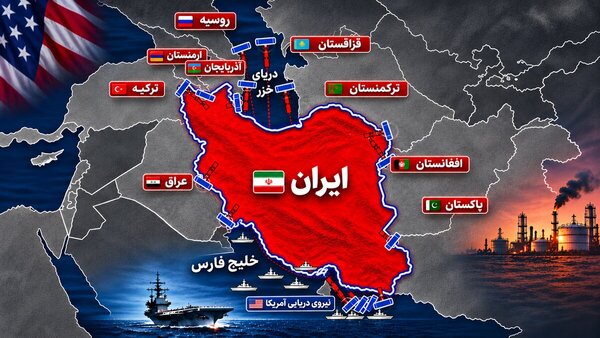
CENTCOM’s announcement of the establishment of the Iron Gate task force marks a new development in this process. According to CENTCOM, the task force is responsible for coordinating with U.S. agencies to prevent the transfer of advanced weapons, dual-use technologies, sanctioned goods and what Washington claims are revenues generated through Iran’s land borders and the Caspian Sea.
The significance of this move lies in the message it sends to Iran’s neighboring countries and trading partners: Washington intends to extend its monitoring and pressure campaign beyond the southern waters to alternative trade routes available to Iran.
In effect, the United States is seeking to extend the restrictions imposed through maritime routes to Iran’s other channels of connectivity. While the naval blockade was intended to put pressure on the country’s main foreign trade lifeline, Iron Gate purports to subject alternative routes to greater uncertainty and higher costs as well. This is what completing the blockade means.
A review of developments over recent months shows that these are not a series of isolated or unrelated decisions. During the 40-day war, an operation dubbed “Economic Fury” was launched, focusing on a naval blockade. This was followed by “Economic Isolation,” an operation aimed at restricting Iran’s aviation fleet. Now, Iron Gate has been introduced as the latest component of this policy, targeting Iran’s land-based trade exchanges.
CENTCOM has claimed that the naval blockade has prevented Iran from exporting more than $25 billion worth of crude oil. This figure, however, is merely the U.S. military’s official claim.
But the issue extends beyond oil. Iran’s economy depends on imports of raw materials, industrial equipment, spare parts, technology and intermediate goods to sustain production. Any disruption to the supply chains for these necessities can increase production costs and make it more difficult for businesses to operate.
Similar challenges exist along land routes. The transportation of goods across borders becomes increasingly difficult, particularly when neighboring countries face pressure from secondary sanctions. Therefore, even if alternative routes exist on paper, making effective use of them requires infrastructure, investment, regional cooperation and commercial confidence—all of which are undermined by U.S. policies of threats and coercion.
Washington consistently justifies its actions under seemingly legitimate pretexts, such as preventing arms transfers, combating sanctions evasion and restricting the financial resources allegedly used to fund military activities. The fundamental question, however, is how far these policies will actually extend and what guarantees exist that pressure on the alleged target networks will not lead to widespread disruption of civilian trade and people's economic lives.
This question is particularly important given that banking and transportation restrictions can directly affect the supply of essential goods, industrial inputs and public services.
Economic Blockade Under the Shadow of Military Threats
Even more significant than the expansion of economic pressure is the fact that it is taking place alongside military threats and continued acts of aggression against parts of Iran, including Qeshm Island and Bushehr. In recent days, reports have emerged of limited U.S. strikes on these locations, which Trump has also confirmed. Economic pressure, therefore, is not being applied in isolation. It is part of a broader climate of military tension, threats of wider attacks, and mounting maritime and trade restrictions.
The significance of this convergence should not be underestimated. Washington appears to be pursuing a multilayered operational plan aimed at exploiting all available instruments of pressure against Iran. Plans to foment internal unrest and street protests—what the United States describes as popular demonstrations—also appear to be part of the agenda, with the aim of completing a broader cycle of discontent and uncertainty.
An assessment of U.S. policy toward Iran requires examining the links between economic, military, political and social instruments of pressure—areas that have become increasingly interconnected in recent developments.
The escalation of pressure against Iran comes precisely at a time when Trump has suffered a major defeat in a highly consequential election. This setback may well be one of his main motivations for intensifying pressure on Iran.
An important question now arises: Is the Trump administration using the Iron Gate policy as an additional instrument of pressure to strengthen its position in negotiations with Iran, or is it pursuing a broader strategy to restrict Iran’s economic and military capabilities independently of the negotiating process? Another question is how deeply Trump's electoral defeat has affected him and whether, in an attempt to compensate for that setback, he might resort to even more extreme and brutal actions.
The effectiveness of the Iron Gate policy, however, is highly questionable. Given its strategic geographical position, Iran is an integral part of the region’s transit and trade networks. Restricting Iran’s trade routes will inevitably affect the economic interests of neighboring countries as well. Countries that rely on routes through Iran to transport energy and goods or gain access to regional markets may be forced to seek more complex alternative arrangements.
In other words, the issue is not simply how much of its foreign trade Iran might lose as a result of Trump’s Iron Gate policy. It is also necessary to consider the impact of Washington’s extraterritorial pressure campaign on the economic conditions of other countries.
More importantly, to what extent can this policy give Washington hope that it will break Iran’s determination to withstand pressure and maintain its resistance? The history of relations between Iran and the United States has shown that extensive sanctions have so far failed to achieve Washington’s objectives.