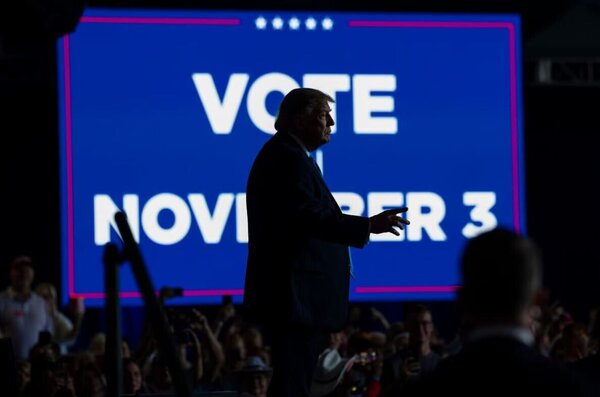
As Americans head to the polls today, Tuesday, November 3, for the midterm elections, several acts of aggression targeting Qeshm Island and Bandar Lengeh have brought tensions between Iran and the US into a new phase. Media outlets reported hearing several explosions and seeing aircraft flying over Qeshm last night. Some US news sources, citing American officials, also reported that the US had carried out limited strikes against targets on Qeshm, describing them as “defensive” in nature. US officials claim the strikes were in response to Iranian forces using air defense systems against American assets and insist they do not mark the beginning of a renewed full-scale war.
But beyond Washington's legal and military characterization of the strikes, there is an important political reality: at the very moment the US president is speaking of the possibility of an agreement with Iran, the US has conducted a military operation on Iranian soil. This contradiction in conduct may, in fact, offer the clearest picture of Trump's current strategy. Yesterday, on the eve of Election Day, and contrary to his threats in recent weeks that military operations could resume after the elections, Trump said he was in no hurry to decide whether to continue the war. In a message, he even stressed that an agreement with Iran “could happen”. At the same time, he had previously threatened that if no agreement were reached, the US might strike targets in Iran, including certain nuclear sites.
The issue, therefore, is not that Trump is wavering between “war” and “peace”. Rather, he is keeping both options active simultaneously in pursuit of a single objective: breaking Iran's resistance. Washington wants Tehran to understand that military force is ready to be deployed if Trump's purported diplomatic efforts fail, while at the same time assuring Iran that the path to an agreement remains open. The attack on Qeshm can also be understood in this context. The operation was limited enough not necessarily to trigger an all-out war, but real enough to demonstrate that the military threat remains in place.
The other side of the equation is America's domestic political situation. Trump is facing an election today that could alter the balance of power in Congress and even the Senate. Given its security, economic and energy implications, the Iran file is clearly no ordinary foreign policy issue for a president seeking to project “strength”. Any achievement in this area, from an agreement to a limited military operation, can be turned into political capital.
A Letter and an Attack: Two Instruments Serving the Same Goal
The most significant development in this context is a letter from US Vice President JD Vance to Mohsen Rezaei, secretary of Iran's Supreme National Security Council. In the letter, Vance proposed resuming negotiations and stressed that any talks intended to prevent further US attacks must also address Iran's nuclear issue. The letter is significant because it represents one of Washington's highest-level direct contacts with Iran's national security establishment in recent months.
Mohsen Rezaei has confirmed receiving the letter. More important, however, was his reference to the change in tone between Vance's letter and Trump's previous letter. Tehran has not yet responded and has said it is waiting for Washington's final response to Iran's proposals. This difference in tone matters. The White House appears to have concluded that Trump's direct language of threats alone is insufficient to reopen the path to negotiations and that a channel using different language must also be activated. Meanwhile, Vance said yesterday that Washington and Tehran had made progress towards an agreement and that both he and Trump “feel good” about the prospect of a negotiated deal. He also made clear that Trump was keeping his “tough” options, including military action, on the table.
In Tehran, Abbas Araghchi has also spoken of an intensification of diplomatic contacts, stressing that negotiations could resume sooner than ever if Washington accepts Iran's conditions concerning the reopening of the Strait of Hormuz. Qatar and Pakistan have also been actively shuttling between the two sides in recent days, with efforts under way to develop an initial confidence-building framework. Putin's telephone conversation with Mohsen Rezaei and Ali Bagheri's visit to Beijing are also regarded as two important developments within this broader diplomatic context.
The most important question now is not whether the US has attacked Iran or whether negotiations are under way. Both realities exist simultaneously. The central question is which of these two paths will prevail once the US election results become clear. At least three approaches are visible in Washington. One camp, including Vance and Steve Witkoff, appears to believe that an agreement should be given a chance. Some Arab countries in the region also support an agreement because a continuation of the war, and the closure or insecurity of the Strait of Hormuz, would carry a heavy cost for them.
By contrast, Benjamin Netanyahu and certain domestic political currents in the US continue to encourage Trump to resume attacks on Iran. According to published reports, they want swift military action after the elections. A third camp advocates neither a full-scale war nor an immediate agreement. Instead, it favors continuing economic and military pressure to wear Iran down and extract further concessions from Tehran. An Axios report points to differences within the Trump administration over these three possible paths: reaching an agreement, returning to war or maintaining maximum pressure without immediately launching a broader conflict.
Clinton's Warning: To Iran or American People?
Hillary Clinton's remarks are also noteworthy in this context. She has warned that if Republicans lose the election, Trump may feel besieged and become “even more out of control”, adopting more aggressive behavior. This is, of course, the assessment of a political rival of Trump and cannot be treated as a definitive prediction. Nevertheless, in one respect, it aligns with existing concerns about the post-election period. The election results may mark not the end of the crisis but the beginning of a new phase in Trump's decision-making.
It would not be unreasonable to suggest that, with these remarks, Clinton is warning both the American public that a climate of war will persist as long as Trump remains in power and Iran that it should expect Trump's war machine to be set in motion. Meanwhile, reports have emerged of Netanyahu pressuring Trump to launch an attack after the elections, even as Trump currently prefers to keep the path to negotiations open. This very divide between Washington and Tel Aviv will be one of the important factors shaping the coming days.
Looking at the dynamics of the confrontation between the US and Iran, it is impossible today to say with certainty whether the two countries are closer to war or peace. A more accurate picture is that both sides are moving towards both possibilities simultaneously. The attack on Qeshm demonstrated that the military option is real and imminent, and that it can be carried out even on a day when Washington speaks of the “possibility of an agreement”. On the other hand, Vance's letter and General Rezaei's position, the movements of Qatari and Pakistani mediators, and contacts with China and Russia show that diplomacy is not merely a media façade but is being pursued at the highest levels.
One point, however, is of particular importance: Trump appears to want to claim victory before the game is over. If an agreement is reached, he can present it as an achievement brought about by his pressure and strength. If no agreement is reached, he can justify military action as the consequence of diplomacy's failure. Even a limited operation could be portrayed in his political narrative as proof that the US has exercised its power. From this perspective, the US midterm elections are not merely a domestic political event; they have become a turning point in the Iran file.