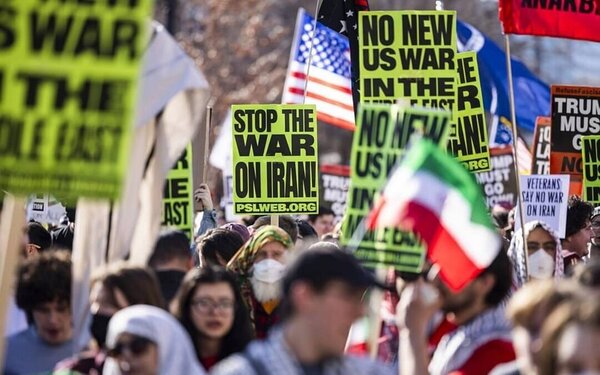
Nournews: The U.S.-Israeli war against Iran has entered a decisive phase, with its consequences no longer confined to the battlefield or the Middle East’s security landscape. What was initially defined as a foreign policy issue and part of Washington’s security strategy has now become a major source of controversy in U.S. domestic politics—a shift that has turned the November 3 congressional midterm elections into a test of the war’s political and economic consequences.
In effect, the war with Iran has gradually shifted from an issue on which the U.S. government makes decisions to one by which the government itself is being judged. This shift is significant because, in the American political system, foreign policy can become a decisive domestic issue when its costs cross geographical borders and begin to affect citizens’ daily lives, party competition and the balance of power in Washington.
The Economy: The Link Between War and the Ballot Box
One of the most important ways the Iran war has entered U.S. domestic politics is through the economy. Rising energy costs, supply-chain disruptions, higher transportation expenses and concerns about worsening inflation are all consequences that can directly affect the purchasing power of American households.
Under such circumstances, an issue such as the Strait of Hormuz—which before the war was largely the concern of specialized security and economic circles—has become directly linked to fuel prices, the cost of living and America’s economic security.
The results of an October 2026 poll by the Chicago Council on Global Affairs also highlight this connection. According to the survey, 68 percent of Americans believe the war with Iran has not been worth the cost. Meanwhile, 86 percent say the war has had a negative impact on the cost of living in the United States.
Notably, only 2 percent of respondents identified the Iran war as the single most important issue affecting their vote. Yet its economic consequences have become one of the main concerns shaping the election. In other words, the war does not necessarily reach the ballot box directly; rather, it influences citizens’ political decisions through its impact on the economy and their livelihoods.
The Iran War and the Redefinition of Two-Party Competition
In this environment, Democrats are seeking to turn the continuation of the war into a symbol of the Trump administration’s failure to manage foreign policy and deliver on its campaign promises.
A president who returned to power by emphasizing the prioritization of America’s domestic interests and avoiding foreign entanglements must now explain the costs and prospects of a war whose necessity and achievements are increasingly being questioned by a significant portion of the American public.
For Democrats, opposition to the war offers an opportunity to connect the administration’s foreign policy to a broader range of domestic criticisms, including the rising cost of living, economic pressure and the management of public resources.
Republicans, meanwhile, can defend the administration’s military decisions by emphasizing security threats posed by Iran and the need to preserve America’s deterrent power. However, after seven months of war and without success in achieving its stated objectives, pursuing this argument is no longer straightforward.
Yet the issue extends beyond the traditional divide between the two parties. Opposition to costly military interventions can also be found among parts of the Republican voting base and movements close to MAGA. This suggests that the Iran war could create divisions that go beyond the conventional Democratic-Republican divide, particularly among voters who expected the Trump administration to devote America’s resources and capabilities to domestic issues rather than foreign conflicts.
Congress: A Second Front in the Political Battle Over the War
The war’s transfer into the domestic political arena can also be seen in growing efforts by lawmakers to increase oversight of the White House’s military decisions.
Questions surrounding the president’s war powers, the allocation of funding for military operations and the administration’s accountability regarding the objectives and achievements of the war have now become part of the political battle in Congress.
A victory by either party in the midterm elections could affect the balance of power in Congress and the degree of pressure lawmakers can exert on the administration. In particular, if Democrats are able to use oversight and budgetary tools to raise the political cost of continuing the war, the White House could face greater constraints and political considerations.
A change in the balance of Congress, however, would not automatically bring military operations to a halt. The president would still retain considerable authority in the realm of foreign policy.
The November Elections: More Than a Battle for Congressional Seats
The significance of current developments lies in the fact that the Iran war has become a benchmark for evaluating the performance of the Trump administration.
The question is no longer simply what the United States has achieved in its confrontation with Iran. It is also what price those claimed achievements have come at—and whether they have actually enhanced the security and protected the economic interests of American citizens.
At the same time, opposition to the war should not necessarily be equated with support for Iran or acceptance of all of Tehran’s demands. Even among opponents of the war, there are differences over Iran’s nuclear program, missile capabilities and regional role.
The common ground among parts of America’s political spectrum, therefore, is not necessarily agreement over the nature of relations with Tehran, but rather doubts about the effectiveness and cost of continuing down the military path.
The Iran war is now unfolding on two interconnected fronts. The first is the military and strategic confrontation between Tehran and Washington. The second is the political battle within the United States over the costs, consequences and responsibility for continuing the war.
The November 3 elections may change the balance of power in Congress, but their significance goes beyond a shift in party seats. They will show to what extent a foreign policy decision can be separated from its domestic consequences.
A war that began with security calculations has, contrary to the initial expectations, now become one of the central issues in Washington’s struggle for political power.