While the United States appears to be devoting its military, political and economic resources to West Asia and its war with Iran, Washington has suddenly closed its embassy and consulates in Brazil and suspended consular services over what it described as “security considerations.” The US Embassy also advised American citizens not to visit the embassy, consulates or other diplomatic facilities for emergency assistance during this period. Coming ahead of Brazil’s presidential election on October 4, the move is a significant indication of Washington’s approach to repeating the pattern of color revolutions through elections in the country. Alongside the revival of the Monroe Doctrine, it could represent an effort to manufacture a political achievement at a time when Trump’s domestic and foreign policies have suffered multiple setbacks and Republicans are approaching the midterm elections with the prospect of facing the political cost.
The timing of the move cannot be separated from the broader political and security developments in Latin America. Washington is turning its attention to one of the region’s most important countries at a time when Brazil, as a BRICS member, continues to stress the preservation of its political and economic independence in the face of US pressure. From this perspective, Brazil’s election is not merely a domestic contest but has become a battleground between two competing visions for the future of Latin America.
Return of the Monroe Doctrine to Contain China, Russia and Iran
A look at Trump’s policies in Latin America points to a return to the Monroe Doctrine, namely an effort to reassert US dominance over the region. The importance of this approach is not limited to access to economic resources and interests, from Venezuelan oil to Latin America’s international waterways. It is also part of the broader US confrontation with China, Russia, Iran and alliances such as BRICS, of which Brazil is an important member.
Electoral developments across Latin America in recent years have also reflected changes in the region’s balance of power. Right-wing and pro-US politicians have achieved electoral victories in several Latin American countries, and a significant portion of the region’s governments are now within Washington’s political orbit. By contrast, countries such as Nicaragua, Cuba, Brazil and Mexico remain among the few that have resisted US pressure and efforts to alter their political course.
Against this backdrop, US actions ahead of Brazil’s election can be viewed as a continuation of the same doctrine, aimed at reasserting dominance over another part of Latin America and limiting the region’s independent capabilities. Brazil is particularly important because of its considerable economic and political weight, while its BRICS membership makes it an important link in the US competition with the emerging new global order.
Brazil’s Warning and the Reproduction of the “Good vs. Evil” Narrative
The suspension of US consular services in Brazil comes after a report by Brazil’s intelligence agency warned of US interference in the country’s presidential election and alleged that Washington was seeking to influence Latin America’s political and economic direction through Brazil’s October 4 election.
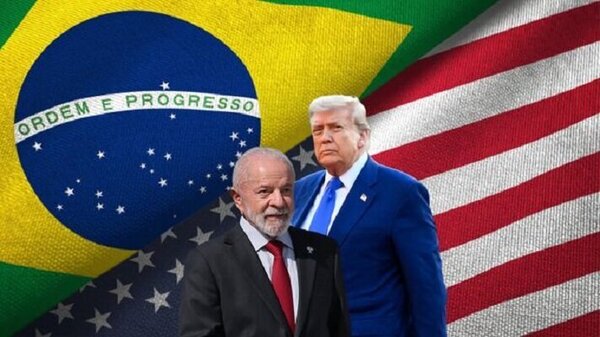
Notably, as in other Latin American countries, combating corruption and criminal gangs has become one of Washington’s demands, an issue that Lula’s pro-Western rival has also strongly emphasized. US interference in Brazil’s election has been considered serious enough that defending national sovereignty has become one of Lula’s central slogans amid diplomatic tensions with the US government.
Lula has also interpreted the statements and behavior of his electoral rival, Flavio Bolsonaro, including his kissing of the US flag and insistence on fulfilling Trump’s demands, in the context of intelligence and security reports alleging a US plan to interfere in Brazil’s election.
The pattern of US intervention in elections in various countries, particularly in Latin America, once again presents the familiar “good versus evil” dichotomy: on one side, pro-Western forces are portrayed as the path to achieving economic and security objectives; on the other, nationalist and anti-US forces face economic pressure, crisis and even military threats.
Security crises, drug cartels and organized crime have also become major electoral issues across Latin America, providing a basis for pro-Western forces to move closer to Washington’s security policies. Flavio Bolsonaro has also pledged that, if elected, he would join the “Shield of the Americas” security initiative proposed by the Trump administration.
Latin America: Trump’s Last Card for Manufacturing a Political Achievement
The electoral effort to whitewash the image of the United States and pro-Western forces does not end there. Ahead of Brazil’s election, the US government revoked the visas of several senior officials from Bolivia, Colombia and Peru, accusing them of “corruption” and “undermining democratically elected governments.” At the same time, Trump met with Venezuela’s interim president on the sidelines of the UN General Assembly’s annual session and spoke of his support for Colombia’s new pro-Western president.
While Trump has threatened to impose heavy tariffs on Brazil, he has simultaneously spoken of expanding relations with countries such as Venezuela’s new government in an effort to present what is portrayed as a successful model to the Brazilian public. On the other side, the “evil” model can be seen in US actions against countries such as Cuba and Mexico, which can be presented to Brazilians as cautionary examples of the consequences of opposing the United States.
Put simply, the United States appears to be organizing its relations with Latin American countries, but in practice it is pursuing a combination of political, economic, security and diplomatic measures to influence Brazil’s electoral equation, a process that can be described as an electoral coup against Brazil’s political independence.
Alongside the Monroe Doctrine, Trump’s precarious position ahead of the US elections, 71 percent opposition among Americans to the proposed war against Iran, the market’s failure, particularly in the energy sector, to respond to Trump’s promises and claims about control of the Strait of Hormuz and the elimination of Iran, as well as the lack of credible foreign-policy achievements from Gaza and the Ukraine war to actions against Iran and China, have combined to leave Trump and Republicans facing the prospect of a major defeat in the upcoming elections.
Under these circumstances, Trump appears to be seeking to manufacture a foreign-policy achievement through a coup in Brazil, perhaps in an effort to reduce the scale of the Republicans’ expected losses. Another dimension of this effort can be seen in the heightened security environment and baseless claims concerning the Fairford base in Britain and the Flydubai flight. These moves, however, do not affect Iran’s decisions regarding its confrontation with the United States, and Tehran continues to emphasize its determination to defend the Strait of Hormuz and uphold its negotiating conditions.
From this perspective, Brazil is not merely an electoral issue for Trump. It is part of Washington’s broader effort to rebuild its influence in Latin America, contain global rivals and manufacture a foreign-policy achievement at a time when US policies in West Asia and other international arenas are facing serious challenges.