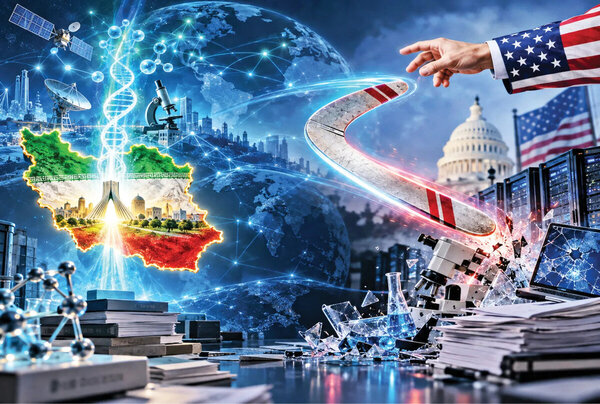
Nournews: Iran’s declining position in some international scientific rankings has once again brought the issue of “scientific sanctions” and restrictions on Iranian researchers’ access to the global scientific community into focus.
Iranian officials say that while sanctions have not necessarily targeted science and research explicitly in official documents, they have in practice increased the cost of scientific progress by restricting access to equipment, academic databases, international exchanges and even the publication process. At the same time, scientific data indicate that the recent decline in Iran’s scientific standing cannot be explained by sanctions alone; factors such as researcher migration, insufficient investment and aging research infrastructure have also played a role.
For an Iranian researcher, conducting scientific and academic work does not end with carrying out research and getting a paper accepted. Paying publication fees, registering for conferences, accessing certain academic services and communicating with foreign institutions are also part of the process—a process that U.S. sanctions have made more difficult for Iranian researchers.
The latest development in this area stems from a decision by the U.S. Treasury Department’s Office of Foreign Assets Control, known as OFAC. Since August 24, 2026, the agency has suspended General License G, which covered certain educational and academic transactions related to Iran.
This change is not merely a legal issue on paper. A paper published in BMJ Global Health identified banking and financial restrictions as a major obstacle to Iranian researchers’ ability to pay for academic services and publish their work. It also noted that in some cases, publishers and academic institutions have refrained from working with Iranian researchers because of concerns about sanctions.
Why Does Publishing a Paper Matter?
The term “ISI papers” is still widely used in Iranian academic circles to refer to papers indexed by major academic databases, particularly the Web of Science. The value of such papers, however, goes beyond publication itself. The number of times a paper is cited by other researchers is also an important measure of scientific impact.
A credible research paper may later be cited in dozens of other papers, academic books, dissertations and even specialized reports and analyses. Therefore, when a researcher loses the ability to publish a paper because of financial or sanctions-related obstacles, the impact goes beyond one fewer publication. The research itself may be left out of the cycle of scientific citation and visibility.
The BMJ study also found that sanctions have not necessarily stopped scientific output in Iran. However, they have affected researchers’ visibility, international collaborations, access to resources and equipment, and participation in scientific events.
What Exactly Does OFAC Do?
OFAC is an office within the U.S. Department of the Treasury responsible for implementing a significant part of the United States’ financial and economic sanctions. In the case of Iran, it enforces regulations that affect banks, companies, universities and foreign institutions dealing with Iran.
OFAC has not, however, directly declared that “publishing Iranian research papers is prohibited.” The main issue is the combination of financial sanctions, restrictions on money transfers and the caution exercised by companies and publishers when dealing with Iran. Even before the latest restriction, Iranian researchers had faced difficulties paying publication fees.
With the suspension of General License G, some educational and academic activities that had previously been permitted under the license now face additional restrictions.
Restrictions Extend to the TOEFL
The impact of the change has not been limited to academic papers and journals. The Educational Testing Service (ETS) recently announced that, following OFAC’s suspension of General License G, it would suspend the administration of TOEFL and GRE exams in Iran.
According to ETS, scheduled examinations in Iran were canceled, and the organization is currently unable to process registrations or payments for individuals in Iran. ETS has also emphasized that Iranian citizenship alone does not prevent a person from taking the exam outside Iran. However, people residing in Iran cannot circumvent registration and payment requirements simply by temporarily leaving the country.
The issue is particularly important for students seeking to pursue higher education abroad, as TOEFL is one of the widely recognized English-language proficiency tests used for university admissions in many countries.
Falling Short of the Seventh Development Plan Target
These restrictions come as Iran has set a specific target for its scientific standing under the country’s Seventh Development Plan.
Under Article 93 of the Seventh Development Plan, approved in 2024, Iran aims to rank 14th globally in terms of the volume of scientific output by the end of the plan. However, Iran’s ranking has unfortunately fallen from 15th in recent years to 18th today, with countries such as Turkey and Saudi Arabia moving ahead of Iran.
The Impact of Scientific Sanctions on Iran’s Scientific Power
The “reduced visibility of Iranian science” can be considered one of the first consequences of scientific sanctions. A paper that is not published in a reputable journal or is less visible across global scientific networks is likely to receive fewer citations and have less impact. Over the long term, this can also affect university rankings and the reputation of researchers.
The second consequence is the “weakening of international scientific cooperation.” Today, major research projects—particularly in fields such as artificial intelligence, medicine, energy, quantum technology and biotechnology—are often the result of collaboration between several countries and laboratories. Restrictions on international communication and cooperation increase the cost of producing knowledge.
The third consequence is the “migration of specialized human capital.” When researchers do not have easy access to laboratories, academic resources, research opportunities and international networks, foreign research institutions become more attractive, potentially encouraging researchers to leave the country. Migration is one of the factors contributing to the decline in Iran’s scientific standing, an issue that Iran’s minister of science has also acknowledged.
The fourth consequence is the “delay in converting scientific knowledge into technology.” The gap between a scientific discovery and a technological product is shaped by access to equipment, raw materials, software, data and international scientific networks.
Sanctions Are Not the Only Factor
At the same time, Iran’s decline or change in scientific standing cannot be attributed solely to sanctions. Researcher migration, research funding, the condition of laboratories, access to equipment, links between universities and industry, and the way researchers are evaluated also play a role.
Iran’s Ministry of Science has previously identified researcher migration and domestic problems within the research system as among the country’s scientific challenges. Sanctions should therefore be viewed as one factor in this chain, rather than the only cause.
The impact of sanctions, however, cannot be ignored. When a researcher faces financial and sanctions-related obstacles to paying publication fees, attending a conference, accessing certain academic services or even taking a language test, participation in the global scientific community becomes more difficult.
Scientific Power as a Guarantee of National Security
From a national-security perspective, the main issue goes beyond a few places gained or lost in scientific rankings. Sustaining a country’s scientific capabilities helps preserve its capacity to produce knowledge, train skilled human resources, develop technology and reduce foreign dependence.
Addressing the effects of sanctions, alongside reforming domestic shortcomings in the research system, should therefore be viewed as part of a broader policy to preserve human capital and technological capabilities, allowing the country to leverage its scientific power in strengthening national security.
It should be emphasized that scientific sanctions alone do not necessarily block a country’s path to scientific development. However, when they are combined with the migration of highly skilled researchers, insufficient funding, weak infrastructure and a disconnect between universities and industry, they can make scientific progress more costly and more vulnerable.