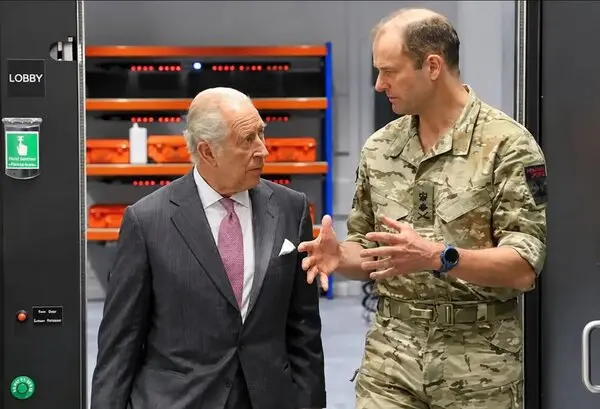
Amid escalating public protests in Britain, including student protests over the rising cost of living, the economic crisis, and the government's failure to address public demands, and while London's foreign policy remains focused on supporting the Zionist regime and fueling wars, General Rob Magowan, a senior British military commander, publicly acknowledged for the first time that Britain conducts offensive cyber operations against Russia, China, North Korea, and the Islamic Republic of Iran. This admission, framed as part of a preemptive response to cyber threats, reveals new dimensions of Britain's aggressive approach. Such conduct is not only a blatant form of terrorism and a dangerous precedent in international relations, but also heightens the responsibility of global institutions, particularly the United Nations, to confront it. Meanwhile, London's leaders cannot conceal their domestic repression or their direct and indirect involvement in US-Israeli crimes against the Iranian people through alleged cases of fabrication and narrative-building, such as the Fairford case.
Cyberterrorism: An Open Breach of Global Security Norms
The statements by Britain's senior military commander should be regarded as an explicit admission of offensive actions against other countries. The principal danger of this approach lies not merely in the nature of cyber operations, but in the logic London uses to justify them. If a country can conduct offensive operations against others under the pretext of preemptively countering potential threats, an uncontrollable precedent will effectively emerge in the international system—one that would allow other governments to use the same rationale to target national security through cyber aggression. Under such circumstances, the distinction between legitimate self-defense and aggressive action would disappear, placing global security under even greater threat. Therefore, the United Nations and responsible international institutions must pursue accountability for the offending government to prevent the normalization of such a dangerous precedent.
Another important point is that, given the spread of extremism in Western societies—which is itself the product of the propaganda, conduct, and interventionist policies of these countries' leaders—cyber sabotage, hacking, bombings, and even mass insecurity in these societies cannot be ruled out. Western governments should seek the roots of their security crises in their own domestic and foreign policies rather than accusing other countries. The historical record of the West is rife with wars, massacres, and interference in the affairs of nations; policies that have fueled anger and retaliatory sentiments among affected peoples. Therefore, accusations against Iran, Russia, and China neither alter existing realities nor conceal the suppression of public protests in the streets of Europe and the US from public scrutiny.
Fairford: Engineering Threats to Deceive Public Opinion
In recent months, Britain has brought forward numerous cases against Iran, Russia, and China, alleging threats to its national security—from the Fairford case to court proceedings alleging that individuals linked to Iran were involved in sabotage against British infrastructure and security facilities. The British military commander's public admission of offensive cyber operations against other countries exposes the nature of these narratives and underscores the need to examine the connection between media-driven threat narratives and London's aggressive policies.
The reality is that Britain needs to create a psychological and security-driven atmosphere within its domestic society to justify its aggressive actions and warmongering against other countries. Alleged case-building, exaggeration of external threats, and accusations against rivals are tools for directing public opinion and legitimizing interventionist policies. The coincidence of these developments with rising anti-government and anti-monarchy protests in Britain and other European countries is also noteworthy. It appears London's leaders are attempting to shift public attention from the cost-of-living crisis, inflation, and government incompetence to security issues by highlighting external threats, while simultaneously using scapegoating to justify the suppression and arrest of protesters.
London: From Covert Support to Creating a Safe Haven for Zionism
Although some British officials, including Burnham, the country's prime minister, have adopted critical positions toward the Zionist regime amid growing public demands for support for Palestine and opposition to the regime, the actual conduct of Western governments continues to demonstrate their ongoing support for Zionism. The blockade of Gaza remains in place, and no effective action has been taken to break it. Instead, Western positions have largely been limited to claims of sanctions against certain settlers—measures that are disproportionate to the scale of the Zionist regime's crimes.
At a time when the regime is facing deep internal crises and widespread global revulsion, US and European leaders are seeking to divert global public opinion from Zionist crimes by highlighting the alleged Iranian threat. Meanwhile, the instrumental use of the label "antisemitism" has become a mechanism for silencing criticism of the regime's crimes. In other words, the West is creating a political and media shield for a regime whose warmongering has not brought it security, but has instead expanded its security, economic, political, and military crises and brought global revulsion toward Zionism to unprecedented levels. Meanwhile, Netanyahu is exploiting the atmosphere of threat-building and false-flag narratives to pursue a new war, hoping to escape political collapse and removal from power.
Britain's Admission: Responsibility Cannot Be Erased Through Blame-Shifting
British officials are attempting to portray themselves as victims and whitewash their record through fabricated cases and baseless allegations, from Fairford to preemptive cyber operations, while Britain's participation in US-Israeli crimes against the Iranian people remains an undeniable reality. NATO Secretary-General Mark Rutte has officially reported that the alliance conducted 5,000 sorties as part of the military aggression against Iran. Reports also point to the role of Britain's Fairford base and bases in Italy in supporting these attacks. These facts provide serious grounds for pursuing the responsibility of countries involved in the aggression against Iran. The blood of the martyrs of these crimes cannot be forgiven, and those who ordered and carried them out must be held accountable before the Iranian people and the relevant authorities. The United Nations and human rights institutions also have a responsibility to pursue and punish the aggressors.
Today, the continued closure of the Strait of Hormuz is only part of the price that those participating in the military aggression against Iran must pay for their crimes. As the country's armed forces have emphasized, Iran's response to the aggressors will not be confined to the region's geographical boundaries, and the range of Iranian missiles extends to targets beyond West Asia. This is the legitimate right of a country that has stood against aggression by relying on its domestic capabilities.
In addition to its military capabilities, Iran's indigenous expertise in electronic warfare and multilayered systems provides the capacity for effective and surprise initiatives. Therefore, Britain and other countries involved in the aggression cannot create a safe haven for themselves through claims of preemptive operations or media-driven threat narratives. The Strait of Hormuz will not be reopened through threats, economic blockade, military attacks, cyber operations, or diplomatic deception; the only path to changing this situation is the fulfillment of Iran's seven conditions. Responsibility for the aggression, crimes, and their consequences will continue to rest with those who ordered and carried them out.