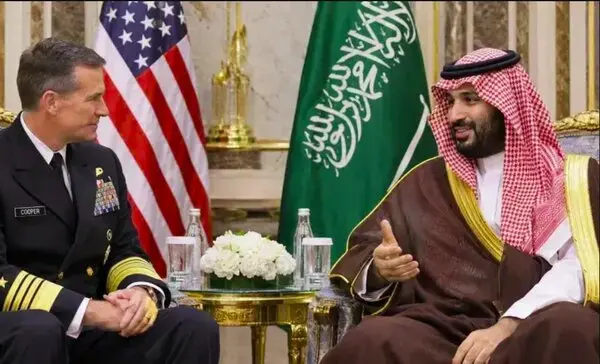
The international silence over Saudi Arabia's military attacks on civilians and infrastructure in Yemen continues, a silence that has become increasingly significant amid US military movements in West Asia. In this context, coinciding with reports of the CENTCOM commander's visit to the occupied territories, Saudi Crown Prince Mohammed bin Salman hosted Brad Cooper, commander of the US Central Command (CENTCOM), in Riyadh and discussed regional developments with him. This was Cooper's third publicly announced visit to Saudi Arabia since fighting and attacks between Saudi Arabia and the Yemeni army resumed.
Given Riyadh's practical inability to counter Yemeni missiles and drones, and the advances made by the army and Ansarullah, backed by popular support, toward Aden, the visit cannot be viewed as merely routine. Evidence points to the possibility of US involvement in sustaining Saudi Arabia's war efforts. However, the fundamental question is this: How can the US, which has itself been defeated in Yemen and is struggling to rebuild weapons and equipment destroyed in the face of Iran's military power, act as Saudi Arabia's savior? This is particularly significant given that Qatar's former prime minister recently emphasized that US support for Arab countries lasts only as long as Washington needs them, a reality once again exposed by the Ramadan War.
Saudi Defeat and the Clear US Footprint in the Yemen War
The meeting took place as Saudi Arabia, despite forming a coalition with several countries, has achieved nothing in Yemen beyond killing and destruction. Reports indicate that the Yemeni army and Ansarullah are approaching Aden, the last stronghold of Saudi mercenaries. At the same time, Yemeni missile and drone operations targeting Riyadh, Aramco and Saudi airports have not only thwarted Saudi military objectives but also imposed heavy economic costs on the country.
Cooper's visit, therefore, is less a sign of Saudi strength and success than a reflection of its battlefield failures. Contrary to Trump's claim that the US has no role in the Yemen war, these developments point to Washington's involvement in supporting Saudi aggression.
Of particular note, following Cooper's visits to the occupied territories and Saudi Arabia, a new pattern of Saudi military escalation in Yemen has emerged, including warnings to residents of various areas to evacuate their homes. This is a pattern previously employed by the Zionist regime in Gaza, where it led to the killing of thousands of people.
US: An Incapable Savior and an Unreliable Ally
Saudi Arabia is counting on US support and the participation of European countries such as France and the UK to continue its aggression against Yemen. However, evidence suggests that Washington is neither a reliable ally of Arab countries nor necessarily capable of ensuring their security.
The remarks made by Qatar's former prime minister on this issue are significant. Referring to the "Israel First" principle in US policy and the Ramadan War, he emphasized that Washington stands alongside Arab countries only as long as it needs them. The experience of the recent war also demonstrated that the US draws Arab countries into arrangements that inflict heavy losses on them in order to secure the interests of the Zionist regime, particularly as world public opinion views these countries as potentially complicit in crimes such as the attack on the Minab school.
Meanwhile, the state of US military capabilities has also exposed the country's limitations. Reports from US intelligence agencies indicate that Washington is unable to rebuild weapons capabilities and equipment destroyed in Iranian attacks. The US nominee for secretary of the Navy has also acknowledged the use of expired ammunition in the war against Iran. The Financial Times, citing US military planners, has warned that continuing the current situation into next year could reduce the operational readiness of US forces.
Under these circumstances, how can a US that has already been defeated in Yemen, with Trump forced to accept a ceasefire based on Yemen's conditions to prevent further escalation, and which is now facing challenges in securing its own bases, assume the role of Saudi Arabia's savior?
Cooper's visit should be assessed within the framework of US plans to prolong the crisis and keep regional countries trapped in a cycle of war. This strategy seeks to make Arab countries' security dependent on Washington, prevent the emergence of indigenous and regionally based security arrangements, and create a safe environment for the Zionist regime by weakening the capabilities of Islamic countries. The West's silence over the wave of executions and the persecution of Shiites in Saudi Arabia and Bahrain can also be examined within this framework.
Riyadh: Aligning With the Blockade or Claiming Friendship With Tehran?
Cooper's visit to Saudi Arabia and the earlier presence of US officials in Arab countries come as Trump recently claimed that Arab countries want to maintain the status quo, meaning refrain from military action while continuing the blockade and economic pressure against Iran.
Saudi Arabia and other Arab countries must now clarify whether hosting US officials, including the CENTCOM commander, is part of their alignment with Washington in pursuing this policy. These countries cannot claim, on the one hand, to maintain relations with Tehran while cooperating with the US in its blockade and sanctions against Iran on the other.
Undoubtedly, one aspect of this visit is an effort to undermine indigenous security arrangements and keep regional countries dependent on the US. However, this does not absolve Arab countries of their responsibility to clarify their positions regarding Washington's hostile actions against Iran.
Indigenous Security: The Only Way to Escape US Dominance
A state of neither war nor peace cannot be sustained. As some media outlets have reported, Iran has several initiatives at its disposal, including the possibility of sending a convoy of oil tankers through the blockade. Meanwhile, any country participating in hostile actions by the US will face corresponding legal responsibilities, and Iran's response will not be confined to the region's geographical boundaries, particularly given the range of Iranian missiles, which extends beyond this area.
Arab countries must have come to realize that the US is the root of the crisis, not a savior of security. It is a power that subordinates its allies' interests to its own priorities and those of the Zionist regime. Therefore, the only sustainable path forward for these countries is to move toward indigenous security arrangements, regional cooperation and complete independence in security decision-making. This path cannot be achieved without breaking free from dependence on Washington.