Among international media outlets, few are as well-known as The Economist for analyzing major global trends and seeking to map the future of political and economic developments. Founded in 1843, the British weekly has become one of the world’s most influential analytical publications over nearly two centuries.
The Economist’s defining characteristic is its effort to go beyond reporting events and uncover the connections between them. In its analysis, a war is not merely a military conflict; it can also reshape energy markets, global trade, food security and even domestic politics in countries around the world. Similarly, a technological development can have economic, social and security implications at the same time.
Its annual The World Ahead series is one of the publication’s best-known products. Edited by Tom Standage, deputy editor of The Economist, the series does not aim to predict the future with certainty. Rather, it seeks to identify the trends, risks and turning points that could shape the coming year. The 2027 edition comes at a time when the world faces several overlapping crises: the war involving Iran, uncertainty over the future of US policy, great-power competition, financial pressures, advances in artificial intelligence and mounting climate risks. The report’s significance lies not simply in listing these issues, but in examining how they are interconnected.
Ten Signs of a Changing World
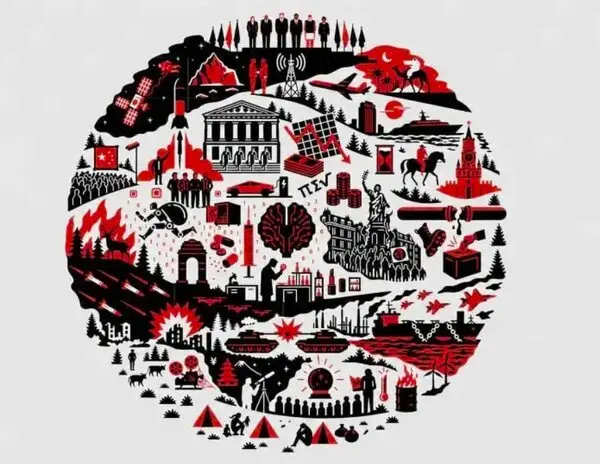
The Economist identifies ten major trends to watch in 2027. Presented in a highly creative and visually striking illustration, they are:
- The beginning of the race to succeed Donald Trump and the possibility that he will take increasingly controversial actions in the final years of his presidency.
- The continuing fallout from the war involving Iran, including disruptions to energy markets and food security.
- The possibility of a new global temperature record.
- Growing concerns about an investment bubble in artificial intelligence.
- The strengthening of right-wing populist movements in Europe and the importance of the French presidential election.
- Mounting pressure on bond markets and government debt.
- The continuing geopolitical sensitivity of Taiwan.
- The expanding economic impact of weight-loss drugs such as Ozempic.
- Lower costs of access to space and the expansion of commercial activity in Earth's orbit.
- Changes in production and consumption patterns across the entertainment industry and Hollywood.
At first glance, these ten issues appear to come from different fields. At a deeper level, however, they point to a common problem: the world's political, economic and social structures are changing faster than many governments and institutions can adapt.
End of Familiar Global Order and the Start of a Period of Instability
One of the most important themes emerging from the report is the declining predictability of international politics. Perhaps the clearest symbol of this is US foreign policy under Trump. Standage’s suggestion that Trump may become a “destructive Angry Bird” rather than a “lame duck” goes beyond humorous characterisation and points to a structural issue: approaching the end of a presidential term does not necessarily mean Trump will become less adventurous. In his final years in office, he could continue to influence US domestic and foreign policy, while the race to succeed him becomes part of his political legacy.
This issue also matters internationally. US allies need a degree of stability in Washington’s policies to plan their security and economic affairs. When decisions by the US government become heavily driven by domestic developments and short-term political considerations, its allies are also forced to reassess their calculations. One of the central questions for 2027, therefore, is whether the US will remain willing and able to perform its traditional role in managing the international order, or whether the world will move towards more fragmented and multipolar arrangements.
This question is also linked to developments in Europe. The growth of nationalist and populist movements, together with the French presidential election, could affect the cohesion of the European Union. If cooperation between Paris and Berlin weakens, Europe's ability to play an independent role in global security and economic affairs could also be constrained. The issue, therefore, is not simply a change of governments, but the future of the institutions and alliances that have served as the main pillars of the international order over recent decades.
The war involving Iran occupies a place in the Economist report that extends beyond a regional crisis. This is because the Persian Gulf is one of the critical junctions connecting the global economy to energy resources and supply chains. The Strait of Hormuz is not merely a passage for oil tankers. The transportation of gas, petrochemical products and raw materials used in fertiliser production also depends on this route. According to a warning issued by the Food and Agriculture Organization (FAO) in September 2026, around 20 to 30 percent of globally traded fertiliser passes through the Strait of Hormuz. Disruption along this route could therefore spread from energy markets to agriculture and food security.
The significance of this issue becomes clearer when viewed in the context of other economic pressures. Higher energy prices can raise production and transport costs; more expensive fertilizer can reduce agricultural output; and the resulting inflationary pressure can ultimately reach consumers. This is what could be described as the globalization of the consequences of war. In today's interconnected economy, a military crisis in one region can affect food prices, industrial production costs and monetary policy in distant countries.
Global Economy Under New Risks: Artificial Intelligence and the Changing Nature of Power
One of the Economist’s main warnings concerns bond markets and government finances. Rising public debt, defense spending, the pressures of ageing populations and massive investment in technology infrastructure have left major governments facing greater financial constraints. In these circumstances, higher bond yields can increase borrowing costs for governments, companies and households. This becomes particularly significant if inflation driven by energy crises persists. The International Monetary Fund’s October 2026 report, which presented the global economic outlook, also warned about government financial vulnerabilities and the risks arising from public debt.
An even more important analytical point, however, is the connection between this situation and investment in artificial intelligence. Technology companies need enormous amounts of capital to develop data centers, purchase chips and secure electricity supplies. A significant share of this investment is also financed through borrowing and long-term financial agreements. If interest rates remain high or companies fail to generate the revenues they expect, valuations could undergo a sharp correction. This situation recalls the dot-com bubble of the late 1990s, although it should not be taken to mean that artificial intelligence itself lacks value. A technology can be genuinely revolutionary while some of the investments surrounding it are based on excessive optimism. This distinction is crucial to analyzing the future of the global economy.
The Economist rightly treats artificial intelligence as more than a new technology. It is gradually becoming one of the main components of countries’ economic, military and political power. Competition over advanced chips, data centers, electricity and technology supply chains shows that global power is no longer measured solely by traditional indicators such as gross domestic product or military strength. Countries capable of developing computing infrastructure, technical expertise and reliable supply chains will occupy a different position in the future economy.
Artificial intelligence, however, also has another side: growing economic and security dependence on infrastructure controlled by a limited number of countries and companies. This could turn technological competition into a national security issue. At the same time, the spread of AI will change the future of employment. Although there is still no evidence of widespread job destruction across the US economy as a whole, changes in required skills and fewer entry-level opportunities in certain professions are significant. From this perspective, countries face a challenge that goes beyond technological development: their ability to manage its social and economic consequences is equally important.
Iran in Global Outlook for 2027: More Than a Regional Issue
Among the ten themes in this year's report, Iran occupies a special place. Its significance stems not only from the war and its direct consequences, but also from the potential impact of developments involving Iran on several key variables in international politics and the global economy.
First is the security of the Strait of Hormuz and the future of energy markets. Any sustained disruption along this route would affect not only oil and gas producers and consumers, but also transport markets, marine insurance and industries dependent on petrochemical raw materials.
Second is food security. The link between fertilizer supplies, energy costs and agricultural production shows how the consequences of a crisis in the Persian Gulf could extend as far as farms and household tables in distant countries.
Third is the future of regional security arrangements. The war and its consequences could affect Iran’s relations with Arab countries, Türkiye, Israel, the US, Russia and China. What kind of security arrangements will emerge after the fighting ends will be one of the important questions for the coming year.
From this perspective, Iran is not merely a regional issue in the Economist report; it is a factor that could influence the future of energy, the economy and international security. This is particularly important for Iran’s neighbors and economies dependent on energy routes through the Persian Gulf. Countries along the Persian Gulf, Türkiye, the Republic of Azerbaijan and even European economies could be affected by developments in the region through different channels.
How Reliable Are the Economist’s Predictions?
The widespread attention given to The World Ahead is partly rooted in the perception that the Economist’s forecasts tend to correspond closely with reality. However, a rigorous assessment of this claim requires a distinction between prediction, scenario-building and trend analysis. Much of the Economist’s work involves identifying trends whose signs are already visible in the global economy and politics. For example, warnings about rising government debt or technological competition between the US and China are not predictions of unknown events; they are analyses of the potential consequences of existing trends.
A proper assessment of the publication’s accuracy would also require a systematic review of all its annual predictions, including those that did not materialize. It is not possible to select only successful forecasts and use them to judge the publication’s overall credibility. The Economist, meanwhile, is not independent of its own intellectual assumptions. Its orientation towards market economics and liberal institutions can influence how it interprets certain developments. Its reports should therefore be read alongside analyses from other research centers and international sources. The series’ main value lies above all in its ability to identify important trends, connect variables that may appear unrelated and raise the right questions about the future.
The World Ahead 2027 presents a picture of a world in which no crisis remains confined to its own geographical or temporal boundaries. The war involving Iran could affect food security; an energy crisis could fuel inflation; rising inflation could leave financial markets more vulnerable; and technological competition could reshape the balance of power among countries.
Perhaps the report’s most important message is that the world is moving beyond a period in which traditional assumptions about political stability, economic security and the predictability of international relations can be relied upon so easily. Under these circumstances, a country's power will depend not only on its natural resources, military capabilities or economic size, but also on its ability to adapt to change, manage crises and make decisions amid uncertainty.
From this perspective, 2027 may be less a year in which a specific prediction comes true than a test of the ability of governments and international institutions to manage a world in which crises are more interconnected than ever.