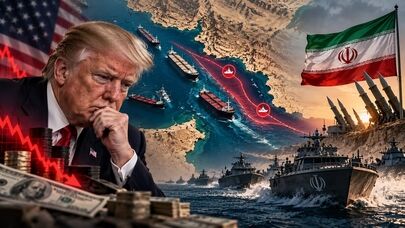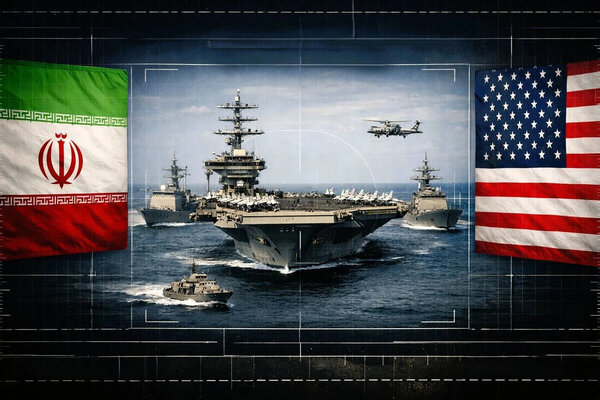
The war between the United States and Iran has entered a phase in which economic pressure, the Strait of Hormuz equation and the domestic costs for the United States are shaping developments alongside military threats and diplomatic manoeuvring. There is still no clear prospect of an end to the conflict, making the decisions taken in the coming period critical.
Washington’s Economic Pressure: From the Blockade of Iran to Rising Costs for US
The Trump administration is pursuing a strategy of economic pressure and a blockade of Iran as an alternative to direct war and a political agreement, even as signs of the growing domestic costs of this policy in the United States become increasingly apparent.
US Secretary of State Marco Rubio, speaking at a closed-door meeting of G7 foreign ministers in Paris, outlined Washington’s approach, saying the Trump administration did not intend to choose between returning to war and signing a peace agreement. Instead, he said, it had a third option: continuing the blockade and economic pressure on Iran.
Claiming that economic pressure would eventually force Iran to reach an agreement, Rubio said the Iranian people ultimately needed to eat and that economic realities would influence their decisions.
This approach is being pursued as a New York Times report indicates that US efforts to persuade Türkiye, Iraq and Pakistan to close their land borders with Iran have failed. Those countries have resisted Washington’s demand because of the economic and social consequences such a move would entail.
Within the same framework, the US has established a special force called "Iron Gate" to target trade and cross-border transactions, an action that points to Washington’s efforts to expand the scope of economic pressure.
Strait of Hormuz: A Decisive Factor in the Political and Economic Equation
The Strait of Hormuz remains one of the main points of confrontation between Tehran and Washington. Mohammad Baqer Qalibaf, speaker of Iran’s parliament, has stressed that the waterway will not return to its pre-war conditions and that its new status forms part of the agreement Iran is seeking under its seven-point proposal.
Qalibaf has also said Tehran has provided the US side with a clear and explicit response setting out its legitimate demands, but Washington has yet to give an official and specific answer to Iran’s proposal.
The parliament speaker has made clear that reopening the Strait of Hormuz and resuming negotiations depend on the full implementation of Iran’s seven conditions by the United States.
In a related development, the Persian Gulf Waterway Management Authority announced that two bulk carriers which had headed towards ports in southern Gulf countries using forged documents and without coordination had faced legal action. It said the vessels had accepted the stated undertakings, thereby avoiding having their names added to the list of non-compliant vessels.
Meanwhile, US Central Command (CENTCOM) has claimed that the main shipping lanes in the Strait of Hormuz are free of naval mines. The US continues its efforts to maintain maritime routes and enforce naval sanctions against Iran.
At the same time, rising oil prices have directly reflected the continuation of tensions in the strategic Persian Gulf waterway. Brent crude has reached around $93 a barrel, intensifying concerns about future energy supplies and the economic consequences of the ongoing conflict.
Cost of War in US: From $4 Gasoline to Congressional Opposition
The economic and political costs of the war have become one of the main points of domestic criticism of the Trump administration.
Senior US Senator Patty Murray has put the cost of the war against Iran to American taxpayers at no less than $47bn, stressing that the actual damage and military fatalities are far greater than this figure.
Criticizing the absence of a clear objective and a specific plan to end the war, she has also said that she will do everything in her power to bring the conflict to an end once the new Democratic majority takes office in Congress.
Chuck Schumer, the Democratic leader in the US Senate, has also described Pete Hegseth’s claim that the US had achieved a historic victory in the war with Iran as ridiculous.
Schumer has said that gasoline prices exceeding $4 a gallon, continued sporadic attacks on passing ships and efforts to conceal the number of US military casualties are incompatible with claims of a historic victory.
An Ipsos poll has also found that 71% of Americans want the war with Iran to end through pressure from the new Congress, pointing to growing public opposition to the continuation of the conflict.
Bernie Sanders has likewise described the war against Iran as based on lies, alongside the wars in Vietnam and Iraq, and criticized Washington’s foreign policy.
Political Crisis at Pentagon: Hegseth’s Temporary Reprieve Ahead of New Congress
Alongside economic pressure, the political future of the US secretary of war has also become uncertain.
The Axios news outlet has reported that, with Republican support, Pete Hegseth has for now avoided consideration of an impeachment resolution in the House of Representatives. However, this political protection is unlikely to last once the new Congress takes office in January.
According to the report, Democrats may once again pursue his impeachment more seriously.
Meanwhile, a New York Times report says US Treasury Secretary Scott Bessent was moved to a military base over security concerns and threats attributed to Iran. The newspaper also reported that at least six senior US administration officials had left their residences over security concerns in the past year and relocated to military bases or secure locations.
These developments, alongside political disagreements over the war, military costs and mounting security concerns, have further complicated the internal situation within the Trump administration.
Tehran: Readiness for a Broader Response and a Shift in Military Calculations
In their latest statements, Iranian military and political officials have stressed the country's readiness to confront any new aggression.
Major General Abdollahi, chief of the General Staff of the Armed Forces, has warned that any source of threat against Iran will be targeted through asymmetric operations and that any new action by the United States and the Zionist regime will be met with a more forceful response.
Amir Heydari, deputy chief of the General Staff of the Armed Forces, has also stated that any country serving as the origin or facilitator of an attack against Iran, whether through aircraft taking off from its territory or missiles being launched from it, will be included in the Armed Forces' bank of legitimate targets.
He also announced that geographical restrictions had been lifted and that a comprehensive, updated target bank had been drawn up, covering bases and locations used by the United States and the Zionist regime both in the region and beyond.
Mohsen Rezaei, referring to changes in Iran’s defensive restrictions, has said that these restrictions would be lifted to an even greater extent if a new war broke out. He also predicted that, in the event of another attack, the war would not last more than three to five days according to the calculations of the opposing side.
In an interview with Lebanon’s Al Mayadeen television network, Rezaei described Iran’s defense management as stronger than that of American generals. He said Iran had managed to take control of seven US drones and capture them intact. He also spoke of the capture of two advanced submarines.
Meanwhile, Heydari has reported the destruction of advanced radar systems and electronic warfare equipment, as well as the withdrawal of US naval vessels. He stressed that the Armed Forces remain prepared to confront any new action.
Sardar Talaei-Nik, spokesperson for Iran’s Ministry of Defense, has also reiterated Tehran’s firm position, saying the opposing side must either accept the Islamic Republic’s legitimate demands or surrender on the battlefield.
Diplomacy at an Impasse: Contradictory Signals from Washington and Tehran’s Insistence on Seven Conditions
On the political front, alongside the continuation of economic pressure, there have also been indications that Washington may be interested in returning to negotiations.
The Wall Street Journal has reported that Donald Trump is prepared to resume negotiations with Iran and that US Vice President JD Vance is considering direct talks with a senior Iranian security official. However, the possibility of Vance travelling for this purpose has been described as being at a preliminary stage.
In contrast, Qalibaf has stressed that Washington must fully implement Iran’s seven conditions before returning to negotiations. He has also said that the Americans travelled to Moscow and asked Vladimir Putin to speak with Iran about facilitating direct negotiations between Tehran and Washington.
Iranian Foreign Minister Abbas Araghchi, responding to Rubio’s remarks, has condemned the policy of economic pressure and attempts to force the Iranian people to comply with Washington’s dictates, describing it as one of the factors behind the failure of US policies.
Meanwhile, the secretary of Iran’s Supreme National Security Council has stated that Iran’s stockpiles of enriched material will remain in the country and that this position has also been communicated to its Russian friends.
Russian Foreign Ministry spokesperson Maria Zakharova has likewise stressed that decisions concerning stocks of enriched uranium fall exclusively within Iran’s jurisdiction.
Separately, Iranian President Masoud Pezeshkian and Pakistani Prime Minister Shehbaz Sharif met in Antalya, where they discussed the development of political and economic relations, regional cooperation, and the strengthening of stability and security.
Qalibaf, Iran’s parliament speaker, has also welcomed the possibility of replicating the Chinese mediation model between Iran and Saudi Arabia to strengthen regional security. He stressed that lasting security must be provided by countries in the region themselves and that the presence of the United States is a source of instability.
Regional Consequences of the War: From Support for the Resistance to War Damage
The consequences of the war continue to extend beyond the borders of Iran and the United States, with regional and international dimensions.
Iraq’s Kataib Hezbollah, declaring its support for the Islamic Republic of Iran, has stressed that it will not leave Tehran alone in the face of its enemies and considers defending the weapons of the Resistance a red line.
Sheikh Naim Qassem, secretary-general of Lebanon’s Hezbollah, has also described control over the region’s strategic resources and wealth as the main objective of the United States and the Zionist regime, stressing the need for greater coordination among regional countries and Resistance forces.
Meanwhile, Israeli Prime Minister Benjamin Netanyahu is holding another security meeting with senior military and security officials of the Zionist regime to discuss Iran. Gadi Eisenkot has also warned Netanyahu against taking any military action during the transitional period.
On the environmental front, Pezeshkian, speaking at the United Nations climate change conference, has called on the international community to take action to compensate for the damage caused by US and Zionist regime attacks on Iran and Gaza.
The president has stated that the attack on fuel facilities in Asaluyeh resulted in the release of around 500,000 tons of carbon dioxide, while an attack on fuel depots around Tehran led to the release of approximately one million tons of the gas.
Pezeshkian has stressed that the environment is the silent victim of wars and that the effects of its destruction can persist for generations. He has called for climate commitments made in peacetime to be linked to environmental responsibilities during wartime.