This means a terrorist American campaign designed to choke Iran’s commerce has accelerated the expansion of land routes, northern ports and regional partnerships that reduce dependence on vulnerable sea lanes.
Officials at the meeting reported multi-fold growth in imports and exports through northern maritime gateways, road crossings and railway borders during the first six months of Iranian year 1405 across Iran.
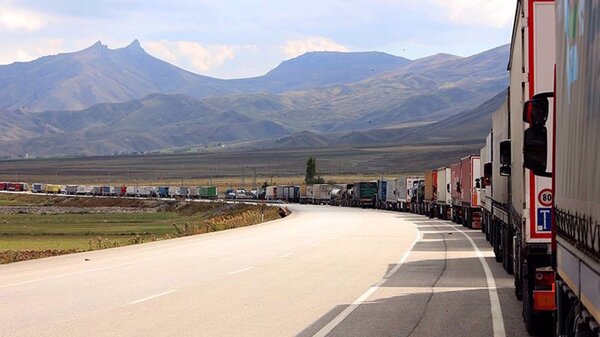
At the Razi–Khoy crossing with Turkey alone, exports rose 300 percent in value between April and August, while freight volumes and rail traffic also climbed sharply over the same period in customs-reported trade.
For decades, Iran’s trade geography was shaped by a Western-facing economic order, with major commercial flows concentrated through southern Persian Gulf ports and Western suppliers and established commercial relationships with Europe and North America.
Before the 1979 Islamic Revolution, the United States and West Germany ranked among Iran’s largest trading partners, while Western countries supplied roughly 70 percent of imports, according to historical trade records from the period.
About three-quarters of Iran’s international trade entered through Persian Gulf ports that year, reflecting an economic structure built around oil revenues, seaborne commerce and close ties with Western industrial powers.
Washington’s sanctions and pressure campaigns sought to preserve that leverage, constraining access to finance, technology, markets and shipping while attempting to make Iran’s international commerce increasingly costly and narrow its choices.
Yet Iran’s location offers a powerful alternative. It borders seven countries, reaches the Caspian Sea, and sits astride routes linking the Persian Gulf with the Caucasus, Central Asia and wider Eurasia.
The recent US blockade has made those connections more urgent, pushing transport corridors and border terminals from long-term development plans into the center of immediate economic and strategic priorities for national development.
Aref said the government is accelerating the North–South and East–West corridors, expanding northern port capacity and strengthening eastern and western land crossings to make Iran a regional transit hub.
The first-half figures presented to the National Transit Headquarters showed growth across several gateways, indicating that trade is spreading through a network rather than shifting onto one replacement route across the country.
At Razi–Khoy, exports reportedly reached $217 million and 440,000 tonnes between April and August, with value rising 300 percent year-on-year and volume increasing by 293 percent over the same period.
The crossing also handled 8,975 railcars, a 205 percent increase, while transit cargo exceeded 135,000 tonnes, evidence of a sharp expansion in cross-border freight activity over those four months.
The Caspian is becoming another vital outlet. Northern ports have increased their role in essential-goods imports, while container arrivals rose as traders made greater use of maritime links beyond the Strait of Hormuz.
Officials reported that the northern ports’ share of essential-goods imports had climbed from 18 percent to 30 percent, while container arrivals increased 50 percent year-on-year during the reported period in 2026.
These developments reinforce the International North–South Transport Corridor, which links India and the Persian Gulf region with Russia and northern Europe through Iran and the Caucasus, strengthening regional trade connections.
One crucial missing link is the Rasht–Astara railway, a 162-kilometer line that would connect Iran’s rail network with Azerbaijan and complete a major section of the corridor’s western branch for international freight.
Iran and Russia are pursuing construction, with the line designed to carry up to 15 million tonnes of freight annually once operational and strengthen the corridor’s commercial appeal across Eurasia.
On October 26, the Economic Council approved financing for the 324-kilometer Khavaran–Tabriz–Marand–Cheshmeh Soraya railway, a double-track electrified route connecting Iran with Turkey and European markets under a national transport investment plan.
Its first phase is estimated at $1.8 billion, and the project would provide another rail gateway toward Turkey and European markets while strengthening Iran’s east–west transport links across the region.
The eastern network is also gaining importance, connecting Iran with Turkmenistan and Central Asia, while the Chabahar–Zahedan railway is intended to extend access toward Afghanistan and markets farther east and neighboring markets.
Trade diplomacy is moving alongside construction, as Tehran works with neighboring governments to improve customs procedures, accelerate freight clearance and expand the capacity of shared border crossings along key routes.
Energy cooperation is widening the same regional architecture. Iran, Russia and Azerbaijan are advancing arrangements for a gas swap, with technical work and pipeline coordination continuing between the partners involved.
Russian Energy Minister Sergey Tsivilev has said the three countries are prepared to pursue the arrangement, while Iran’s oil authorities have described the agreement as nearing completion in recent statements.
The proposed exchange would deepen energy links among the three neighbors and add another dimension to a trade strategy increasingly built around regional infrastructure, shared interests and long-term commercial ties.
Trump’s repeated statements about taking control of Iranian oil and strategic energy assets have underscored the stakes behind Washington’s pressure campaign and Tehran’s determination to defend its economic sovereignty and independence.
The blockade has therefore accelerated a shift whose significance reaches beyond logistics. Iran is widening its economic geography, multiplying commercial partners and strengthening connections that do not depend on Western approval.
Rather than isolating the country, the pressure has increased the strategic value of Iran’s borders, railways, northern ports and regional partnerships, turning geography into an instrument of economic resilience and national strength.
The surge at Razi–Khoy, expanding Caspian traffic and new rail commitments show how quickly that adjustment is gathering force, as Iran builds a more diversified platform for trade and transit.