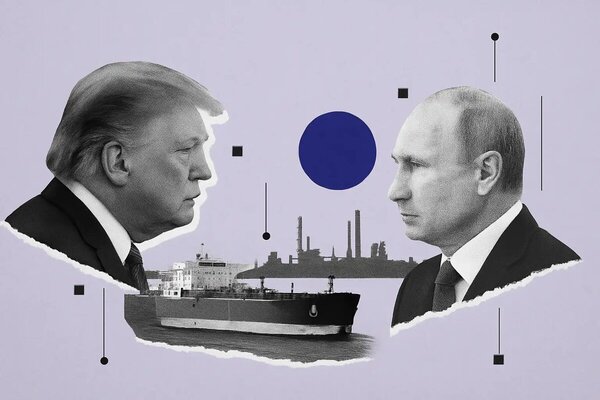
At a time when a new Reuters/Ipsos poll shows that 78% of Americans, including 64% of Republicans, blame Trump’s tariff war and his criminal warmongering against Iran for rising costs, and the Republicans’ electoral position is deteriorating, the US Treasury Department has authorized transactions related to the sale, delivery, unloading and import of Russian diesel through April 7, 2027. Trump also announced a deal with Putin for an initial export of 300,000 metric tons of diesel, claiming that fuel prices would soon fall. He is seeking to present the agreement as a remedy for the economic crisis and an electoral opportunity. Yet the limited volume of the shipments and another betrayal of European allies could trigger a fresh wave of protests and further expose the erosion of US sanctions power.
The decision comes as Europe has imposed new sanctions packages on Moscow and has even discussed using frozen Russian assets. Ukraine, meanwhile, is under pressure from extensive Russian military operations, while Moscow continues to intensify its pressure on the battlefield. In this context, Trump’s move should be seen as a new stage in Washington’s erosion of its own credibility and commitments, a process that has already exacted a heavy toll on allied trust through trade tariffs, insistence on taking control of Greenland, and warmongering against Iran at the behest of the Israeli regime. Ukrainian President Volodymyr Zelenskyy has also described the exemption as an unfair and dishonest deal. Ukraine’s latest attacks on Russian refineries, backed by Europe, can likewise be viewed in the context of this deepening distrust.
Sanctions Boomerang: Economic Pressure Returns to the US
Exempting Russia from energy sanctions appears, on the surface, to be an economic and political deal intended to contain the fuel crisis. At a deeper level, however, it points to a weakening of the US economy’s resilience. For years, Washington claimed that sanctions would wear down the economies of targeted countries and force them to surrender. Now, the US itself has had to retreat from the very instrument of pressure it once relied on in order to meet its own needs. Diesel prices rising above $6 a gallon have become a symbol of the sanctions boomerang striking the US economy.
The Ramadan War and Iran’s authority in the Strait of Hormuz also demonstrated that, contrary to its propaganda claims, the US economy is not immune to major energy shocks and that its structural vulnerabilities can be exposed. When pressure on energy transit routes drives up domestic costs in Washington, sanctions rhetoric can no longer guarantee economic superiority.
Moscow’s Gain: The Fruits of Resisting Western Pressure
The Russian-US diesel agreement cannot be viewed solely as a betrayal of allies or a challenge to the unipolar order. From Moscow’s perspective, it may represent the fruits of resisting years of Western pressure. By expanding its ties with the East, establishing alternative mechanisms and relying on its own military capabilities, Russia has gained greater leverage in negotiations. The US now needs to cooperate with Moscow, even if only temporarily, to contain its domestic crisis, a situation that could strengthen Russia’s negotiating position.
Although the agreement may temporarily ease public pressure on Trump, abandoning a strategic instrument of pressure to secure short-term fuel supplies carries costs that go beyond any immediate benefits and highlights the failure of Washington’s sanctions policy on the global stage.
Diesel Figures: Exposing the Limits of Trump’s Solution
Trump has claimed that Russia will initially supply more than 300,000 metric tons of diesel, followed by another 500,000 tons in November, and then an additional one million tons and three million tons. Converting these figures into barrels reveals the actual scale of the claim: at an approximate conversion rate of 7.23 barrels per metric ton, 300,000 tons amounts to around 2.17 million barrels. That is equivalent to approximately 13 to 15 hours of US daily consumption of middle distillates, assuming daily consumption of about 3.9 million barrels. The total of 4.8 million tons amounts to approximately 34.7 million barrels, equivalent to around nine days of consumption on the same basis.
Trump had previously spoken of an agreement with Europe to release 100 million barrels from strategic reserves over four months, equivalent to approximately 800,000 barrels a day. This comparison demonstrates the limits of the solutions he has announced. The market’s indifference to the fanfare surrounding these agreements, along with continued price increases, also shows that announcing large figures alone cannot contain the crisis.
Strait of Hormuz: A Reality Washington Denies
Trump’s insistence that prices will improve after the congressional elections, alongside his agreement with Putin, raises a fundamental question: If the Strait of Hormuz is open and the US has control over it, why has Washington been forced to retreat from sanctions on Russia just to secure several hours’ worth of fuel consumption? This contradiction calls into question the White House’s claims that it controls energy transit routes. Iran’s authority in the Strait of Hormuz and its strategy of “besieging the siege” have disrupted Trump’s calculations, a reality that media theatrics cannot change.
In this equation, the security of energy transit depends on realities on the ground, not Washington’s propaganda-driven pronouncements. The US cannot eliminate the strategic costs of the crisis by denying Iran’s role.