Nournews: The UN General Assembly this year has, so far, been a battleground of competing narratives. Just one day before the Iranian president took the podium, the U.S. president used the same platform to accuse Tehran in the strongest terms of supporting terrorism and sought to frame the war of recent months through the familiar narrative of “Iran as the source of regional instability.” Pezeshkian’s response, however, was more than a political rebuttal; it was an attempt to rewrite Iran’s place in that global narrative. He spoke not merely on behalf of a government, but of a nation that portrayed itself as a victim of war and terrorism, while at the same time declaring that it was neither afraid of war nor reluctant to negotiate.
This was one of the features that distinguished Pezeshkian’s speech from many of the addresses delivered in previous years. It was neither merely a protest statement nor a one-sided and ceremonial invitation to dialogue. His speech was built around a precise communication strategy: conveying the message that Iran can be both powerful and rational; that it can resist while keeping the path to diplomacy open. This is where a moderate president translates the language of resistance into the language of diplomacy.
From the very beginning of the speech, Pezeshkian changed the terms of the debate. Instead of opening with legal or political language, he placed images of schoolchildren killed in Minab and Lamerd before representatives of the world. This choice was not accidental. Images of children killed in war shift the narrative from the level of interstate conflict to the conscience of global public opinion. Pezeshkian sought to confront his audience with the victims of war before Iran itself was judged. In other words, he attempted to reverse the roles of accuser and accused: to portray a country accused of terrorism as a country that itself has fallen victim to terrorism and aggression.
But that was only the beginning of the narrative. The central part of the speech was built around the concept of “power,” perhaps the most frequently repeated word in the text. Yet almost every time he referred to power, he immediately qualified it: power for defense, power for survival, power to prevent aggression—not power for domination. This deliberate repetition shifts the concept of power from the language of aggression to that of deterrence. Pezeshkian does not say that Iran is powerful in order to reshape the regional order; he says Iran must be powerful enough to ensure that its survival is not threatened.
It is within this framework that perhaps the most important line of the speech emerges: “We are not afraid of war when it comes to defending ourselves, and we do not shy away from negotiations when it comes to peace.” This sentence summarizes the government’s communication strategy in the post-war period. For years, resistance and negotiation were presented as opposing concepts in Iran’s political discourse, as though choosing one meant rejecting the other. Pezeshkian broke with this binary. In his narrative, resistance is not an alternative to negotiation but a foundation for it—the factor that allows dialogue to begin from a position of strength rather than weakness.
The same logic can be seen in the section on Iran’s nuclear program. Pezeshkian moves the nuclear issue away from the technical language of centrifuges, enrichment levels and sanctions and reframes it in terms of development: technology for treating patients, food security, industry and the country’s energy future. He then summarizes Iran’s nuclear policy in a short phrase: “No nuclear weapons, no deprivation of nuclear knowledge.” The phrase conveys two messages simultaneously: rejecting the production of nuclear weapons while rejecting any monopoly over nuclear knowledge and technology. In effect, the focus of the dispute is shifted from the “bomb” to the “right to development.”
This approach to messaging is one of the most notable features of the speech. On virtually every issue, Pezeshkian attempts to change the terms of the debate: from terrorism to being a victim of terrorism; from a nuclear threat to the right to development; from military power to defensive deterrence; and from security based on force to security based on regional cooperation. In political communication, this is known as “reframing the conflict”—responding on ground that you have defined yourself, rather than on ground defined by your opponent.
More important, however, is the person delivering the message. If the same statements had been made by a military commander or security official, a global audience would have heard them through the lens of security rhetoric. But the speaker is a president who, from the beginning of his tenure, has been associated with dialogue, de-escalation and national consensus. That background gives his words a different weight. Pezeshkian demonstrated that it is possible to defend deterrent power while also defending dialogue, without one having to come at the expense of the other.
Throughout the speech, he presents negotiations as conditional on mutual respect. He neither avoids negotiations nor accepts them unconditionally. The message is clear: Iran is ready for an agreement, but one that both reassures the world of the peaceful nature of its nuclear program and guarantees the rights of the Iranian people. This is the image a moderate government seeks to project: a government that views engagement as a tool for resolving crises, rather than as a sign of retreat.
One of the most significant sections of the speech concerned Iran’s neighbors and regional security. The statement, “We do not consider our neighbors to be our security rivals; we want our neighbors to be strong,” may be Iran’s most important regional message in recent years. This is not merely a diplomatic courtesy; it articulates a different model of regional security. Pezeshkian does not portray security as a zero-sum game. He does not see Iran’s security as dependent on the insecurity of its neighbors and stresses that a crisis in one country will sooner or later spread across the region.
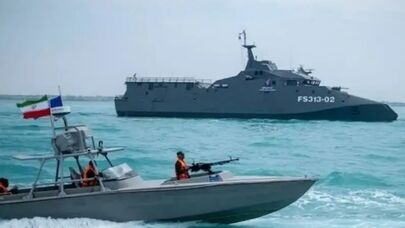
Within the same framework, the issue of the Strait of Hormuz is presented not through the language of threats, but through the language of justice and equal rights. He does not say that Iran will close the Strait of Hormuz; rather, he argues that it is unacceptable for a country that has historically safeguarded the waterway to be deprived of its rights to shipping and free trade while the same route is used to transport weapons and military equipment against Iran. This difference in language is significant: defending national interests without resorting to crisis-generating rhetoric.
Another part of the speech that received considerable attention inside Iran was Pezeshkian’s repeated references to people taking to the streets during the past several months. He did not say that Iran’s power consists only of missiles and defense systems; he said people were in the streets every night and that they are Iran’s power. This statement transforms the street from a political concept into a component of national security. In his narrative, the people are neither spectators to the war nor instruments of propaganda; they themselves constitute the foundation of deterrence. This is the concept of “people-centered security,” which has become increasingly prominent in Iran’s political discourse in recent months.
In effect, Pezeshkian took the social capital of resistance to the United Nations. He told the world that if Iran stood up to military pressure, it was not solely because of its defensive capabilities, but also because of national cohesion. This message mattered both to global public opinion and to Iranian society, which needed to feel that its presence and the sacrifices it had made during the months of war had been seen on the highest international stage.
Perhaps the most carefully crafted part of the speech, however, was its attack on “double standards” in the international system. Pezeshkian did not engage in an ideological confrontation; instead, he placed a series of simple but easily understood contradictions side by side: Israel is not a member of the Nuclear Non-Proliferation Treaty, yet Iran is subject to inspections; Israel possesses nuclear weapons, yet Iran is sanctioned; civilians are killed, yet the victim is blamed. He moved the issue beyond Iran and challenged the credibility of the international system itself.
This section of the speech is particularly important from the standpoint of persuasion because it forces the audience to think about the fairness of global rules, rather than simply about Iran. Instead of merely complaining about sanctions against Iran, Pezeshkian argues that if international law is enforced only when it serves the interests of major powers, the result will be a world in which all countries seek security primarily through military power. That warning is no longer only about Iran; it is about the future of the global order.
The same logic can be seen in the section on Palestine. Pezeshkian does not present resistance merely as an organization or political movement; he describes it as a natural human response to occupation, displacement and bombardment. He moves resistance from the level of a political concept to that of a human one, arguing that as long as occupation and injustice persist, resistance will continue to be reproduced. This shift in terminology confronts the global audience with a universal concept: the right to defend one’s home and homeland.
Perhaps the most important word in the speech is “trust,” a term that also echoed the official theme of the summit. Pezeshkian presents trust not as the product of words, but as the result of equal treatment. In his view, trust can be rebuilt when double standards are abandoned, the rights of nations are treated equally, and sanctions do not replace diplomacy. It is at this point that the speech moves from a national defense of Iran’s position to a proposal for reforming the international order.
From a content-analysis perspective, the speech had five distinct audiences, with a separate message designed for each. For the Iranian public, the message was national pride and unity—that the country’s real power lies in its people. For the United States, it was deterrence—that war and sanctions would not force Iran into submission. For Europe and the United Nations, it was a criticism of double standards and a call for the impartial application of international law. For neighboring countries, it was a message of cooperation and shared security. And for the Global South, it was a defense of the right to development and equality among nations in the global order.
This multilayered approach turns Pezeshkian’s speech from a protest statement into a strategic text. He speaks several languages at once: the language of law, security, ethics and diplomacy. The strength of the address lies precisely in the fact that none of these languages is allowed to eliminate the others.
The domestic response to the speech can also be understood from this perspective. After months of war, sanctions and pressure, Iranian society needed, above all, a narrative capable of bringing dignity and hope together. Pezeshkian promised neither military victory nor immediate peace; he said Iran was powerful enough to pursue peace from a position of dignity. This combination links the sense of resistance with the possibility of opening a diplomatic horizon and, for this reason, generated a sense of national pride among a significant segment of public opinion. The positive and unified reaction of the country’s political figures and senior officials to the speech stems from this reality.
The New York address should not be viewed merely as a speech at the United Nations; it can be seen as the government’s first serious attempt to formulate Iran’s post-war foreign policy. If this rhetoric continues, Iran’s foreign policy could rest on three pillars: power for defense, diplomacy for de-escalation, and justice as the basis of the regional and global order.
Perhaps the speech’s most important achievement is that it shifted diplomacy from a position of asking to one of dignity. Pezeshkian’s final message was neither that Iran welcomes war nor that it would accept any condition for peace. His message was that Iran is ready for dialogue, but for dialogue in which force does not replace law and the equal rights of nations are not sacrificed to the will of major powers. Above all, this was an attempt to rewrite Iran’s narrative in the world—a narrative that seeks to portray Iran as a country that is resilient, rational and committed to reducing tensions, rather than as a country forced to choose between resistance and diplomacy.