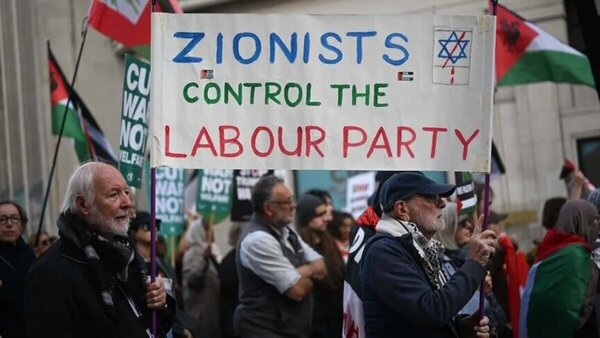
A significant development in Britain’s political arena offers a clear indication of the changing global view of the Palestinian issue and its transformation from a marginal concern into an issue at the center of global political developments. The British Green Party, which described the Israeli regime as an apartheid regime in 2024, adopted a motion at its annual conference in Brighton by a vote of 1,022 in favor to 813 against. The motion defines Zionism as a “political and ethno-nationalist project” and calls for it to be treated in the same way as other forms of racism.
According to The Guardian, the motion was put to a vote on the initiative of the “Greens for Palestine” group and has now become official Green Party policy in England and Wales. The motion, titled “Zionism Is Racism,” also argues that Zionism is inherently racist because it asserts the superiority of one ethnic group through the suppression of others. Although Israeli regime leaders have responded sharply and sought to turn the development into a display of strength against supporters of Palestine, the reality is that the event represents another achievement of resistance in globalizing the Palestinian issue and is a new indication of the deepening isolation of the Israeli regime. At the same time, it increases the global responsibility to hold accountable and punish the leaders of the Zionist apartheid regime and their supporters.
From Al-Aqsa Operation Storm to the Ramadan War: Palestine Returns to the Center of Global Attention
Removing Palestine from global developments and ultimately attempting to erase it from the map has long been part of the approach taken by the Israeli regime and its supporters, with maps of West Asia repeatedly published without Palestine. But the Al-Aqsa Operation Storm in 2023 marked the beginning of Palestine’s return to the center of global attention. The 12-day war and the Ramadan War, along with the crimes committed by the Israeli regime and the US, and the comprehensive resistance of the Iranian people and the Resistance Front, further strengthened Palestine’s position on the global stage.
This return first became visible in the streets through popular demonstrations and protests, then spread to universities, ceremonies and arts festivals, and has now reached politics and elections. Political movements and figures, even in European and American societies, are adopting anti-Zionist positions in an effort to align themselves with public opinion and win votes. The victories of anti-Zionist candidates in the United States and the global reception of the positions taken by countries such as Spain and Ireland are part of the same shift.
Today, even Britain, which itself played a role in laying the groundwork for the creation of the Israeli regime, has become a stage for such a transformation. This ranges from the Green Party to Burnham, the prime minister and leader of the Labour Party, who have turned to criticizing settlement construction and expressing concern over the suffering of the people of Gaza in an effort to win public support and reduce pressure from protests stemming from economic crises. Trump and Vance, who once promoted the slogan “Israel First,” are now seeking to project distance and independence from the Zionist lobby. These are part of the gains achieved from the Al-Aqsa Operation through the Ramadan War, which have once again brought Palestine to the forefront of global developments.
An Isolation That Can No Longer Be Concealed
Israeli regime leaders, who once spoke of “from the Nile to the Euphrates” and claimed broad influence across every continent, are now facing such deep international isolation that they have little choice but to acknowledge it. The isolation has reached the point where even Netanyahu angrily asks why the world is taking a position against the regime and not taking action against Iran.
The Boycott, Divestment and Sanctions movement against Israel has also gone beyond the level of civil society, with sanctions targeting settlers and parts of the occupation structure reaching the European Union. This year’s UN General Assembly was also held under circumstances in which 77 delegations walked out of the hall during Netanyahu’s speech, while many countries focused their remarks on opposing the policies of the regime. In the United States, a large segment of public opinion also rejects the continuation of their country’s relations with the Israeli regime.
This international isolation has also been reflected within the regime itself, from growing protests against Netanyahu’s policies, which could exact a political cost in the elections, to the highlighting of security allegations concerning issues such as Flydubai and RAF Fairford in an effort to conceal the depth of the regime’s political and social isolation.
Resistance: Force Changing the Equation and Ending Aggressors’ Impunity
The decisive point is that the global shift toward Palestine and the isolation of the Israeli regime, which has now reached even British political parties, are not the product of conciliatory diplomacy. They are the result of Palestinian and regional resistance. Decades of accommodation and silence in the face of occupation achieved nothing beyond increasing the costs and further eroding Palestinian rights. Resistance, by contrast, despite the heavy human and material costs it has incurred, has paved the way for this transformation.
Today, Palestinians and the peoples of the region have come to understand that their rights can be achieved not through promises such as “Middle East peace” and “Trump peace,” but through steadfastness and resistance. At the same time, the West cannot absolve itself of responsibility for decades of supporting and arming the Israeli regime and participating in its crimes, from Palestine to Iran, simply by changing its positions belatedly.
The United States, political movements and governments in Britain, and even the European Union cannot simultaneously be partners in the crimes of the Israeli regime and then, through a few political statements, seek to preserve their interests in West Asia and the Muslim world or expect to enjoy immunity in the Strait of Hormuz. They must answer for their role in these crimes.
Today, the international community and international institutions have a responsibility to fulfill their obligations to the Palestinian people after decades of suffering and, while carrying out their commitments before the International Court of Justice, hold the leaders of the Israeli regime and their supporters accountable as well. The world is entering a new order, one in which Zionist apartheid and its supporters should not enjoy impunity. Failure to hold aggressors accountable will itself lay the groundwork for more wars and conflicts, because it is impossible to remain silent in the face of occupation and aggression while simultaneously expecting suffering peoples not to resist.
The model demonstrated by the Al-Aqsa Operation Storm and the Ramadan War has shown that, in the face of the Zionist-American occupier and aggressor, resistance and the localization of security can change the equations and return control over the course of events to the peoples who have paid the price of occupation and aggression for decades.