
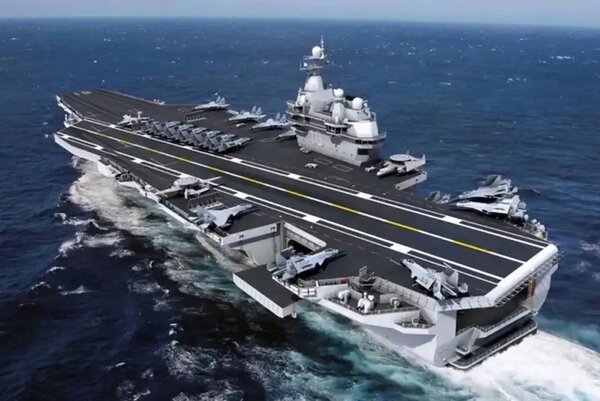
Recent developments in China's naval industry-particularly satellite images showing the construction of a new aircraft carrier-offer a strong indication that Beijing has entered a new phase in its maritime power-projection strategy. The appearance of a structure that bears a striking resemblance to a "nuclear reactor compartment" reinforces the hypothesis that China is moving toward developing its first nuclear-powered carrier. Should this speculation prove accurate, it would represent one of the most significant strategic pivots China has made in decades-a shift that could fundamentally reshape the balance of maritime power in the Asia-Pacific.
A Direct Message to U.S. Naval Hegemony
At the most basic level, nuclear propulsion would materially redefine the trajectory of China's navy. Beijing's conventional carriers - including the Liaoning, Shandong and, more recently, the Fujian - are advanced but remain limited by their full reliance on fossil fuels, constraining both their range and endurance. A nuclear-powered carrier, by contrast, could operate for years without refueling, enabling sustained presence in distant waters. This capability is the missing link China needs to transition from a regional naval power into a true ocean-going force.
On a second level, the move sends an unmistakable signal to the United States. Until now, only the U.S. has possessed the capacity to build nuclear-powered carriers, and China's entry into this domain would break a longstanding monopoly. This is not merely a technological leap but a geopolitical statement. Developing a nuclear carrier also dovetails with China's A2/AD strategy, shifting it from a predominantly defensive posture toward a hybrid defensive-offensive orientation. With such a capability, Beijing would be able to seize the initiative farther from home and expand its maritime influence.
Industrial Maturity and China's Evolving Role in Global Security
Domestically, constructing such a vessel reflects China's industrial maturity and organizational cohesion. Successfully advancing this project would lend greater legitimacy to its model of development built around national strength. Internationally, a nuclear carrier would enable China to play a more active role in global missions-including safeguarding energy routes and combating piracy-thereby expanding its influence in the Middle East, Africa and the Indian Ocean.
Taken together, China's entry into the realm of nuclear-powered aircraft carriers constitutes a high-level strategic transformation-one that may redefine the architecture of maritime power in the years ahead.
NOURNEWS