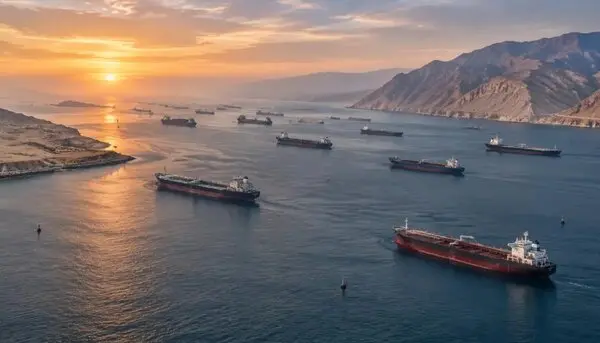
As the global economic crisis triggered by the US-Israeli war of aggression against Iran continues, the far-reaching consequences of the conflict are becoming increasingly evident. These repercussions are now being felt not only in the US economy but also in the European Union’s budgetary situation. Against this backdrop, the International Maritime Organization has issued a noteworthy report stating that approximately 300 ships and 6,000 seafarers are stranded in the Strait of Hormuz. Warning that regional risks persist, the organization stressed that seafarers continue to operate in unsafe and uncertain conditions and that disruptions to maritime traffic have affected global supply chains for fuel, fertilizers, and other essential commodities.
Beyond exposing the severity of the global economic crisis, the report also reveals another reality: US claims that Iran’s military capabilities have been destroyed and that the Strait of Hormuz remains open are inconsistent with facts on the ground. Official figures from an international organization paint a picture markedly different from the one Washington is attempting to project to the world.
Iran’s Naval Strength: A Reality Beyond Trump’s Claims
Trump speaks daily of the destruction of Iran’s military capabilities, claiming that the country’s navy effectively no longer exists. The commander of US Central Command (CENTCOM) has echoed the same claim. However, the International Maritime Organization’s report raises a fundamental question: If Iran has lost its military and naval capabilities, how have approximately 300 ships carrying 6,000 crew members become stranded in limbo? Can a country whose defensive and naval capabilities have supposedly been destroyed still maintain control of the Strait of Hormuz and exercise authority over maritime traffic?
The reality is that a number of large and small vessels violating Iran’s approved navigation routes are targeted by deterrent measures on a daily basis. Trump, meanwhile, claims that the US is managing the Strait of Hormuz and promises to increase daily oil shipments through it. CENTCOM has also claimed that nearly two billion barrels of oil have passed through the waterway. The question is clear: If the Strait of Hormuz is open and under US management, how can the stranding and suspension of hundreds of vessels be explained? This contradiction becomes even more significant in light of maritime transit figures showing that approximately 130 ships crossed the Strait of Hormuz daily before the Ramadan War, whereas that number has now fallen to just a handful of vessels, with passage possible only with Iran’s authorization.
Boomerang Effect of War: Costs of Aggression Return to Aggressors
The International Maritime Organization’s report not only exposes the reality of maritime traffic and disruptions to energy and commodity supplies, but also paints a troubling picture of the crisis’s global repercussions. While US leaders resort to empty promises and European countries introduce support packages to portray the situation as under control, the reality is that the suspension of maritime traffic through the Strait of Hormuz continues to impose a fresh bill on the global economy every day.
In the past, the US and Europe routinely shifted the direct costs of their wars of aggression onto others. However, Iran’s strategic measures, drawing on its strength on the ground, diplomacy, and popular support, have overturned the old equations and established a new model for confronting occupiers and hegemonic powers: turning the boomerang of war’s consequences back against the aggressors themselves. What is now being witnessed in the energy crisis and rising prices, particularly in the US and its allied countries, reflects the resilience and steadfastness of the Iranian people and the result of Iran’s astute management of the Strait of Hormuz—a strategy that makes the perpetrators bear the costs of their aggression.
The Republicans’ defeat in the congressional midterm elections is also an indication of the consequences of this situation and the impact of foreign developments on US domestic political dynamics. These developments have further underscored Iran’s global standing and turned Tehran into a model for other countries seeking to resist the system of domination. The persistence of the global economic crisis throughout 2026 also demonstrates that the repercussions of this war are not confined to its initial days. Europe’s increasingly difficult budgetary situation provides further evidence of this reality.
Ending Ships’ Ordeal: Accepting the Region’s New Reality
Although Western media have turned the International Maritime Organization’s report into an instrument of pressure against Iran, seeking to exploit it to whitewash the war of aggression against the country under the pretext of restoring global transit, the legal and political reality is clear. Under international law and the United Nations Charter, and within the framework of its inherent right to self-defense, Iran is entitled to use its geopolitical assets, including its maritime position, to safeguard its national security and interests. Accordingly, portraying Iran as a destabilizing force behind the current situation in the Persian Gulf and the Sea of Oman is an unacceptable narrative that cannot undermine Tehran’s resolve to deter aggressors.
If the international community genuinely seeks to end the ordeal of stranded ships, normalize maritime navigation, and restore stability to the global economy, it must acknowledge two fundamental realities. First, conditions in the region and the Strait of Hormuz will not return to their prewar state. Recognizing Iran’s sovereignty over the Strait of Hormuz and accepting Tehran’s seven conditions as prerequisites for any negotiations are undeniable necessities. Second, confronting the US, the Israeli regime, and their partners, who remain deluded by the prospect of military aggression and forcing Iran into submission, is an unavoidable strategy for bringing the current crisis to an end.
Relying on its national strength and indigenous defense capabilities, Iran has thwarted US plots and succeeded in reshaping the region’s security equations. From this perspective, a global effort to expel the US from the region could become a collective initiative to restore stability to the international economy and security—an objective that cannot be achieved without Iran’s participation and active role. Otherwise, the Strait of Hormuz will remain under Iran’s management, with neither any relinquishment of national rights nor any compromise with aggressors.
Editorial verification note: The official English name is International Maritime Organization (IMO). The current CENTCOM commander is Admiral Brad Cooper. I retained the original's unnamed reference to the commander rather than inserting a name not present in the Persian text.
One factual point to double-check before publication: the IMO's August 28, 2026 statement refers to up to 400 ships carrying approximately 6,000 seafarers, rather than 300 ships. The translation above preserves your original figures without alteration.